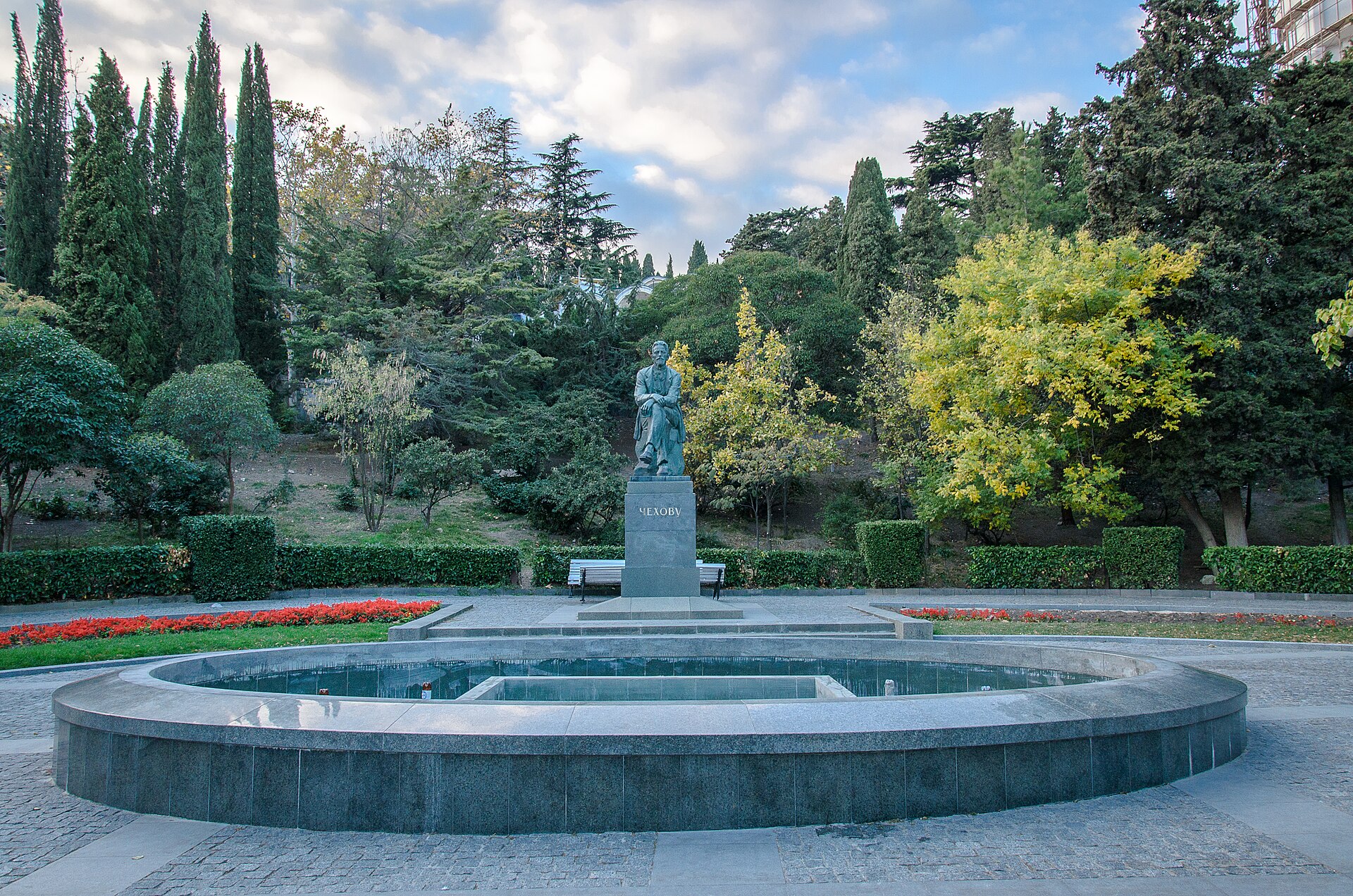
The monument to Anton Chekhov in Yalta is one of those quiet places where literature feels alive. It stands along the waterfront, where the Black Sea breeze carries the scent of salt and pine, and where the past lingers in the air just as much as the present. Chekhov spent his final years here, drawn by the mild climate that doctors hoped would ease his tuberculosis, but Yalta gave him far more than just relief from illness. It became a place of work, reflection, and unexpected inspiration, shaping some of his most enduring plays and stories.
The sculpture captures Chekhov in a moment of quiet contemplation, seated on a bench with a book in his hands. He gazes toward the sea, his posture relaxed, as if he’s just paused during an evening stroll. There’s no grandeur in the way he’s depicted—no towering pedestal, no dramatic pose. Instead, the figure feels approachable, almost as if Chekhov himself might look up from his reading to exchange a few words with a passerby. The sculptor, Georgy Motovilov, chose to emphasize not just the writer’s likeness but his presence, the sense that he was a man who observed life closely, whether it was the bustle of Yalta’s streets or the quiet drama of human relationships.
Yalta was more than a backdrop for Chekhov; it was a place that seeped into his writing. When he arrived in 1898, he rented a house in Autka, a quiet suburb just outside the city, but he spent much of his time in Yalta itself. The town was then a fashionable resort, frequented by artists, actors, and intellectuals, and Chekhov became part of its lively cultural scene. He attended literary gatherings, visited the local theater, and engaged in long conversations with friends and fellow writers. It was here that he wrote *The Three Sisters* and *The Cherry Orchard*, plays that would redefine Russian drama. The sea, the mountains, and the slow rhythm of life in Yalta all found their way into his work, though often in subtle, almost imperceptible ways.
The monument was unveiled in 1953, decades after Chekhov’s death, yet it doesn’t feel like a relic of the past. Instead, it has become a natural part of Yalta’s landscape, blending seamlessly with the waterfront’s daily life. Locals and visitors often sit beside Chekhov on the bench, as if keeping him company, while others leave flowers or books at his feet—a small but telling gesture. The spot is never empty for long. Street musicians sometimes play nearby, artists set up their easels to capture the view, and couples stroll along the promenade, pausing to take in the sea. Chekhov, in his quiet way, seems to be part of it all, an observer who never quite left.
What makes this monument unusual is how unassuming it is. Chekhov himself had little patience for pomp. He once joked that he wanted to be buried in a simple grave, without fanfare, and the sculpture in Yalta reflects that same understated sensibility. There’s no attempt to mythologize him; instead, the figure feels like a reminder that great art often comes from ordinary moments—from watching the way light falls on the water or listening to the laughter of strangers in a café. It’s a monument that doesn’t demand reverence but invites connection, as if to say that literature, at its best, is something lived, not just admired from a distance.
The waterfront where the monument stands is one of Yalta’s most vibrant places. In the mornings, the air is filled with the sound of seagulls and the clatter of café tables being set up. By afternoon, the promenade hums with activity—tourists browsing souvenir stalls, children chasing each other along the pavement, old men playing backgammon on benches. Chekhov’s bench is often occupied, not just by those who come specifically to see the monument, but by people who happen upon it while going about their day. Some sit for a moment, flipping through a book or scrolling on their phones, while others linger, lost in thought. The sea stretches out before them, its surface shimmering under the sun, and it’s easy to imagine Chekhov doing the same—watching, listening, gathering impressions.
For many, the monument is a starting point for rediscovering Chekhov’s work. Some visitors bring his books with them, reading passages aloud or silently to themselves. Others, encountering his plays for the first time, leave with a new appreciation for his sharp wit and deep empathy. There’s something about Yalta that makes his writing feel immediate, as if the stories he set here—the longing of *The Lady with the Dog*, the quiet despair of *The Three Sisters*—are still unfolding somewhere nearby. The city’s light, its warmth, even its occasional melancholy, all echo the themes that defined his work.
Yalta has changed since Chekhov’s time, but the essence of the place remains. The grand hotels and palm-lined boulevards still evoke the fin-de-siècle atmosphere that once drew artists and aristocrats to the Crimea. The sea is just as blue, the mountains just as imposing, and the air just as thick with the scent of cypress and salt. Chekhov’s monument, though modest, serves as a bridge between past and present, a reminder that the places we associate with great figures are often the ones that shaped them as much as they shaped history. It’s not a shrine, but a quiet acknowledgment that some lives leave traces that can’t be contained in museums or textbooks.
What lingers most about the monument is the sense that Chekhov, in some small way, is still here. Not as a distant figure from the past, but as someone who once walked these same streets, who sat in cafés and watched the world go by with the same curiosity as any visitor today. Yalta was his refuge and his workplace, a place where he could be both an observer and a participant in life. The monument doesn’t try to capture all of that—it doesn’t need to. Instead, it offers a moment of stillness, a chance to sit beside him and consider how much of what we love about his writing came from places like this: ordinary, beautiful, and full of stories waiting to be told.