On the western slopes of the Margalla Hills, the Pakistan Monument stands as a landmark where the country’s identity is carved into granite. Its design—a flower with petals opening toward the sky—carries meaning. Seven petals represent Pakistan’s provinces and territories, each a piece of a larger whole. Punjab, Balochistan, Khyber Pakhtunkhwa, Gilgit-Baltistan: the monument gathers them into one shape, visible from afar.
The idea emerged in the early 2000s, when Pakistan marked six decades of independence. Construction started in 2004 and finished in 2007. Architect Arif Masood wanted more than a memorial. He designed a space where history could be walked through, not just read. The petals, covered in polished granite, hold mosaic murals. These murals show the Indus Valley civilizations, the struggle for independence, and the years that followed. They turn history into something you can see and touch.
The monument’s museum is small but focused. Exhibits begin with Mohenjo-Daro and Harappa, move through the Mughal era, and end with Partition. A section honors Muhammad Ali Jinnah, whose vision still shapes the nation. The museum doesn’t cover everything—it connects the dots instead. For visitors, it’s a chance to see Pakistan’s history in one place, free from political noise.
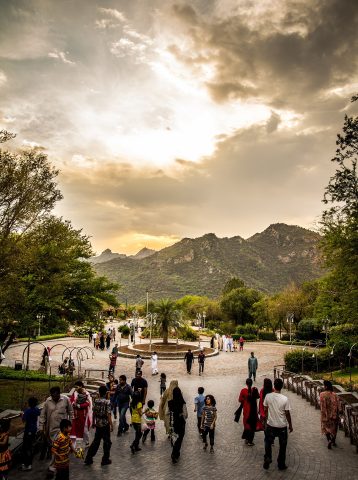
The surrounding park is where the city slows down. Families picnic on the lawns. Children run along the paths. Friends take photos against the monument’s curves. In the evening, lights illuminate the granite, casting shifting shadows. Locals come here as often as tourists do. This isn’t a monument hidden in a museum district. It’s a place where people gather, celebrate, and rest.
The design blends old and new. Islamic motifs meet contemporary lines. The petals rise like hands toward the sky, a gesture that feels hopeful. The mosaics remind visitors that Pakistan’s history didn’t start in 1947. It stretches back thousands of years. This balance reflects the country itself—honoring the past while moving forward.
For Pakistanis, the monument matters most during national holidays. On Independence Day or Pakistan Day, crowds fill the park. Music, speeches, and celebration fill the air. But even on quiet days, the monument stays alive. School groups visit. Couples take wedding photos. Elderly men sit on benches, watching the world pass by. The monument feels like it belongs to the people, not just the state.
The Margalla Hills offer a view of Islamabad. The city spreads below—high-rises, tree-lined streets, older neighborhoods. The monument sits between these worlds, one foot in history, the other in the present. You can spend an hour here or an afternoon. Walk the park. Visit the museum. Sit on the grass. The hills provide quiet in a city that rarely slows down.
What makes the Pakistan Monument different is how it feels personal. It doesn’t demand silence or awe. It invites you to climb the steps, spread a picnic blanket, or discuss the mosaics. There’s warmth here. History isn’t distant—it’s something you can touch, walk through, and take with you.