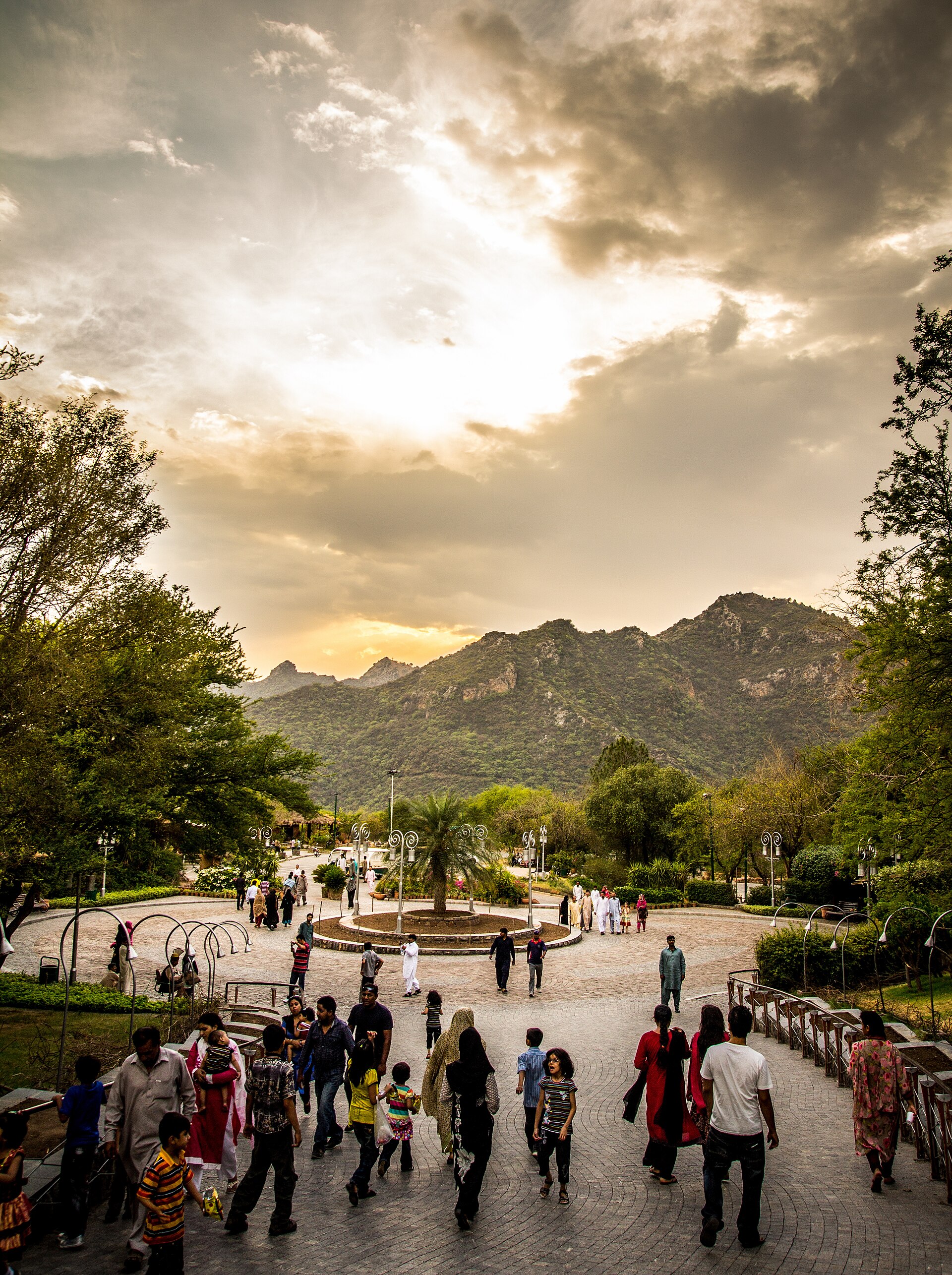
Perched on the slopes of the Margalla Hills, Daman-e-Koh isn’t so much a landmark as it is a quiet revelation of Islamabad’s unexpected beauty. From this vantage point, the city unfolds in a way that feels almost intimate—a sprawling valley where modernity and tradition coexist without fanfare. Below, the capital’s white government buildings stand in contrast to the lush greenery of its parks, while the distant silhouette of the Himalayas lingers on the horizon. It’s a view that strips away the noise of urban life, leaving only the essence of the place: a city nestled in nature, breathing at its own unhurried pace.
The name Daman-e-Koh translates to the hem of the mountain, and that’s precisely where it sits—a natural terrace carved into the foothills of the Margalla range. These hills, part of the Himalayan foothills, cradle Islamabad from the north, shielding it from harsh winds and lending the city its distinctive character. There’s no grand architecture here, no ornate structures or manicured gardens, just a simple clearing where the land drops away to reveal the panorama below. On clear days, the view stretches far beyond the capital: to the east, the plains of Punjab stretch endlessly, while to the west, the jagged outlines of mountain ranges rise like a distant wall. Below, Islamabad sprawls in orderly grids, its wide boulevards and neatly divided sectors softened by the surrounding greenery.
The history of Daman-e-Koh is inseparable from the story of Islamabad itself. When Pakistan decided to move its capital from Karachi in the mid-20th century, the search for a new location led to this valley—a place that was both strategically secure and naturally beautiful. The city was planned meticulously, with broad avenues, ample green spaces, and infrastructure designed to blend with the landscape rather than dominate it. Daman-e-Koh became one of the few places where the original terrain was left untouched, a deliberate choice to preserve the connection between the city and its surroundings. Today, it remains a place where both locals and visitors come to escape the bustle of urban life, to breathe in the crisp mountain air, and to see the capital from a perspective that feels almost secret.
There’s nothing elaborate about the spot itself. A few benches, winding paths leading to different viewpoints, and a small shaded area where visitors can sit and take in the scenery. No crowds, no souvenir stalls, no cafes blaring music—just the quiet rustle of leaves in the wind and the occasional murmur of voices. It’s this simplicity that makes Daman-e-Koh special. Here, time seems to slow down, and the city below transforms from a place of daily routines into something larger—a living part of the landscape, shaped by both human hands and the forces of nature.
The best times to visit are at dawn or dusk. In the early morning, Islamabad stirs beneath a veil of mist, the sun rising slowly over the hills and casting a soft glow over the valley. The air is cool and fresh, carrying the scent of earth and pine. But it’s the sunset that truly captivates. As the sky shifts from gold to pink to deep indigo, the city below begins to twinkle with lights, its outlines blurring into the gathering dusk. The shadows of the hills stretch long and lazy across the landscape, and for a moment, everything feels still. It’s a scene that invites you to simply stand and watch, to let the transition from day to night unfold without hurry.
For locals, Daman-e-Koh holds a significance that goes beyond its views. On weekends, families often drive up for picnics, spreading out blankets on the grass and spending hours under the open sky. Children race along the paths, while elders sit on benches, chatting or watching the city below. During festivals like Independence Day or Eid, the area comes alive with even more energy—people arrive with flags, music fills the air, and the atmosphere buzzes with celebration. For many, this place is tied to personal memories: birthdays, family gatherings, moments of quiet reflection. It’s not just a viewpoint; it’s a part of their lives.
Reaching Daman-e-Koh isn’t always straightforward. The road winds up the hills, narrow and steep in places, with sharp turns that demand careful driving. During the monsoon season, the path can become slick, and in winter, the air grows chilly, so it’s wise to come prepared. But the effort is worth it. The climb itself feels like a small adventure—along the way, you might spot monkeys swinging through the trees, birds darting between branches, or even the occasional wild goat grazing on the slopes. The higher you go, the more the city recedes, until all that’s left is the vastness of the sky and the quiet promise of the view ahead.
What makes Daman-e-Koh truly special isn’t something that can be captured in a photograph or summed up in a description. It’s the way the place makes you feel—the crispness of the air, the hush of the wind, the sense of standing at the edge of something much larger than yourself. Below, Islamabad hums with life, unaware of the eyes watching from above. There’s no pretense here, no attempt to impress or entertain. Just the land, the city, and the people who come to pause, to breathe, and to remember that even in the midst of a bustling capital, there are still places where time moves at its own gentle pace.