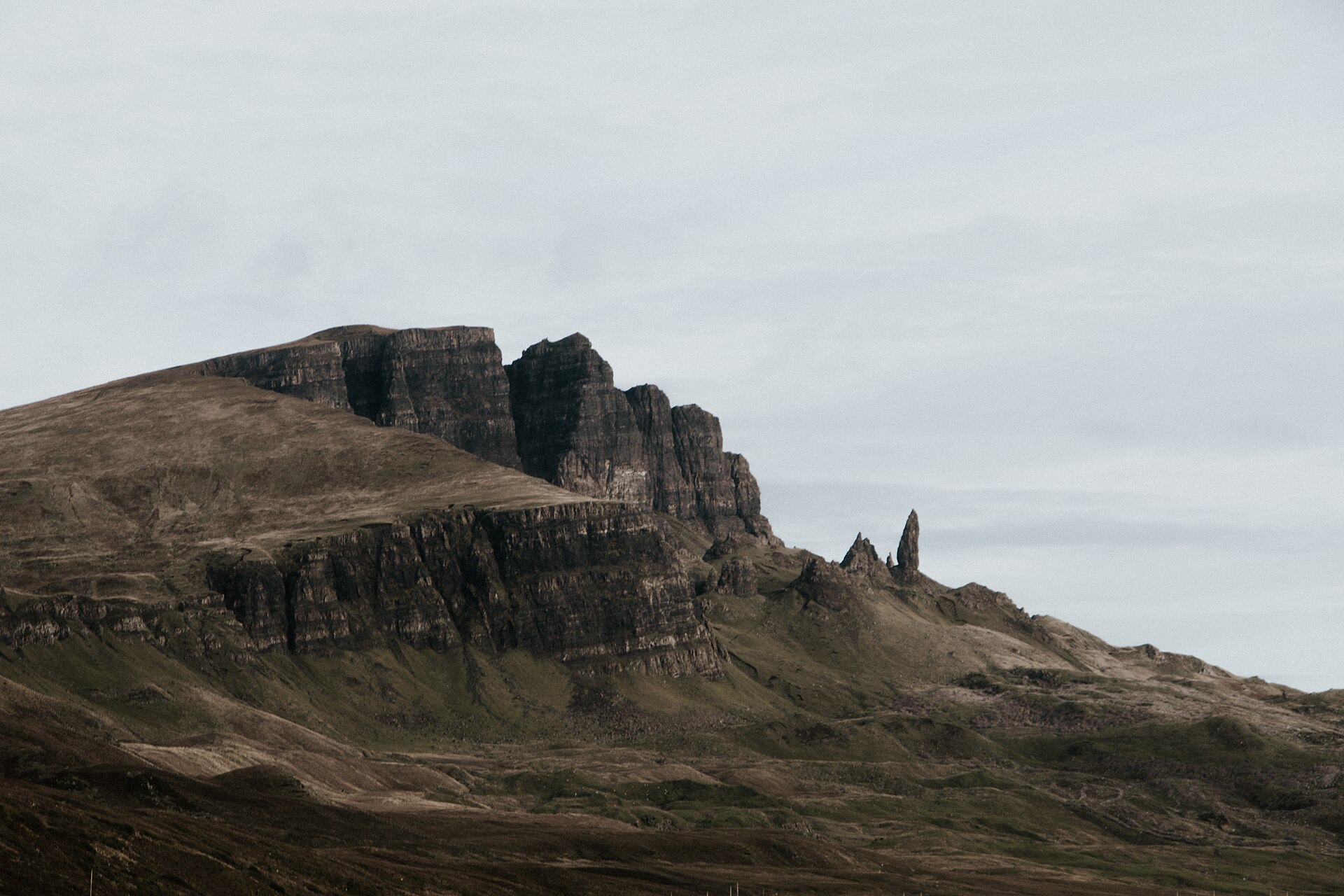
The Old Man of Storr rises above the northeastern coast of the Isle of Skye. This towering rock formation stands like a solitary figure carved by time, its jagged outline sharp against the sky. It was not shaped by human hands but by forces that worked over millions of years, leaving behind something that looks both impossible and inevitable.
The climb starts at the base of Storr. From the car park, the path winds upward through heather and peat bogs, where damp soil and wild herbs scent the air. The ground changes quickly—soft grass turns to loose scree, and the wind grows stronger as you ascend. The higher you go, the more the landscape below shrinks into a patchwork of green and grey, until only the sky and the Old Man remain.
Geologists describe formations like this as a "pinnacle" or "hoodoo." The Old Man is part of a basalt plateau that formed around 60 million years ago, when molten rock surged through cracks in the earth’s crust. Ice and rain wore down the surrounding rock, leaving this stack standing alone. Wind and water still shape it, grain by grain, though the changes are too slow to see.
The people of Skye have told stories about the Old Man for centuries. Some say he was once a giant, turned to stone as punishment. Others believe he guards hidden fairy glens, where the boundary between the human world and the supernatural blurs. On a misty morning, standing at the base of the rock, it’s easy to feel the land holding its breath, the wind carrying whispers from another time.
The hike takes about an hour if you move carefully. The path is uneven, with loose stones shifting underfoot, and the weather can change suddenly—sunshine one moment, rain the next. From the top, the view stretches across the Sound of Raasay to the islands of Rùm and Canna. On clear days, the mainland coast appears on the horizon. Dawn and dusk are the best times to visit, when the light softens and the rocks glow in shades of gold and rust.
This isn’t a place for quick photos or ticking off a tourist list. There are no gift shops, no signs, no cafes. Just wind, rocks, and sky. The Old Man doesn’t demand attention—it holds it, not through spectacle, but through stillness. It reminds you how small we are against geological time, how brief our lives are by comparison. Yet there’s comfort in that. The rock has stood here for millions of years and will remain long after we’re gone.
Photographers come here often. The Old Man changes with the seasons—snow in winter, heather in spring, mist in autumn. The light shifts, too, turning the rock from sharp and angular in daylight to soft and dreamlike at twilight. Some return year after year, chasing a different shot, only to find the landscape has changed again.
The Old Man has appeared in films, music videos, and album covers. But no amount of exposure has lessened its mystery. It remains what it has always been—a quiet, unyielding presence, indifferent to those who visit. It doesn’t care if you’re a tourist, a local, or just passing through. It simply is.
If you come to Skye, don’t rush past. Climb the hill, stand beside the Old Man, and listen. Not for voices or legends, but for the silence beneath them. It’s the kind of place that stays with you, not because of what you saw, but because of how it made you feel.