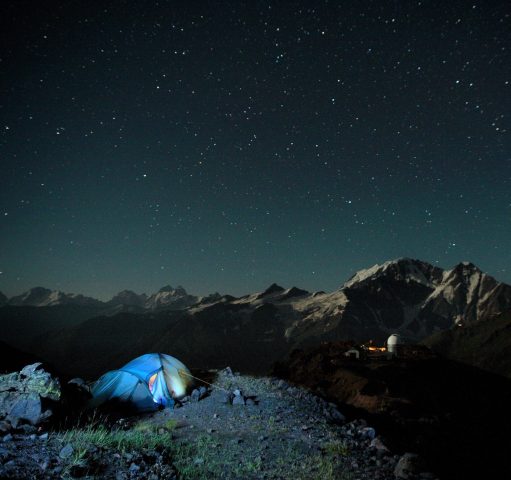
High in the Caucasus Mountains, where the air is thin and the silence is broken only by the wind, lies Terskol—a small settlement tucked between towering peaks. Perched over three thousand meters above sea level, it’s home to one of Europe’s highest-altitude observatories. The location wasn’t chosen by chance. Here, the atmosphere is remarkably clear, light pollution is nonexistent, and the nights are often cloudless, offering some of the best conditions on the continent for stargazing. For astronomers and visitors alike, the Terskol Observatory isn’t just a scientific facility; it’s a place where the vastness of the cosmos feels almost within reach.
The observatory’s origins trace back to the mid-20th century, when Soviet scientists were searching for an ideal site to expand their astronomical research. The Caucasus Mountains, with their high elevations and relatively stable weather patterns, proved to be the perfect solution. By the 1980s, the first telescopes were installed, and over the decades, Terskol grew into a key center for astronomical studies. Today, it operates as part of the International Center for Astronomical and Medico-Ecological Research, a collaboration that underscores its importance not just for Russia but for global science.
The architecture of the observatory is unassuming, designed for function rather than aesthetics. The most striking features are the domed structures housing the telescopes, scattered across the rocky plateau like oversized mushrooms. Made of metal and plastic, these domes open at night to reveal powerful optical instruments capable of capturing light from galaxies millions of light-years away. The largest of these is a two-meter telescope, a precision tool that allows researchers to study distant celestial objects in unprecedented detail. Nearby, modest buildings serve as laboratories and living quarters for the staff, blending seamlessly into the rugged landscape.
Life at the observatory follows a rhythm dictated by the sky. During the day, scientists analyze data, calibrate equipment, and prepare for the night’s work. But when darkness falls, the real magic begins. The observatory is a working facility, not a tourist attraction, and access is restricted to professionals. Still, occasional guided tours are offered for small groups, giving visitors a rare glimpse into how modern astronomy operates. Watching the telescopes rotate silently under the stars, it’s easy to forget the complexity of the science behind them—until someone explains the intricate calculations and technology that make these observations possible.
The atmosphere in Terskol is unlike anywhere else. The air is crisp and cool, even in summer, and the silence is profound. At night, the sky transforms into a breathtaking spectacle. Without the interference of city lights, the Milky Way stretches across the heavens in vivid detail, while planets, nebulae, and countless stars shine with an intensity rarely seen elsewhere. It’s a reminder of why humanity has always been drawn to the night sky—here, the desire to understand the universe feels more urgent, more personal.
Terskol Observatory plays a crucial role in studying the cosmos. Its high-altitude location provides unique advantages for observing small bodies in the solar system, variable stars, and distant galaxies. The data collected here is often impossible to replicate elsewhere, making the observatory a valuable resource for international research. Scientists from around the world collaborate on projects here, and the findings regularly appear in leading scientific journals, contributing to our broader understanding of the universe.
For those who visit Terskol not for science but for the mountains themselves, the observatory adds another layer of fascination to the journey. The road to the settlement winds through dramatic gorges and alpine meadows, where horses graze and the snow-capped peak of Mount Elbrus looms in the distance. The drive takes about an hour, and along the way, travelers can stop at small cafés where locals serve hot tea and fresh pastries. Terskol itself is a quiet place, with a handful of guesthouses and lodges offering a base for exploring the region.
More than just a scientific outpost, the Terskol Observatory embodies humanity’s enduring curiosity. It’s a place where the boundaries between Earth and sky blur, where researchers push the limits of knowledge, and where visitors can momentarily feel connected to something far greater than themselves. The observatory stands as a bridge between the natural world and the mysteries of the cosmos, making the vastness of space feel a little more tangible. If you ever find yourself in this part of the Caucasus, take the time to visit—you might just see the stars in a way you never have before.