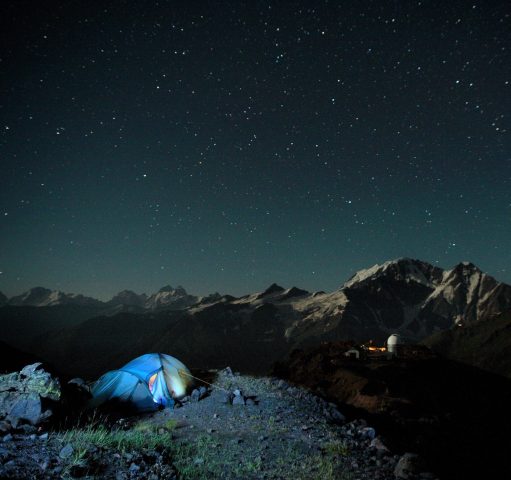
Adyr-Su Gorge is one of those rare places in the Caucasus where you come not for postcard-perfect views, but for the raw, untouched essence of the mountains. It lies just off the beaten path, a short distance from Terskol, the gateway to Mount Elbrus, yet it feels worlds away from the usual tourist trails. There are no crowds here, no souvenir stalls, no kebab stands—just sheer cliffs, glaciers, and the quiet hum of a mountain river cutting through the silence. The gorge begins almost imperceptibly: the road winds through pine forests at first, then the trees thin out, and suddenly, you find yourself in a valley squeezed between jagged ridges, as if the mountains themselves have drawn you into their embrace.
This isn’t just any gorge—it’s part of an ancient glacial system that once blanketed the region. The remnants of that era are still visible in the moraine ridges, piles of rocks left behind by retreating ice, and the cirque lakes hidden high in the peaks. The name Adyr-Su translates from Balkar as "valley between the rocks," and it’s an apt description. The gorge is narrow and elongated, its steep slopes rising almost vertically in places, creating a sense of isolation that’s hard to find elsewhere. At its upper reaches lies the Adyr-Su Glacier, one of the largest in the Elbrus region, though like many glaciers, it has noticeably receded over the past decades.
There are no paved roads here, only trails worn by hikers and climbers over the years. One of the most well-trodden paths leads to the Adyl-Su alpine camp, a relic of Soviet-era mountaineering that still serves as a base for those attempting peaks along the Main Caucasus Range. Perched at around three thousand meters, the camp is the starting point for ascents of formidable summits like Ushba, Shkhelda, and Dzhangitau. Even if you’re not a climber, the hike to the camp is worth it for the way the landscape transforms around you—dense forests give way to alpine meadows, then to barren rock and patches of lingering snow, while the air grows so crisp it feels like you could reach out and touch the peaks.
Adyr-Su isn’t just for thrill-seekers, though. In the summer, hikers come to explore its gentler trails, following the river or making their way to the high-altitude lakes. One of the most striking is Bashkara Lake, nestled at nearly three thousand meters. It’s small but mesmerizing, its waters shifting from turquoise to deep blue depending on the light. The trail to the lake starts in the forest, then opens up to a landscape of dry grass and lichen-covered boulders, where the only sounds are the crunch of gravel underfoot and the distant rush of the river. On clear days, the Adyr-Su Glacier is visible from here, spilling down the valley like a frozen river.
Winter turns the gorge into a different world entirely—one of snow and ice. Skiers and snowboarders come for the untouched slopes, while freeriders seek out the challenging descents far from the groomed runs of commercial resorts. But winter here is not without its dangers. Avalanches are a real threat, and even experienced visitors are cautious about venturing out without a guide. Those who do brave the cold are rewarded with a rare sight: the gorge in its silent, frozen state, where every sound echoes through the still air, and the mountains seem to hold their breath.
The history of Adyr-Su is intertwined with the story of the Caucasus itself. In the 19th century, these mountains were largely unexplored, and few dared to venture this deep into the range. One of the first to document the gorge was the Russian geographer and mountaineer Andrei Pastukhov, who led several expeditions to the Elbrus region in the late 1800s. He wrote of the area’s wild beauty and the difficulty of the passes leading into Georgia. Later, during the Soviet era, the gorge became a training ground for climbers, and the first alpine camps were established to prepare those attempting the region’s peaks.
Today, Adyr-Su remains a place where you can step away from the noise of modern life. There’s no cell service, no internet, no distractions—just the crisp mountain air, a sky full of stars, and the feeling of being at the edge of the world. It’s not a place for those seeking comfort or entertainment, but for those willing to meet it on its own terms: rugged, beautiful, and quietly mysterious. Even a single day here leaves a lasting impression, as if the mountains have shared a secret—one that lingers long after you’ve left.