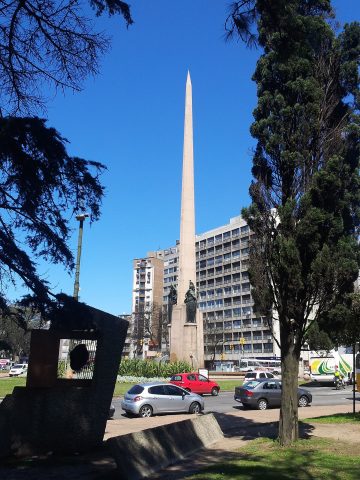
Nestled in Montevideo’s quiet Prado neighborhood, the church of Nuestra Señora de Lourdes y San Vicente Pallotti feels like a well-kept secret. Unlike the grand cathedrals that dominate tourist itineraries, this unassuming building blends into its surroundings, its presence announced only by the soft glow of its stone facade under the afternoon sun. The streets here move at a slower pace, lined with century-old trees and houses that whisper of early 20th-century life. There’s no bustle, no urgency—just the occasional rustle of leaves and the distant hum of the city, muffled by distance.
The architecture is a subtle fusion of Neo-Gothic and Neo-Romanesque styles, a combination rarely seen in Uruguay. The light-colored stone exterior warms in sunlight, while tall, narrow windows filter the daylight into a gentle haze inside. The interior is deceptively spacious, its simplicity creating an atmosphere of quiet reverence. Columns with delicate floral carvings support the nave, leading the eye toward the altar, which is understated yet striking in its balance. There are no gilded excesses or elaborate frescoes—just an uncluttered space where the mind can settle.
Built in 1927, the church was commissioned by the Pallottine community, a Catholic apostolic society founded in the 19th century by Italian priest Vincenzo Pallotti. This was a period of growth for Uruguay, when economic prosperity and European influences shaped the country’s urban landscape. The Pallottines, known for their missionary and charitable work, chose Prado for its emerging immigrant population, many of whom sought a sense of community in their new home. The church’s dual dedication—to Our Lady of Lourdes and to Pallotti himself—reflects both universal Catholic devotion and the specific values of the Pallottine movement. Lourdes, a symbol of healing and comfort, resonated deeply in a country where faith often intersected with secular life.
Prado itself is a world apart from the rest of Montevideo. Once a retreat for the city’s elite, it retains an air of old-world elegance, with its wide, tree-lined avenues and stately mansions. The church fits seamlessly into this setting, as if it has always been here. On Sundays, the pews fill with locals and visitors alike, drawn by the promise of a service that feels both intimate and timeless. On weekdays, the doors usually remain open, inviting passersby to step inside, sit in silence, or watch the shifting patterns of light through the stained glass.
For those who take the time to explore, the church offers more than just a place of worship. It’s a quiet witness to Uruguay’s layered history, where European traditions met local realities. In a country where secularism took root early, such spaces served as bridges between cultures and generations. The Pallottines, with their emphasis on service and humility, found a natural home here, their legacy woven into the fabric of the neighborhood.
Visiting Nuestra Señora de Lourdes y San Vicente Pallotti isn’t about ticking off a landmark. There are no crowds, no souvenir stands, no grand narratives—just the quiet interplay of light and shadow, the faint scent of old wood, and the sense that time moves differently here. Whether you come in the morning, when the sun first touches the stone, or in the late afternoon, when the shadows stretch long, the church leaves an impression that lingers. It’s not the kind of place you remember for its grandeur, but for the way it makes you pause, even if just for a moment.