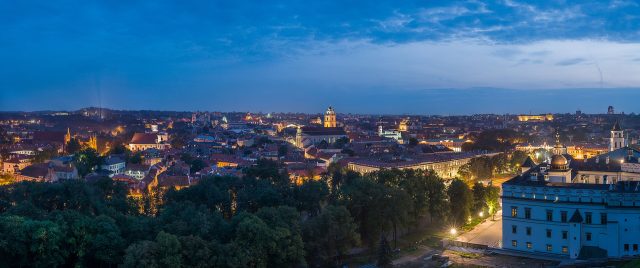
Nestled in the heart of Vilnius’ Old Town, St. Nicholas Church is one of those quiet places that feels suspended in time. It doesn’t demand attention with grand facades or ornate decorations, yet there’s something quietly powerful about it. The church stands on a narrow cobblestone street, where the past lingers in the worn stones underfoot and the unhurried rhythm of the neighborhood. It’s easy to walk past without noticing, but those who pause find themselves drawn into a space that feels both intimate and timeless.
The church’s origins trace back to the 14th century, a period when Vilnius was emerging as a key religious and cultural hub of the Grand Duchy of Lithuania. The first written records mention it in 1340, though historians still debate the exact year of its founding. What is clear is that St. Nicholas was established by the city’s Orthodox community, which played a significant role in Vilnius’ early history. At a time when Catholicism was becoming dominant, the church remained a steadfast symbol of Orthodoxy, reflecting the city’s long tradition of religious diversity.
Over the centuries, the building has absorbed layers of history, and its architecture tells that story. Originally constructed in the Gothic style, it has been rebuilt and restored multiple times, incorporating elements of Baroque and neoclassical design. The exterior is unassuming—whitewashed walls, narrow arched windows, and a modest bell tower topped with a pyramidal roof. Inside, however, the church holds treasures that feel far older than the building itself. Seventeenth-century frescoes cover the walls, while the iconostasis, with its intricate carvings and gilded details, follows traditional Orthodox design. Among the icons, the image of St. Nicholas the Wonderworker is especially revered, believed by some to possess miraculous properties.
St. Nicholas Church has weathered its share of upheavals. In the 16th century, during the Reformation, it was looted and damaged, only to be restored later. The 17th century brought wars and fires that once again left their mark, yet each time, the church was rebuilt, preserving its original character. When Lithuania came under Russian rule in the 19th century, the church became a focal point for the city’s Orthodox community. It was during this period that a side chapel dedicated to Alexander Nevsky was added, further enriching the building’s historical layers.
Today, the church remains an active place of worship, though it also draws visitors curious about Vilnius’ past. The interior is always hushed, even when the streets outside are bustling. Sunlight filters through the narrow windows, casting a soft glow on the ancient icons and creating an atmosphere of quiet reflection. Services are conducted in Church Slavonic, their chants echoing under the vaulted ceilings in a way that feels both solemn and transporting. For many, the church offers a moment of stillness in a city that’s otherwise full of movement—a place to step away from the rush of modern life.
The surrounding streets of the Old Town are just as compelling. Cobblestone lanes wind past historic buildings, leading to other landmarks like the Town Hall Square or the banks of the Vilnia River, where the city unfolds in layers of red-tiled roofs and church spires. Yet there’s something particularly evocative about this corner of Vilnius. The church doesn’t dominate the street; it blends into it, almost as if it’s always been there, waiting for those who take the time to notice.
St. Nicholas Church is more than just a historical monument. It’s a living piece of Vilnius’ past, one that has endured wars, shifting borders, and changing faiths without ever losing its sense of purpose. The people who have prayed here over the centuries—merchants, soldiers, ordinary townsfolk—are long gone, but their presence lingers in the quiet corners of the church. In a city that’s constantly evolving, it remains a steadfast reminder of the enduring power of tradition and memory. For those who seek it out, it offers not just a glimpse into history, but a connection to something deeper.