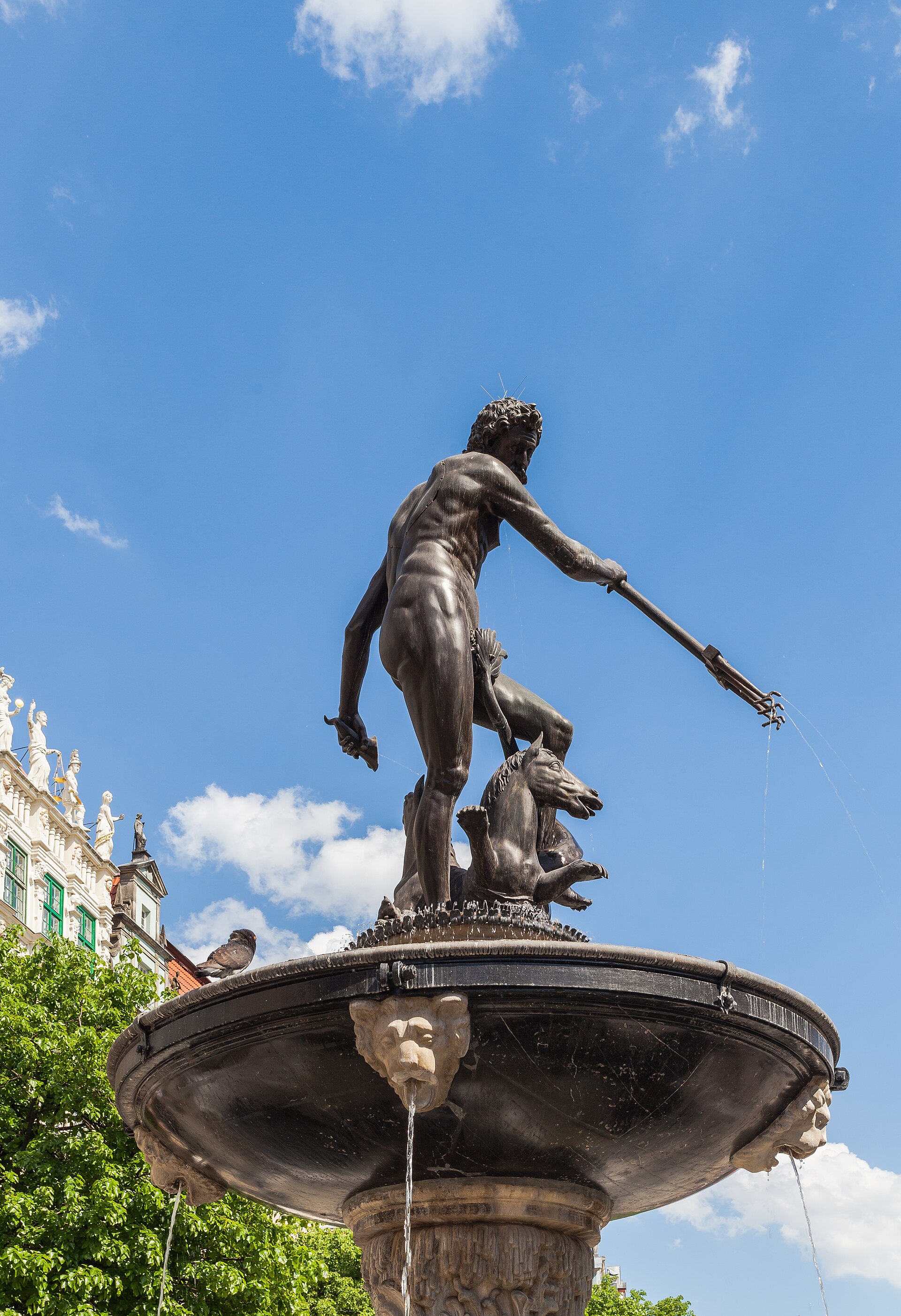
The Neptune Fountain in Sztutowo is one of those quiet landmarks that doesn’t demand attention but lingers in memory long after you’ve seen it. Tucked away on a small square in front of the town hall, it fits naturally into the surroundings, as if it has always been part of the landscape. And in many ways, it has. The fountain dates back to the late 19th century, a time when Sztutowo was flourishing thanks to trade and shipping along the Vistula River. The town was expanding, and public spaces were being adorned with symbols that reflected its growing ambitions.
Neptune himself isn’t an unusual choice for a fountain—after all, the Roman god of the sea has appeared in similar monuments across Europe, especially in port cities. But here, he takes on a character of his own. The bronze statue bears the marks of time: a patina of greenish-blue, worn folds in his cloak, and a slightly weathered expression. Yet rather than looking neglected, Neptune seems at ease, as if he’s grown accustomed to the occasional visitor stopping to take a photo or simply watching the water spill from the shells held by the tritons at his feet.
The fountain is modest in size but carefully designed. Neptune stands on a rocky pedestal at the center, water cascading around him, while four tritons—mythical sea creatures—surround him, each holding a shell that sprays water in graceful arcs. These figures aren’t just decorative; they add movement to the scene, making the fountain feel alive, as if it’s breathing with the rhythm of the town. The water isn’t just there for show—it gives the whole structure a sense of energy, whether anyone is watching or not.
What many people don’t realize is that the fountain hasn’t always looked the way it does today. In the early 20th century, it underwent renovations that altered some of its original features. Initially, water only flowed from the tritons’ shells, but later, additional streams were added, shooting up from the rocks beneath Neptune’s feet. These changes weren’t just about aesthetics—they also made the fountain more reliable, ensuring it could function smoothly without constant repairs.
Sztutowo isn’t the kind of place that draws crowds of tourists, and that’s part of its charm. The town has a quiet, unassuming history that reveals itself in small details, like the Neptune Fountain. It’s not grand or extravagant like the fountains of Rome or St. Petersburg, but there’s something honest and unpretentious about it. Maybe that’s because it doesn’t try to impress—it simply exists, woven into the fabric of daily life.
In the summer, the fountain becomes a gathering spot. Couples meet here, parents bring their children to splash in the water on hot days, and locals pause for a moment in its shade. In winter, the fountain falls silent, its surface dusted with frost, as if Neptune has retreated beneath the waves, leaving the town to its quiet season. There’s something particularly moving about seeing it like this—a reminder that even in small towns, there are little moments of beauty worth noticing.
Beyond its decorative role, the Neptune Fountain has practical roots. In the past, it served as a water source for residents, and though it no longer fulfills that function, some people still approach it with bottles or flasks, filling them out of habit or curiosity. It’s not that the water is special—it’s just that the fountain has been part of the town’s life for so long that it feels natural to interact with it.
Sztutowo doesn’t try to be like other Polish towns. There are no tourist traps, no crowded streets, no pushy souvenir vendors. The Neptune Fountain is one of those places where you can sense the rhythm of a small town, where life moves at its own pace and history blends seamlessly with the present. It’s the kind of spot that appeals to those who aren’t just looking for sights, but for the feeling of a place—the way the past and present coexist without fanfare. Maybe that’s why, despite its simplicity, it leaves such a lasting impression.