Victoria Falls National Park is where the raw power of nature takes center stage, and words often feel unnecessary. Straddling the border between Zimbabwe and Zambia, the park surrounds one of the most spectacular waterfalls on Earth, known locally as *Mosi-oa-Tunya*—the Smoke That Thunders. The name captures the essence of the place perfectly: water plunges over a hundred-meter cliff, sending up clouds of mist visible for miles, while the roar of the falls reaches you long before the gorge itself comes into view.
Established in 1939, the park was created to protect the unique ecosystem that thrives around the falls. Here, the dry savanna meets dense tropical forests, creating a landscape where two worlds collide. During the dry season, the Zambezi River shrinks, reducing the falls to a series of narrow cascades that expose the ancient basalt cliffs, carved smooth by millions of years of erosion. When the rains arrive, the river swells, stretching nearly two kilometers wide, and the spectacle becomes overwhelming. The mist rises hundreds of meters into the air, nourishing the lush, evergreen forests that cling to the edge of the abyss.
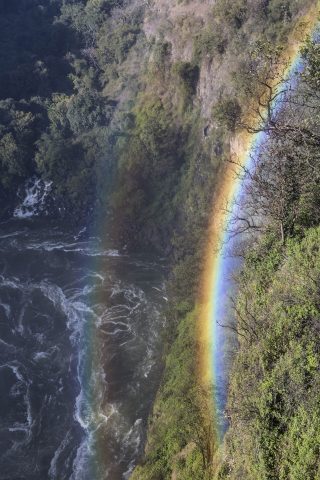
Walking through the park is like moving through different natural realms. Most visitors start along the trails that trace the lip of the falls, where viewing platforms offer the most dramatic perspectives. One of the most famous, the Devil’s Cataract, sits directly above the churning cauldron where the main torrent crashes into the gorge below. On clear days, rainbows shimmer in the spray, shifting with the light. In the wet season, the paths can be slick, and the mist may obscure the view, but that’s when the falls are at their most powerful—wild, untamed, and almost alive.
Beyond the falls themselves, the park is rich in wildlife and plant life. Along the riverbanks, dense gallery forests thrive, home to rare trees like African ebony and mahogany. Troops of vervet monkeys dart through the branches, while leopards, though rarely seen, lurk in the shadows. On the open plains, elephants, buffalo, and antelope graze, and overhead, eagles and vultures circle on thermal currents. The Zambezi is teeming with fish, and crocodiles often lurk near the banks, waiting for an opportunity to strike.
The history of this place stretches back centuries. The first European to document the falls was David Livingstone, the Scottish explorer and missionary, who arrived in 1855 and named them after Queen Victoria. Yet long before his arrival, the local Tonga and Lozi people had revered the site as sacred, a place where ancestral spirits dwelled. Today, descendants of those communities still live and work in the area, guiding visitors and sharing stories that have been passed down through generations.
For those who want a different perspective, the park offers more than just walking trails. A steep path descends into the gorge, leading to the river’s edge, where the sheer cliffs frame the Zambezi as it races toward the drop. In some spots, natural pools form at the very brink of the falls, like the famous Devil’s Pool, where brave swimmers can peer over the edge into the abyss. But caution is essential—the current is strong, and the rocks are slippery.
Adventure seekers will find plenty to do here. The Zambezi is renowned for its white-water rafting, with some of the best rapids in the world just downstream from the falls. The river calms briefly before surging again, creating waves and whirlpools that challenge even experienced rafters. For those who prefer a gentler experience, sunset cruises offer a chance to watch animals come to drink at the water’s edge, or simply to soak in the golden light reflecting off the river.
Victoria Falls National Park isn’t just a tourist attraction—it’s a place where nature’s grandeur is on full display. There’s no artifice here, no man-made spectacle to distract from the raw beauty of the landscape. The sound of the water, the scent of damp earth, the sheer scale of the falls—it all feels primal, as if you’re standing at the edge of something ancient and untamed. Time seems to slow down, and even a short walk along the cliffs leaves an impression that lingers long after you’ve left. This is a place to experience, not just see—to feel the mist on your skin, to hear the thunder in your bones, and to remember what it means to be small in the face of something truly magnificent.