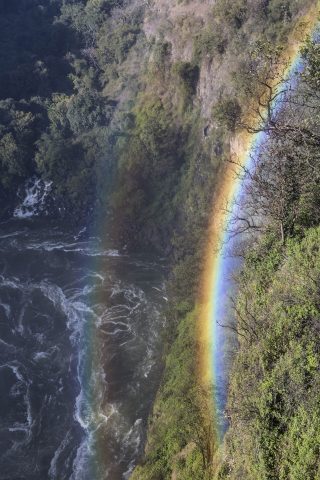
Mosi-oa-Tunya National Park stretches across the border of Zimbabwe and Zambia, cradling one of Africa’s most breathtaking natural wonders—Victoria Falls. The name, given by the local Lozi people, translates to "The Smoke That Thunders," a phrase that barely begins to capture the raw power of the place. The roar of the water crashing over the edge carries for miles, while mist rises in towering clouds, visible long before the falls themselves come into view. This isn’t just a park about a waterfall, though. It’s a landscape where wildlife, history, and culture intersect, offering something far richer than a single spectacle.
The falls themselves are a force of nature that defies easy description. At over a hundred meters high and nearly two kilometers wide, Victoria Falls isn’t just a wall of water—it’s a complex system of gorges, rapids, and islands carved into the earth over millennia. During the rainy season, the Zambezi River swells, turning the falls into a deafening, mist-shrouded cascade that leaves even seasoned travelers in awe. In the dry months, the water recedes, revealing the dark basalt cliffs beneath and transforming the scene into something quieter but no less striking. The contrast between the river’s calm upstream and its violent plunge into the gorge below is what makes this place unforgettable.
Established in 1972, the park was created to protect the delicate ecosystem surrounding the falls. Its boundaries extend beyond the water’s edge, encompassing savannas, woodlands, and river valleys where elephants, buffalo, giraffes, and zebras roam freely. Lions and leopards are less commonly seen but still part of the landscape, while the Zambezi’s banks teem with birdlife—kingfishers darting over the water, fish eagles circling overhead, and herons standing motionless in the shallows. Well-maintained trails and viewpoints allow visitors to explore the terrain from different angles, whether perched on a cliff’s edge or walking through the bush with a guide.
One of the most compelling ways to experience the falls is from above. Helicopter flights, often called "flight of the angels," offer a perspective that ground-level views can’t match. From the air, the Zambezi appears as a broad, serene ribbon until it suddenly vanishes over the edge, the water churning through narrow gorges before resuming its journey downstream. The scale of the falls becomes truly apparent only when seen from this height, where the river’s power and the land’s rugged beauty come together in a single, sweeping view.
The park’s history is intertwined with the broader story of Africa’s exploration. Scottish missionary David Livingstone was the first European to document the falls in 1855, naming them after Queen Victoria, though the Lozi people had known them as Mosi-oa-Tunya for generations. Today, a memorial to Livingstone stands on an island near the falls, a reminder of how this region shifted from an unknown frontier to a destination that draws travelers from around the world. Yet despite its fame, the park retains a sense of wildness, a place where nature still dictates the rhythm of life.
Beyond the falls, the park offers glimpses into the culture of the people who have lived here for centuries. Nearby villages welcome visitors to learn about traditional Lozi life, from storytelling and dance to craftsmanship passed down through generations. These encounters aren’t staged for tourists—they’re a chance to see how communities have adapted to the land, relying on the river for sustenance and inspiration. The handmade crafts sold here, whether woven baskets or carved wooden figures, carry the stories of their makers, making them more than just souvenirs.
For those who want to engage more deeply with the landscape, the park provides a range of activities. Game drives and walking safaris offer close encounters with wildlife, while canoeing on the Zambezi above the falls provides a peaceful contrast to the water’s fury below. Adventurous visitors can tackle white-water rafting on the rapids downstream, where the river’s energy is channeled into thrilling, fast-moving waves. Night safaris reveal a different side of the park, as nocturnal animals emerge and the sounds of the bush take on a new intensity. The key to enjoying these experiences is respect—this is a place where humans are guests, not masters.
What sets Mosi-oa-Tunya apart from other African parks is its relative quiet. There are no crowds here, no sense of being rushed from one attraction to the next. Instead, there’s space to sit by the Zambezi’s edge, watching elephants drink from the river or hippos wallow in the shallows. Early mornings at the falls are particularly magical, as the rising sun turns the mist into a shimmering curtain of gold. It’s in these moments that the park’s true essence reveals itself—not just as a natural wonder, but as a place that stirs something deeper, something almost primal.
The best time to visit depends on what you hope to see. From May to October, the dry season brings lower water levels, making it easier to explore the trails and spot wildlife congregating near the river. The falls are still impressive, though less dramatic than during the rainy season. From November to April, the Zambezi swells, and the falls become a thunderous spectacle, but some paths may be flooded, and animals can be harder to find. Regardless of when you come, the park offers a rare combination of grandeur and intimacy, a place where nature’s power is on full display, yet still feels within reach.
Mosi-oa-Tunya isn’t just a destination—it’s an experience that lingers long after you’ve left. Whether it’s the sight of the falls at dawn, the sound of a lion’s roar in the distance, or the quiet conversation with a local guide sharing stories of the land, this place has a way of staying with you. It’s a reminder of how small we are in the face of nature’s forces, and yet how deeply we can connect to them. For many, that’s reason enough to return.