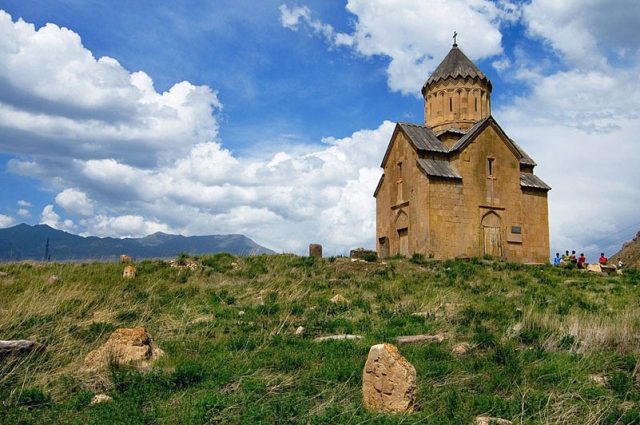
Byurakan is a quiet village nestled in the foothills of Mount Aragats, best known for its observatory—a place where the night sky feels closer than anywhere else in Armenia. But beyond the telescopes and scientific instruments, there’s another reason to visit: a small museum dedicated to Viktor Ambartsumian, the man who put Armenian astronomy on the world map. His name might not be as widely recognized as Einstein or Hubble, but his contributions to astrophysics were just as profound, reshaping how we understand the universe.
Ambartsumian was born in Tbilisi in 1908, yet his life’s work became inseparable from Armenia. He founded the Byurakan Astrophysical Observatory in the 1940s, turning it into one of the most influential centers of astronomical research in the world. What made him remarkable wasn’t just his brilliance as a theorist but his ability to build a scientific community from the ground up. He created a school of thought that still influences astrophysics today, mentoring generations of scientists who carried his ideas forward. The museum bearing his name is housed in the very building where he worked, met with colleagues, and shaped the future of astronomy.
Walking through the museum, you won’t find the usual sterile displays of equations or intimidating instruments. Instead, the exhibits feel personal, almost intimate. There are his handwritten notes, letters, and photographs that reveal not just the scientist but the man behind the discoveries. Ambartsumian was known for his wit and charm, someone who could effortlessly connect with people from all walks of life. His desk remains as it was during his lifetime—a simple wooden table with a lamp, bookshelves lined with well-worn volumes, and a blackboard still marked with chalk equations, as if he had just stepped out for a moment.
The building itself is a piece of history. Constructed in the mid-20th century, it reflects the modest, functional architecture of the time, yet there’s a quiet elegance to it. Low ceilings, large windows, and wooden paneling create an atmosphere that feels both scholarly and welcoming. It’s easy to imagine Ambartsumian here, deep in thought, surrounded by the tools of his trade. The space doesn’t just preserve his legacy; it invites visitors to step into his world, to see the universe through his eyes.
One of Ambartsumian’s most groundbreaking ideas was that stars aren’t born in isolation but in clusters, and that the cores of galaxies play a crucial role in their evolution. At the time, these theories were revolutionary, challenging long-held assumptions. Today, they form the foundation of modern astrophysics. The museum features models of the telescopes used to test his hypotheses, including a replica of the Byurakan Observatory’s large telescope, which was one of the most powerful in the world when it was built. These instruments weren’t just tools; they were extensions of Ambartsumian’s vision, helping to unlock the secrets of the cosmos.
But the museum isn’t just a tribute to the past. It remains a living part of Armenia’s scientific community. Researchers still gather here for discussions, students attend lectures on the latest astronomical discoveries, and visitors from around the world wander through its halls. Ambartsumian believed that science should be accessible to everyone, and that philosophy is still alive in Byurakan. Schoolchildren peer at the exhibits with curiosity, while tourists who came for the observatory often find themselves drawn in by the story of the man who made it all possible.
Byurakan itself is a place where science and nature intersect in a way that feels almost poetic. The village sits against a backdrop of dry, rolling hills and the rugged slopes of Mount Aragats, where the vastness of the landscape mirrors the scale of the questions Ambartsumian sought to answer. It’s not hard to picture him here, gazing at the night sky, contemplating the mysteries of the universe. There’s something about this place—the stillness, the clarity of the air, the way the stars seem to hang just within reach—that makes his achievements feel even more extraordinary.
The museum isn’t just a monument to a great scientist; it’s a place where science becomes human. Here, complex ideas are stripped of their abstraction and given a face, a voice, a story. Ambartsumian’s work wasn’t just about formulas and calculations; it was about the people who dedicated their lives to understanding the cosmos. Though he passed away in 1996, his influence endures—not just in the museum or the observatory, but in the minds of those who visit, who leave with a deeper appreciation for the universe and the people who study it. Byurakan reminds us that behind every great discovery, there’s a person, a place, and a moment when curiosity changed everything.