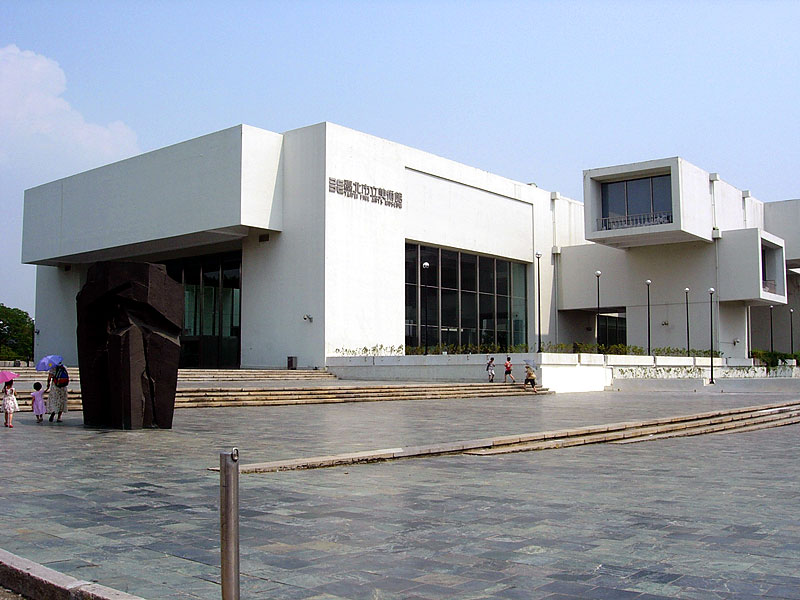
The Taipei Fine Arts Museum feels less like an institution and more like a quiet conversation between the city and its people. Tucked away in Daan District, an area known for its bookshops, cafés, and tree-lined streets, the museum doesn’t demand attention—it simply exists, woven into the daily rhythm of the neighborhood. There’s no tourist bustle here, just the hum of locals going about their day, stopping by to wander through the galleries or sit in the courtyard with a book. The building itself seems to understand this unspoken pact: it doesn’t impose, but invites.
Designed in the late 1980s, the museum reflects Taipei’s ambition to carve out its own cultural identity during a time of rapid modernization. The architecture balances the raw, geometric lines of concrete with softer, almost calligraphic curves that nod to traditional Chinese aesthetics. Inside, the galleries are airy and uncluttered, with high ceilings and natural light that spills across the walls. There’s none of the cramped, labyrinthine feel of older European museums; instead, the space encourages slow, deliberate movement, as if the art itself dictates the pace. The absence of crowds isn’t by accident—it’s a deliberate choice, a way of letting the work breathe.
The collection spans centuries, though it’s not bound by geography or era. While Taiwanese art takes center stage—from the Japanese colonial period to contemporary voices gaining international recognition—the museum also holds classical Chinese scrolls and modern installations that challenge the boundaries of form. A particular strength lies in mid-20th-century works, a time when Taiwanese artists grappled with their place between tradition and Western influence. The result is a dialogue rather than a timeline: ink paintings hang near digital projections, and sculptures from the 1960s share space with pieces created last year. The museum doesn’t just preserve the past; it asks how the past speaks to the present.
What sets this place apart is its refusal to be static. Temporary exhibitions often tackle urgent themes—climate change, technology, identity—while giving local artists a platform to experiment. The museum has become a testing ground for new ideas, where young creators can take risks without the pressure of commercial success. This approach keeps the institution relevant, but more importantly, it fosters a sense of ownership among visitors. People don’t come here to passively observe; they come to engage, to debate, to see their own experiences reflected in the work on display. The museum doesn’t just showcase art—it cultivates a community around it.
There’s an ease to the way people move through the space. Families sprawl on benches, students sketch in notebooks, and older visitors linger in front of familiar pieces, as if revisiting old friends. The rules are minimal: no hushed tones, no rigid barriers between viewer and artwork. On weekends, the courtyard transforms into an open-air venue for concerts, film screenings, and workshops. In the winter, calligraphy brushes and watercolors replace the summer’s music, turning the museum into a classroom without walls. The lack of an admission fee for the permanent collection ensures that this remains a public space in the truest sense—one that doesn’t cater to tourists, but to the city itself.
Education is woven into the museum’s fabric. Lectures, seminars, and hands-on workshops make art accessible to those who might otherwise see it as intimidating. Children’s studios offer everything from painting to animation, teaching kids that creativity isn’t just for professionals. The museum’s approach is practical: if you want to understand a technique, try it yourself. This philosophy extends to adults, too, with programs that demystify everything from abstract expressionism to digital media. The goal isn’t to turn visitors into artists, but to remind them that art isn’t a spectator sport—it’s something you participate in, even if just by looking a little closer.
Perhaps the most striking thing about the Taipei Fine Arts Museum is how unpretentious it feels. There’s no grand narrative about genius or masterpieces, no insistence that you must admire what’s on display. Instead, the museum trusts the art to speak for itself—and it does, in ways that are often quiet but never indifferent. The absence of glass barriers in some galleries reinforces this intimacy, as if the work is waiting to be discovered rather than revered. It’s the kind of place where you might return to the same painting three times in one visit, noticing something new each time: a brushstroke, a shadow, a detail that changes with the light.
This isn’t a museum you can rush through. It rewards patience, whether that means sitting in a gallery until the afternoon light shifts or returning months later to see how a new exhibition alters the space. The building itself seems to encourage this slow engagement, with its courtyards and hidden corners that invite lingering. There’s no pressure to “see it all”—just the quiet suggestion that art, like the city outside, is best experienced over time. And maybe that’s the point: in a world that moves too fast, the museum offers a place to pause, to look, and to remember that beauty isn’t always grand or dramatic. Sometimes, it’s just there, waiting to be noticed.