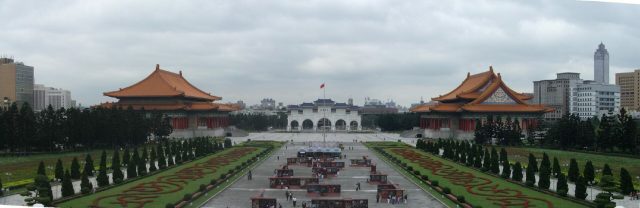
Chiang Kai-shek Memorial Hall stands as a quiet giant in the heart of Taipei, its white marble walls and blue-tiled roof rising above the surrounding treetops. Built to honor the man who shaped modern Taiwan, the memorial is more than just a monument—it’s a place where history lingers in the air, where the past feels both distant and immediate. The building sits in Daan District, a neighborhood where the city’s energy softens into something more contemplative, and where locals and visitors alike find themselves drawn to its open spaces.
The architecture is a striking blend of tradition and modernity, designed by architect Yang Cho-cheng to evoke classical Chinese aesthetics while embracing a grand, almost theatrical scale. The main hall rests on a raised platform, accessible by wide stone staircases that seem to invite reflection before even stepping inside. The surrounding park, with its ponds, arched bridges, and winding paths, offers a sense of calm that contrasts with the bustle of the city just beyond its edges. The bronze statue of Chiang Kai-shek inside the hall, seated in quiet dignity, serves as a focal point, though the meaning behind it has shifted over time.
Construction of the memorial began in 1976, a year after Chiang’s death, and was completed in 1980. At the time, Taiwan was under martial law, and the memorial was as much a symbol of state authority as it was a tribute to its namesake. The years that followed brought dramatic changes—democratization, the lifting of restrictions, and a reevaluation of Chiang’s legacy. What was once a place of reverence became a space for dialogue, where the complexities of Taiwan’s history are acknowledged rather than glorified. Today, the hall hosts exhibitions, cultural events, and educational programs that explore the island’s past with a nuanced perspective.
The plaza in front of the memorial, known as Liberty Square, has its own story to tell. It’s a vast, open space that has witnessed everything from military parades to peaceful protests. In 1990, it was the stage for the Wild Lily student movement, a pivotal moment in Taiwan’s push for democracy. Now, the square is a gathering place for all kinds of activities—morning tai chi sessions, weekend markets, and the occasional political rally. Tourists snap photos of the grand archway at the entrance, while locals use the space as an extension of their daily lives, a rare expanse of open sky in a densely packed city.
Inside the memorial, the atmosphere is more subdued. The main hall, with its high ceilings and marble columns, feels almost ceremonial. The walls are inscribed with quotes from Chiang’s speeches, and displays of photographs, documents, and personal artifacts offer a glimpse into his life and the era he dominated. The basement museum delves deeper into Taiwan’s history, covering the Chinese Civil War, the retreat of the Nationalist government to the island, and the decades that followed. The exhibits don’t shy away from difficult topics, presenting a balanced view that encourages visitors to think critically about the past.
The park surrounding the memorial is where the weight of history gives way to something lighter. Pine trees and bamboo groves provide shade, while koi-filled ponds add a sense of tranquility. In spring, cherry blossoms transform the area into a sea of pink, and in autumn, maple leaves paint the paths in warm hues. Early mornings bring groups practicing yoga or qigong, their movements slow and deliberate against the backdrop of the memorial’s imposing structure. It’s a place where people come to escape the city’s pace, whether for a quiet walk or a moment of stillness on a bench.
Chiang Kai-shek Memorial Hall is more than just a landmark—it’s a reflection of Taiwan’s evolution. Over the decades, it has shifted from a symbol of authoritarian rule to a space for public discourse, mirroring the island’s own journey toward openness. For some, it remains a place of remembrance; for others, a reminder of how far the country has come. And for many, it’s simply a beautiful corner of Taipei, where history and everyday life intersect in unexpected ways.
A visit here pairs well with exploring Daan District, one of Taipei’s most livable neighborhoods. The area blends old and new effortlessly—traditional temples stand near trendy cafes, and narrow alleys open into hidden courtyards. Nearby Daan Park offers another green retreat, where locals gather for morning exercise, games of mahjong, or leisurely strolls. As evening falls, the memorial’s lights come on, casting a soft glow over its white walls. It’s a reminder that history isn’t just something you read about—it’s something you can walk through, sit beside, and even argue with, all in the same afternoon.