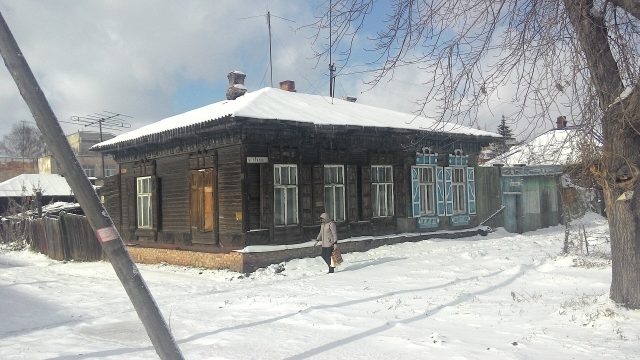
The Vrubel Museum of Fine Arts in Omsk is one of those rare places where art doesn’t just hang on the walls—it feels alive, as if it breathes in rhythm with the city itself. Housed in a historic mansion on Lenin Street, the building is a piece of history in its own right. Constructed in the late 19th century for a merchant named Batyushkin, it later became the property of the Plotnikov family, another prominent merchant dynasty. The architecture reflects the grandeur of Siberia’s urban past: soaring ceilings, intricate plasterwork, heavy wooden doors, and stained-glass windows that still filter soft, diffused light into the rooms. Stepping inside, you don’t feel the sterile hush of a typical museum. Instead, there’s a warmth, as if the walls remember the voices and footsteps of those who lived here over a century ago.
The museum bears the name of Mikhail Vrubel, though the artist never set foot in Omsk. His legacy, however, is deeply woven into the collection. Among the most significant works here is his preparatory sketch for the frescoes of St. Vladimir’s Cathedral in Kyiv, along with several of his graphic pieces. But Vrubel is just one thread in a much larger tapestry. The museum’s holdings span centuries of Russian and European art, from paintings and drawings to sculpture. Visitors can encounter works by Ivan Aivazovsky, Isaac Levitan, and Vasily Surikov, as well as pieces by the Peredvizhniki, the influential group of realist artists who broke away from academic traditions. A particularly strong section is devoted to Siberian art, showcasing works by local masters that capture the stark beauty of the region—its landscapes, its people, and the quiet resilience of life in the north.
The building itself is an architectural landmark, but its history is intertwined with that of Omsk. In the early 20th century, it served as the city hall, and after the revolution, it housed various Soviet institutions. During World War II, the mansion became a temporary home for the Institute of Oriental Studies, evacuated from Moscow, and later, a children’s art school. The museum only settled here in the 1950s, when its collection—assembled over decades—finally found a permanent home. Today, the exhibits go beyond paintings and sculptures. The museum also displays decorative and applied arts: porcelain, antique furniture, and old clocks, all of which transport visitors to another era.
This mansion on Lenin Street is more than just an exhibition space; it’s a place where art engages with the city. In summer, flowerbeds bloom outside, and in winter, a festive tree stands by the entrance. During warmer months, the courtyard often hosts small concerts and poetry readings. Inside, the atmosphere is one of quiet contemplation, broken only by the soft footsteps of visitors or the rustle of catalog pages. The layout encourages slow exploration, allowing you to wander from one hall to another, moving through time as you go. There are no pushy guides or blaring audio tours—just the art, the silence, and the unhurried passage of time.
The Vrubel Museum isn’t just about art; it’s about memory. Its collections tell the story of how artists’ perspectives evolved—from the rigid academicism of the 19th century to the bold experiments of the avant-garde. The Soviet-era works are particularly fascinating, revealing how art both reflected and resisted the ideologies of the time. Here, you’ll find official portraits of leaders alongside lyrical landscapes and once-forbidden or forgotten pieces. The museum doesn’t chase trends or sensationalism; it simply preserves what has become part of the country’s cultural DNA.
For Omsk, a city often seen as industrial or merely a transit point, the museum is something more—a haven of human thought, a place to pause and reflect. It hosts lectures, workshops, and artist talks, and in recent years, it has introduced interactive programs for children. Yet its greatest strength lies in its ability to remain a living institution, growing and adapting alongside the city. The collection expands, exhibitions change, but the essence of the place endures: thoughtful, unhurried, and quietly timeless.
A visit here is less about ticking off exhibits and more about immersing yourself in an atmosphere. The high ceilings and antique chandeliers make it easy to imagine the balls that once filled these rooms, the music that played, the debates about politics or art that unfolded. Today, the scene is different—no tailcoats or crinolines, just jeans and jackets, no waltzes, just the murmur of voices. But the connection to the past remains unbroken. The Vrubel Museum is a bridge between eras, a place where art doesn’t just hang on the walls but continues to live, reminding each visitor that beauty and meaning don’t vanish without a trace.