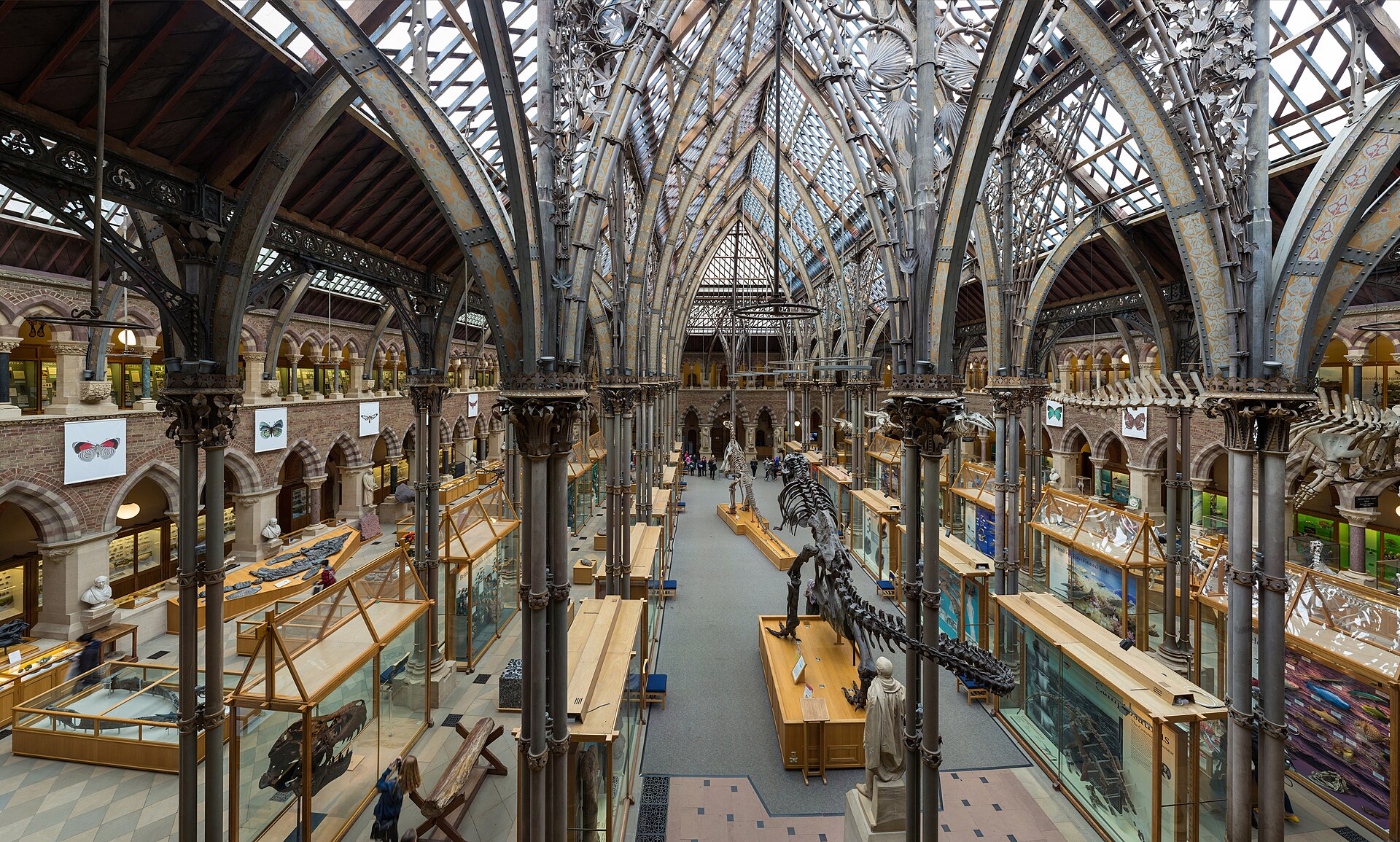
Oxford University Museum of Natural History is one of those rare places where the past isn’t just preserved—it breathes. The building itself is a testament to the Victorian era’s fascination with discovery, its soaring Gothic arches and intricate stonework designed to inspire awe. Walking through its doors feels like stepping into a cathedral of science, where every exhibit tells a story not just of nature, but of the people who sought to understand it.
The collections here have been gathered over centuries, and they reflect the evolution of scientific thought itself. Among the most striking displays are the dinosaur skeletons, including the remains of Megalosaurus, one of the first dinosaurs ever described. The museum also houses an extraordinary array of minerals, fossils, and specimens brought back from expeditions across the globe. Some of these items are tied to Oxford’s own history, like the work of Charles Darwin, whose time at the university shaped ideas that would later revolutionize biology.
What makes this museum different from others is its living connection to research. The collections aren’t just relics—they’re still actively studied by scientists and students. Visitors might catch glimpses of this work in progress, whether it’s a researcher examining a specimen under a microscope or a curator explaining a recent discovery. There’s a sense that the museum isn’t just a repository of knowledge, but a place where new knowledge is still being created.
The central hall is where the museum’s grandeur is most apparent. Light streams through the high windows, illuminating the towering skeletons of whales and other creatures suspended as if in mid-motion. Around them, glass cases display shimmering minerals and ancient fossils, each one a fragment of a world long gone. The space feels both vast and intimate, inviting visitors to linger and absorb the scale of natural history.
Beyond its scientific importance, the museum is deeply engaged with the public. Lectures, temporary exhibitions, and hands-on activities make it accessible to all ages. School groups often visit for interactive sessions where children can handle real fossils or learn about evolution through games. For families, it’s a chance to explore together, blending curiosity with education in a way that doesn’t feel like a lesson.
There’s a quiet magic to the place, too. Wandering through the galleries, it’s easy to imagine the debates and breakthroughs that once took place within these walls. The museum has been a hub of intellectual life for over 150 years, and that legacy lingers in the air. It’s not just a building full of objects—it’s a space where the spirit of inquiry is still very much alive.
What sets the Oxford University Museum of Natural History apart is its ability to make science feel personal. You don’t need to be a researcher to appreciate the wonder of a dinosaur’s bones or the intricate patterns of a crystal. The exhibits don’t just inform—they invite you to look closer, to ask questions, and to see the natural world through fresh eyes. In that sense, the museum isn’t just about the past. It’s a reminder that discovery is an ongoing journey, and that anyone can be part of it.