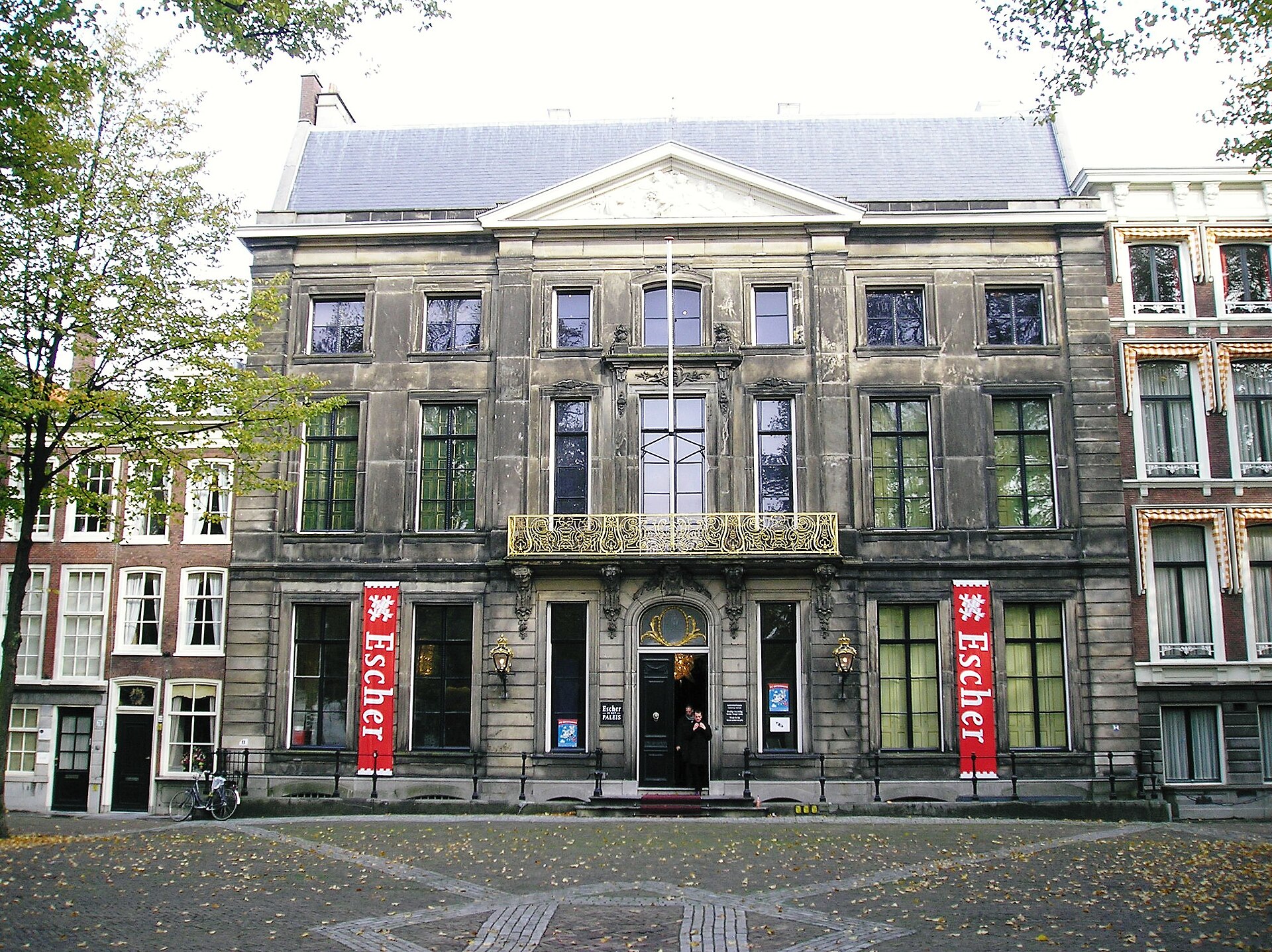
The Escher Museum in The Hague is where art and mathematics collide, bending reality into something entirely new. Housed in a former royal palace, this museum brings together the works of M.C. Escher, the Dutch artist whose prints and lithographs redefined the boundaries of perception. His images play tricks on the mind—stairs spiral into infinity, water flows upward, and hands draw themselves in an endless loop. Escher didn’t just manipulate perspective; he reinvented it, turning abstract concepts into tangible illusions that challenge the way we see the world.
The building itself is steeped in history. Once a residence for Dutch royalty, the palace on Lange Voorhout has stood for over three centuries. Its grand interiors, with their high ceilings, ornate moldings, and marble fireplaces, still carry the elegance of a bygone era. Yet as you ascend the staircase, the opulence of the past gives way to Escher’s universe, where logic and imagination intertwine in mesmerizing patterns. The contrast between the classical architecture and the surreal art it now holds makes the experience all the more striking.
The museum’s collection spans Escher’s entire career, from his early Italian landscapes to his later works dominated by geometric precision. Here, you’ll find iconic pieces like *Ascending and Descending*, where a never-ending staircase loops back on itself, and *Relativity*, where three gravitational forces coexist in a single space. His tessellations—endless mosaics of birds, fish, and other creatures—reveal an almost mathematical obsession with symmetry. Escher didn’t just create art; he built entire worlds where the rules of physics and perception no longer applied.
Despite the mathematical complexity of his work, Escher never considered himself a mathematician. He often spoke of his ideas coming to him intuitively, with calculations serving only as a means to bring them to life. The museum offers a glimpse into this process, displaying not just finished works but also sketches, notebooks, and preliminary studies. These materials show how simple lines and shapes evolved into the intricate compositions that would later define optical art. It’s a rare chance to see the artist’s mind at work, experimenting with form and perspective until the impossible became possible.
What makes the Escher Museum unique is its interactive approach. Visitors aren’t just passive observers—they can engage with the art in unexpected ways. There are installations where you can try creating your own optical illusions or navigate a mirror maze that distorts reality. In one room, optical devices demonstrate the principles behind Escher’s techniques, turning abstract theories into hands-on experiences. The museum blurs the line between art and play, inviting everyone to step into the artist’s world and see things differently.
The Hague was a fitting choice for this museum. The city has long been a hub for both art and science, home to masters like Vermeer and Rembrandt in the 17th century. Escher, though working in the 20th century, carried on this tradition, merging artistic skill with scientific curiosity. His work resonates across disciplines—mathematicians, architects, designers, and puzzle enthusiasts all find something in his creations. The museum bridges the gap between past and future, between rigid logic and boundless creativity, making it a place where different ways of thinking converge.
A visit to the Escher Museum leaves you with a lingering sense of wonder. It’s not just the dizzying array of impossible figures that stays with you, but the realization of how much more there is to discover in the world around us. Escher’s art reveals layers of reality we often overlook, making the invisible visible. There’s always something new to notice, even in familiar works—another detail, another connection, another puzzle to unravel. That’s why the museum remains one of The Hague’s most intriguing and unforgettable destinations. It doesn’t just show you art; it changes the way you see.