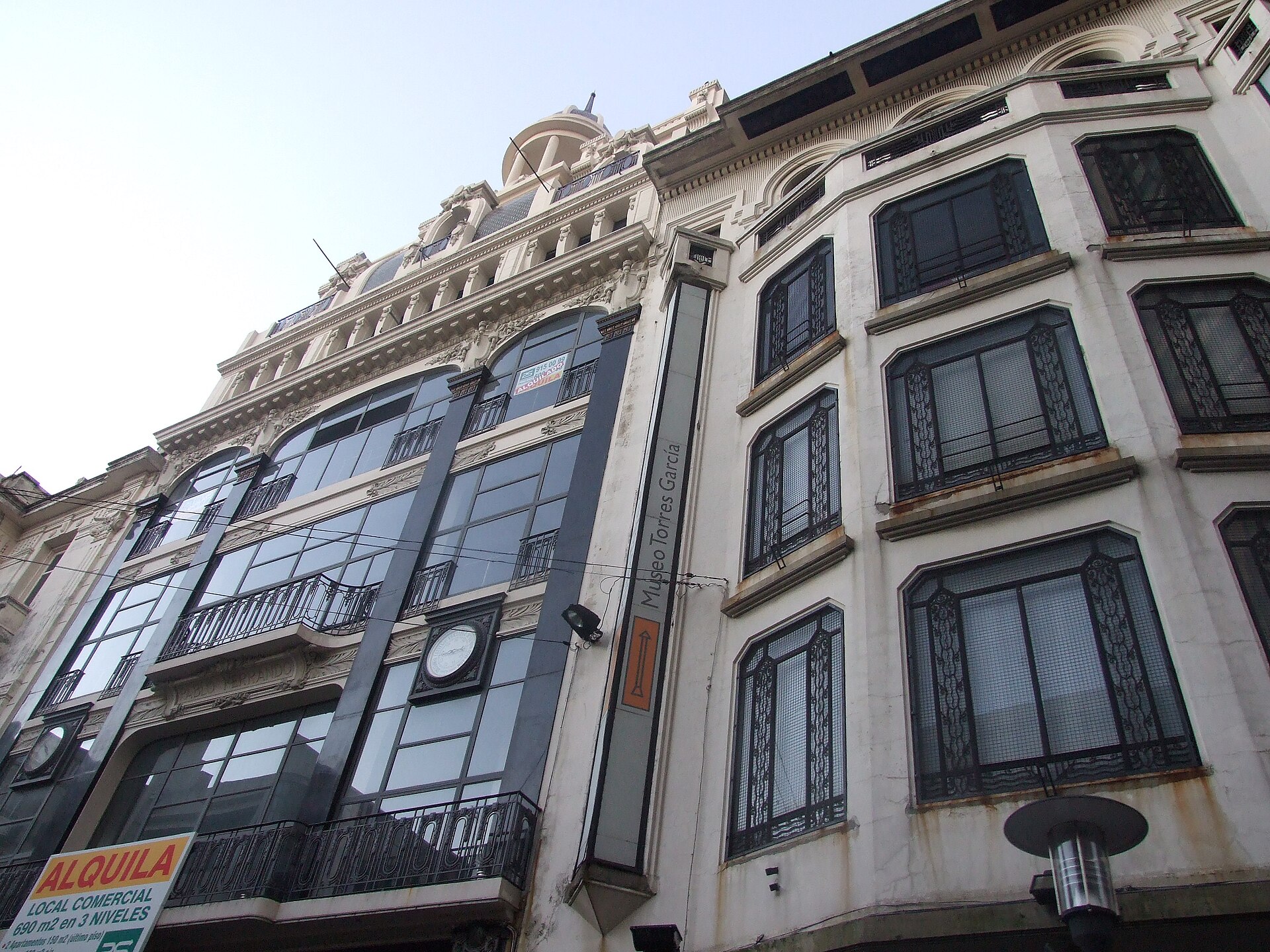
The Torres García Museum stands in a historic mansion in Ciudad Vieja. Its worn stone and creaking floors hold sketches, paintings, and sculptures by Joaquín Torres García. He didn’t just work in Uruguay—he redefined its creative voice, leaving behind a legacy that spread across Latin America.
Born in Montevideo in 1874, Torres García spent decades in Europe. He moved among Picasso and Miró, absorbing modernism’s radical ideas. When he returned in 1934, he brought Constructive Universalism—a philosophy blending geometric abstraction with pre-Columbian symbolism. His paintings look like puzzles: a sun, a fish, a grid. Each mark is deliberate, stripped of ornament. Every shape carries meaning, whether spiritual, philosophical, or simply visual.
The building itself tells a story. Built in the early 20th century, it has high ceilings, exposed wooden beams, and a quiet courtyard where light filters through a single tree. Once a wealthy family’s home, today it feels like an artist’s studio paused mid-thought. The walls hold finished works alongside rough sketches, letters, and photographs. The library is filled with books and journals that shaped his thinking—some annotated in his own hand.
Torres García’s influence extends beyond his own work. His sons, Augusto and Horacio, carried forward his teachings. So did other artists who adopted Constructive Universalism after his death. The collection shows how one vision evolved, splintered, and took new forms. At first glance, the works seem uniform. Look closer, and you’ll see shifts in technique, material, and philosophy. Some pieces follow his ideas directly. Others challenge them.
He wasn’t just a painter. He designed furniture, created mosaics, and drafted murals for public buildings—some still visible in Montevideo today. The museum preserves sketches for these projects. One of his most visible legacies is the mosaic panels in the city’s municipal building. Seeing these studies alongside finished works makes one thing clear: for Torres García, art wasn’t meant to be admired from afar. It was meant to be part of daily life.
Here, you don’t just observe. You step into a way of thinking. There are no ropes keeping you at a distance. Stand inches from the canvases. Notice how the paint thickens in some places, thins in others. The space invites slow looking—details emerge over time.
The museum also hosts temporary exhibitions, lectures, and workshops. These explore Uruguay’s broader artistic history, the dialogue between Europe and Latin America, or how his ideas connect with contemporary artists. They prove his work isn’t just historical. It’s still alive.
Torres García was part of a generation that proved Uruguay could carve its own creative path. His work was controversial—some saw it as visionary, others as too abstract. That tension keeps the museum vital. It’s not a shrine. It’s a place where ideas are still debated, where art keeps evolving.
Montevideo doesn’t shout about its cultural treasures. The Torres García Museum is no exception. No grand entrance, no crowds. Just quiet. After a visit, you might start noticing his influence elsewhere in the city: a sidewalk mosaic, a mural’s bold lines, an old building’s clean geometry. Suddenly, Montevideo reveals itself differently. Art isn’t just displayed here. It’s woven into daily life.