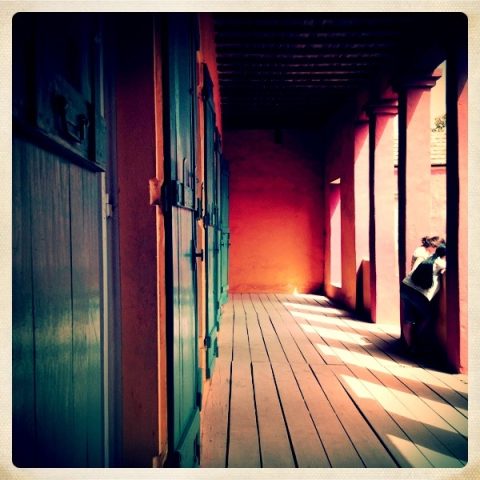
The Musée de la Mer on Gorée Island is one of those rare places where history isn’t just preserved behind glass—it lingers in the very walls, in the salt-stained air, in the way the light falls through the high windows. Housed in a 19th-century building that once served as a warehouse and later a barracks for French soldiers, the museum is as much a part of Gorée’s layered past as the exhibits it contains. The island itself, a small speck off the coast of Dakar, carries the weight of centuries—once a hub of the transatlantic slave trade, now a quiet reminder of Senegal’s deep and often painful ties to the sea. The museum doesn’t shy away from this context, but it frames the ocean as something more than a backdrop to tragedy. Here, the sea is a witness, a provider, and a force that has shaped everything from daily life to global trade.
The building itself is a study in colonial architecture, its thick stone walls and heavy wooden beams built to withstand both time and the elements. Inside, the space is uncluttered, almost austere. There are no flashy displays or interactive screens—just a handful of rooms where artifacts rest under glass, accompanied by photographs, maps, and the occasional handwritten note. The simplicity isn’t a flaw; it’s an invitation to slow down, to look closer. The high ceilings and wide doorways, designed for practicality rather than grandeur, create a sense of openness, as if the museum is breathing in the same air as the island outside.
The exhibits are organized around a few key themes, each one a thread in the larger story of Senegal’s relationship with the ocean. One room is dedicated to the traditional fishing boats known as pirogues—slender, hand-carved vessels still used by local fishermen today. Painted in bold stripes of blue, red, and yellow, these boats are more than tools; they’re a living tradition, passed down through generations. Nearby, nets, harpoons, and woven baskets offer a glimpse into the rhythms of coastal life, where the day’s catch dictates everything from meals to markets. Another section focuses on marine life, with shells, coral, and taxidermied fish lining the shelves. For many visitors, it’s the first real introduction to the biodiversity of the Atlantic off West Africa—a world that’s vast and vibrant but rarely seen beyond these shores.
A separate gallery traces the history of seafaring in the region, from the early days of European exploration to the bustling trade routes of the 18th and 19th centuries. Old navigational instruments, yellowed maps, and logbooks tell the story of ships that once crisscrossed the Atlantic, carrying goods—and people—between continents. A particularly striking display features artifacts salvaged from shipwrecks: coins, pottery, even fragments of hulls, their edges worn smooth by time. These objects hint at Gorée’s role as a crossroads, a place where cultures collided and commerce thrived, even as darker chapters unfolded. The museum doesn’t dwell on the horrors of the slave trade, but it doesn’t ignore them either. Instead, it presents the sea as a space of contradiction—both a path to freedom and a route to suffering, a source of livelihood and a force of destruction.
Beyond its permanent collection, the museum occasionally hosts temporary exhibitions that tackle contemporary issues, like plastic pollution or the decline of fish populations due to overfishing. These topics aren’t abstract here; they’re urgent, tied to the survival of communities that depend on the ocean. Senegal’s fishing industry remains a cornerstone of the economy, and the museum serves as a quiet advocate for sustainability, bridging the gap between past and present. It’s not just about preserving history—it’s about asking what comes next, how people and the sea can coexist in a way that doesn’t deplete either.
A visit to the Musée de la Mer is best paired with a walk around Gorée itself. The island is small enough to explore in an afternoon, but its history is dense, layered into every cobblestone and crumbling fort. After leaving the museum, it’s worth climbing to the highest point on the island, where the view stretches across the water to Dakar’s skyline. Below, the waves lap against the shore, and the scent of salt and fish hangs in the air—a reminder that the ocean isn’t just a backdrop here, but a living, breathing part of daily life. Back at the docks, pirogues bob in the water, their bright colors fading in the sunlight, while fishermen mend their nets and children play along the shore. The museum doesn’t just show you these scenes; it gives them context, turning a simple walk into a conversation with the past.
What makes the Musée de la Mer special isn’t its size or its grandeur, but its honesty. There are no crowds, no guided tours rushing you along, no pressure to buy souvenirs. You can wander the halls at your own pace, reading the labels or simply sitting on a bench to take it all in. When you step back outside, the island feels different—not just because you’ve learned something new, but because the museum has a way of making the familiar strange again. The fishermen, the boats, the endless horizon—they’re not just part of the scenery anymore. They’re part of a story, one that’s still being written. And that, in the end, might be the museum’s greatest achievement: it doesn’t just preserve the past. It shows how the past is still here, in the salt on your skin and the sound of the waves.