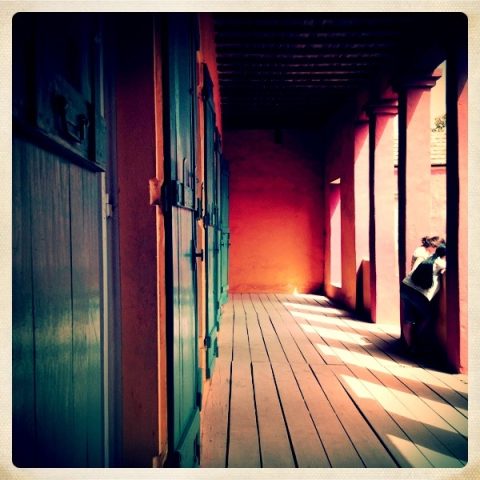
Perched on a rocky outcrop overlooking the Atlantic, Fort d’Estrées feels like a place time forgot. Built in the late 17th century by the French, it was one of several coastal fortifications meant to secure their foothold in Senegal, though its role was as much about trade as it was about defense. The fort never saw the kind of dramatic sieges or battles that define so many colonial strongholds, but its walls have witnessed the slow, grinding shifts of power—from the slave trade to the eventual decline of French influence in West Africa. Today, the structure stands as a quiet monument to that complicated past, its weathered stone and rusted cannons speaking more of endurance than conquest.
The architecture is unmistakably military, yet there’s a certain elegance to its simplicity. Thick, whitewashed walls rise from the jagged cliffs, their corners reinforced with bastions that once bristled with artillery. The main gate, though now worn by salt and wind, still bears the faint outline of the royal crest, a reminder of the distant authority that once commanded this remote outpost. Inside, the courtyard is open to the sky, its uneven stones polished smooth by centuries of footsteps. The barracks and storerooms, though empty, hint at the daily rhythms of life here—soldiers drilling, merchants haggling over goods, the clatter of wooden wheels on cobblestones.
What makes Fort d’Estrées unusual is how little it was altered over the centuries. Unlike many forts that were expanded or repurposed, this one remained largely as it was built, a relic of a specific moment in history. The French abandoned it in the 19th century, and for decades it stood neglected, its cannons sinking into the earth, its walls crumbling at the edges. Locals sometimes used it as shelter or a landmark, but it never became a ruin in the romantic sense—just a place that was slowly reclaimed by the landscape. When restoration efforts began in the late 20th century, the goal wasn’t to rebuild it into something grand, but to stabilize what was left, preserving the layers of wear and decay that tell its story.
The fort’s location is as much a part of its character as its walls. Mount Gora is a small, sleepy town, more fishing village than tourist hub, and the fort sits at its highest point, where the land drops sharply into the ocean. The views from the ramparts are vast—endless blue water to the west, the curve of the coastline to the south, and the patchwork of red-roofed houses and dusty streets below. On clear days, you can see all the way to the distant hump of Goree Island, another relic of Senegal’s colonial past. The wind here is constant, carrying the scent of salt and fish, and the sound of waves crashing against the rocks below.
There’s a melancholy to Fort d’Estrées that’s hard to shake. It’s not the kind of place that dazzles with grandeur or overwhelms with history; instead, it invites quiet reflection. The cannons, now silent, point out to sea as if still waiting for ships that will never come. The empty rooms echo with the absence of the people who once filled them—soldiers, traders, perhaps even enslaved Africans held here briefly before being shipped across the Atlantic. The fort doesn’t glorify that past, nor does it offer easy answers. It simply stands, a witness to the complexities of power, trade, and survival.
For visitors, the fort is less about spectacle and more about atmosphere. There are no guided tours or audio exhibits, just the open space and the stories it suggests. You can wander the ramparts at your own pace, tracing the lines of the walls with your fingers, or sit in the shade of the old gatehouse and watch the fishing boats bob in the harbor below. The lack of crowds makes it feel like a discovery, a place where you can step out of time for a little while. In the late afternoon, when the light turns golden and the shadows stretch long, the fort takes on a different mood—less a monument, more a part of the land itself.
It’s worth noting that Fort d’Estrées isn’t a destination in the traditional sense. There are no souvenir stalls or cafes nearby, no grand museums to visit afterward. Mount Gora itself is a place where life moves at its own unhurried pace, where the rhythm of the tides dictates the day. The fort is just one piece of that, a quiet counterpoint to the bustle of Dakar or the tourist circuits of Saint-Louis. For those who make the journey, it offers something rare: a chance to engage with history on its own terms, without the filter of interpretation or the pressure of expectation.
If you do visit, come with a sense of curiosity rather than a checklist. The fort doesn’t reveal itself all at once. It’s the kind of place where the details matter—the way the light catches the rust on a cannon, the sound of the wind whistling through the embrasures, the way the stones warm under your palm. It’s also a place that rewards patience. Sit for a while, and you might notice the way the fishermen below mend their nets, or how the children from the town use the fort’s outer walls as a shortcut on their way home from school. These small, everyday moments are as much a part of its story as the grand narratives of empire and trade.
In the end, Fort d’Estrées is what you make of it. For some, it’s a footnote in the history of colonialism, a reminder of the forces that shaped Senegal. For others, it’s a place of quiet beauty, where the past and present coexist without fanfare. And for the people of Mount Gora, it’s simply part of the landscape, a familiar landmark that has stood watch over their town for generations. Whatever brings you here, it’s the kind of place that lingers in the mind long after you’ve left, not because of what it is, but because of what it makes you feel.