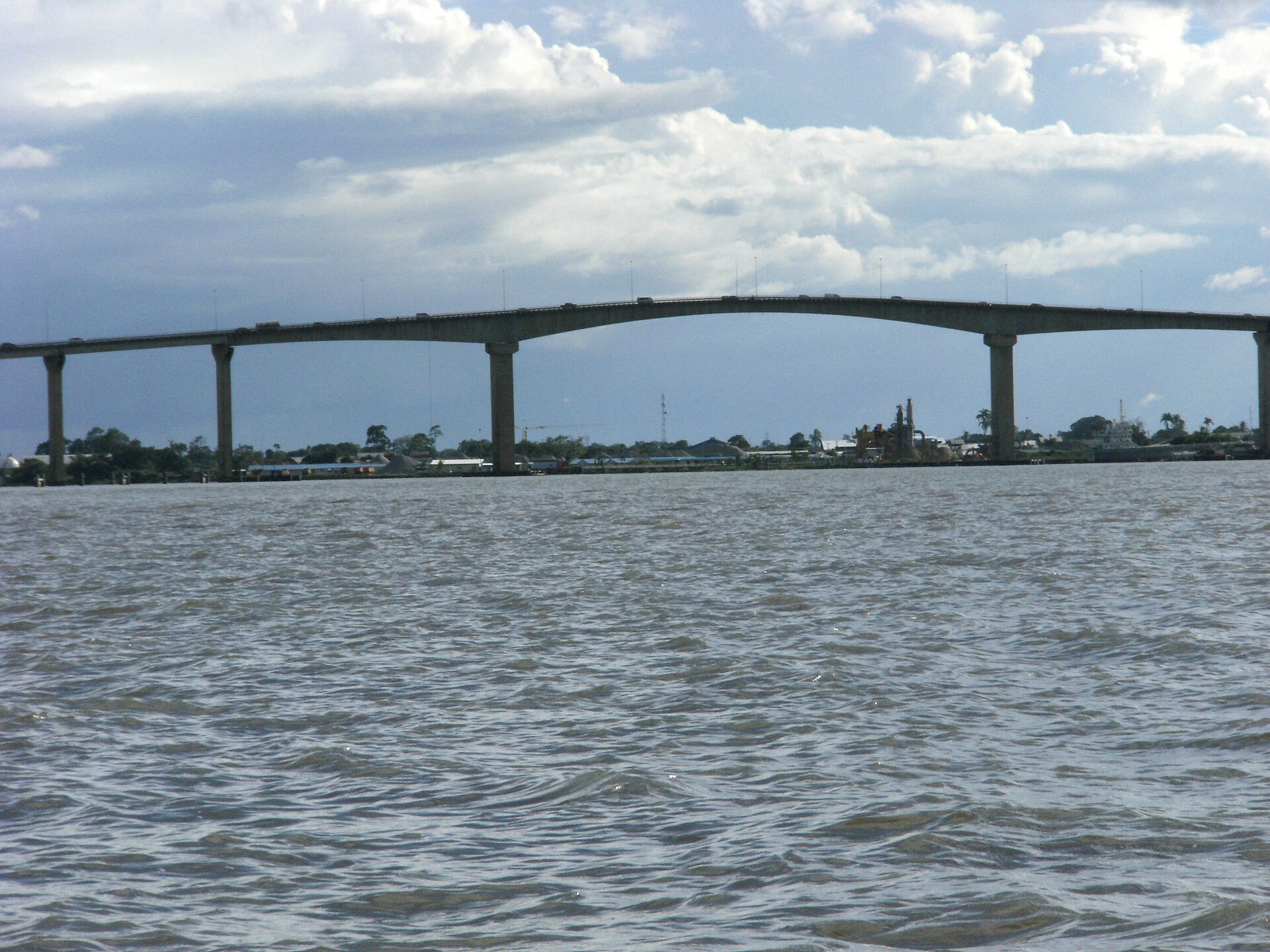
The Jules Wijdenbosch Bridge stretches across the Suriname River like a quiet giant, connecting Paramaribo to the district of Commewijne. It’s not just a way to cross the water—it’s one of the few modern landmarks in a country where nature still sets the pace. Completed in 2000, the bridge was named after the president who commissioned it, a man whose name now lingers in the air every time someone drives over its length. At nearly two kilometers, it’s the longest bridge in Suriname, and for many, it’s the first real glimpse of the capital when arriving from the east.
Before this bridge existed, the only way to cross the river was by ferry, a slow and unpredictable journey that could take hours depending on the weather or the mood of the currents. The ferry still runs, of course, but now it shares the river with this steel and concrete span, its towers rising like sentinels over the water. The bridge was built by a Dutch construction firm, a nod to Suriname’s colonial past, though the design is purely functional—no grand arches or decorative flourishes, just a straightforward structure built to last.
Standing on the bridge, you can feel the weight of the river below. The Suriname is wide here, its brown waters carrying sediment from the interior, where the rainforest slowly gives way to the coast. On a clear day, the view upstream is all greenery and distant hills, while downstream, the river widens into an estuary before meeting the Atlantic. The bridge itself is a study in contrasts: the hum of cars and motorcycles overhead, the occasional fisherman casting a line from the bank, and the ever-present heat, thick and unrelenting, even in the shade of the bridge’s pillars.
For locals, the bridge is more than infrastructure. It’s a symbol of connection, a way to reach family, markets, or jobs on the other side without relying on the ferry’s schedule. Before it was built, the districts of Commewijne and Paramaribo might as well have been worlds apart. Now, the drive takes less than ten minutes, and the bridge has become part of daily life—so much so that people rarely stop to admire it. It’s just there, like the river itself, a constant presence in the background of Suriname’s rhythm.
The bridge also tells a story of Suriname’s relationship with the outside world. The funding and engineering came from abroad, a reminder of how small countries often rely on larger ones for major projects. Yet the bridge is unmistakably Surinamese in its purpose, serving a population that moves between tradition and modernity. The villages on either side are a mix of old wooden houses, rice fields, and newer concrete buildings, all tied together by this single stretch of road.
At night, the bridge lights up, its lamps casting a soft glow over the water. The reflection shimmers in the current, and the hum of traffic fades into the sounds of the riverbank—frogs, insects, the occasional boat engine. It’s a different place after dark, quieter, almost serene. The heat lingers, but the air feels lighter, as if the day’s weight has been lifted with the setting sun.
There’s something almost poetic about a bridge in a country like Suriname. It’s a man-made structure cutting through a landscape that has remained largely unchanged for centuries. The rainforest, the river, the villages—they all existed long before the bridge, and they’ll exist long after. But for now, the Jules Wijdenbosch Bridge stands as a reminder of what connects us, not just in terms of roads and rivers, but in the way people move through the world. It’s not a tourist attraction in the traditional sense, but it’s the kind of place that makes you pause, if only for a moment, to consider the quiet significance of something so ordinary.