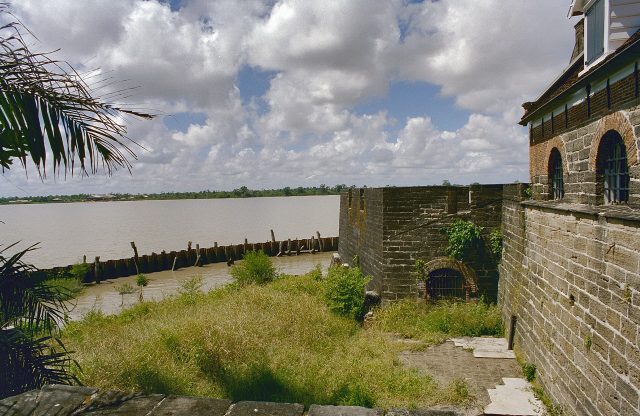
The Reformed Church in Meerzorg is one of those quiet places that doesn’t demand attention but lingers in the mind long after you’ve left. Perched on a gentle rise, it’s surrounded by the low, brightly painted houses typical of Surinamese towns, their colors softened by time and sun. The church itself is modest in size, its clean lines and unassuming spire giving it a quiet dignity, as if it holds not just the memories of its congregation but the very essence of the town that grew up around it.
Meerzorg’s history is woven into the broader colonial past of Suriname. Founded in the 18th century, it was one of the earliest Dutch settlements in the region, and the church arrived with the European colonists who shaped its early years. Back then, Suriname was part of Dutch Guiana, and Protestant communities played a central role in the lives of the settlers. Unlike the grand cathedrals of Europe, the Reformed Church in Meerzorg was built for practicality, reflecting the needs of a small, close-knit community. Its walls have witnessed generations come and go, wars, the abolition of slavery, and the gradual emergence of the multicultural society Suriname is today.
The church’s architecture is unmistakably Dutch Protestant, simple and functional. A single nave with high windows lets in a soft, diffused light, while the wooden roof—once likely tiled—adds to the building’s understated charm. The facade is free of ornamentation, just clean symmetry and restraint. Inside, there’s little to distract: wooden pews, a modest altar, a pulpit. The space feels calm, almost meditative, as if inviting visitors to leave the outside world behind for a moment.
Meerzorg itself is an unassuming town with a quiet character. Just a short distance from Paramaribo, Suriname’s capital, it was once an important agricultural hub, where sugar cane and coffee were cultivated. Today, it retains the rhythm of a small provincial place. The streets are quiet, houses often hidden behind gardens, and the locals are friendly without being intrusive. The church isn’t just a place of worship here—it’s part of the everyday fabric of life, like the old tree in the square or the fruit stand by the road. On Sundays, its doors open for services, but on weekdays, it stands silently, watching the town change around it.
Suriname is a country where cultures, religions, and traditions intertwine, and Meerzorg is a microcosm of that diversity. Descendants of enslaved Africans, Indian and Javanese immigrants, Indigenous peoples, and more recent arrivals from Europe and China all call this place home. The Reformed Church is just one of many religious communities in the town, but its history offers a glimpse into how Suriname’s unique society took shape. Nearby, you’ll find mosques, Hindu temples, and Catholic churches, each telling their own part of the country’s story.
Visiting the church isn’t about ticking off a tourist attraction—it’s about experiencing the pace of life in Meerzorg. The town doesn’t try to impress visitors, and that’s its charm. There are no crowds, no souvenir shops, no pushy guides. You can wander the streets, step inside the church if it’s open, and then sit down for a coffee at a small café nearby. The locals won’t stare—they’re used to life moving at its own unhurried pace.
In recent years, Suriname has begun to explore tourism more seriously, though cautiously. The country draws those who seek nature—jungles, waterfalls, wildlife—but its towns have their own appeal. Meerzorg, small as it is, offers a glimpse of Surinamese life beyond the capital. There are no luxury hotels or bustling restaurants, just the chance to see how people live away from the usual tourist trails.
The Reformed Church in Meerzorg isn’t just a building—it’s a living piece of history. It has endured wars, economic shifts, and social change, yet it remains, a quiet witness to time. Perhaps that’s its greatest value: it doesn’t try to amaze or overwhelm, but simply exists, a reminder that even in a fast-changing world, there are places where time seems to stand still. If you ever find yourself in Suriname, it’s worth making the short trip to Meerzorg to see it for yourself.