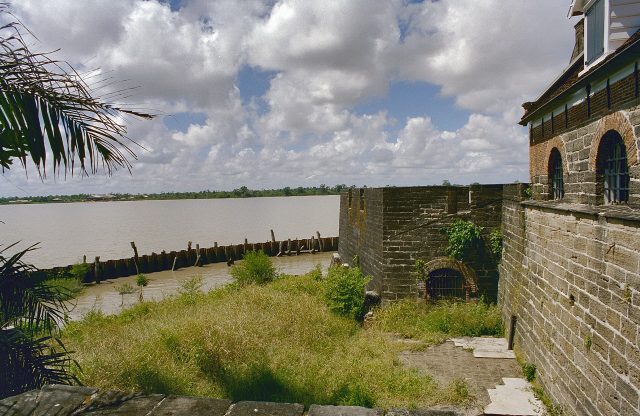
Goslar is one of those rare places where the past lingers in the air like a quiet, unshaken presence. Tucked along the Suriname River near Meerzorg, this former plantation complex feels suspended in time, its crumbling structures bearing witness to an era when sugar and labor shaped the country’s economy. There are no grand restorations here, no polished tourist attractions—just the slow decay of history, left to speak for itself. The ruins stand as they have for decades, their weathered walls and overgrown paths telling a story that is both ordinary and extraordinary in its honesty.
The first thing that strikes you is the sheer scale of the industrial buildings. These were not delicate constructions but robust, functional structures designed to withstand the demands of sugar production. Their thick stone walls, now cracked and streaked with moss, were built to last, and in a way, they still do. Nearby, the remains of workers’ quarters offer a glimpse into the lives of those who once lived here. The buildings are modest, almost austere, with little ornamentation—just bare necessities for people whose days were defined by labor. There’s no romanticizing the past in these ruins; they show life as it was: hard, repetitive, and tightly controlled.
At the heart of Goslar lies the old sugar mill, its skeletal remains a testament to Suriname’s colonial economy. Sugar was the lifeblood of the country’s trade, and mills like this one operated at full capacity, processing cane into raw sugar bound for European markets. Today, the machinery is long gone, but if you look closely, you can still make out the outlines of boilers, pipes, and crushing equipment, their forms softened by time and vegetation. Nature has begun to reclaim the site, with trees pushing through concrete and vines curling around rusted metal. It’s a quiet reminder of how fleeting human industry can be when left to the elements.
The history of Goslar is inseparable from the darker chapters of Suriname’s past. During the 18th and 19th centuries, hundreds of enslaved Africans were brought here to work the plantations under brutal conditions. Their labor fueled the colony’s prosperity, yet their stories were rarely recorded. Today, there are no plaques or memorials to mark their presence, but the land itself carries their memory. Walking through the ruins, it’s impossible not to think about the lives that unfolded here—the backbreaking work, the resistance, the quiet moments of humanity in an inhumane system. Goslar doesn’t offer easy answers, but it doesn’t shy away from the weight of its history either.
What makes Goslar unusual is its lack of commercialization. There are no souvenir stands, no guided tours, no crowds. It’s just the ruins, the river, and the surrounding jungle, which has slowly begun to envelop the site. The silence is broken only by the occasional call of a bird or the rustle of leaves in the wind. For those who venture here, it’s a chance to experience history without filters—no curated narratives, no polished presentations, just the raw, unvarnished past. The absence of modern distractions makes it easier to imagine what this place might have been like in its prime, when the air was thick with the scent of cane and the sound of machinery.
Despite its abandonment, Goslar doesn’t feel like a dead place. There’s a sense of continuity here, as if the past and present exist side by side. The ruins haven’t been demolished or repurposed; they’ve simply been left to fade, becoming part of the landscape in the process. Locals sometimes visit, whether to reflect on their heritage or simply to find solitude in a place where time moves differently. For outsiders, it’s a rare opportunity to step outside the usual tourist experience and engage with history on its own terms.
Goslar is a place for those who seek more than just pretty sights. It offers a tangible connection to Suriname’s colonial past, revealing the scale of plantation life and the forces that shaped the country’s development. But it also prompts larger questions about progress and loss. Two centuries ago, this was a thriving economic hub; today, it’s a relic. The contrast is stark, yet it’s a reminder of how quickly the world changes—and how some places resist being forgotten. Goslar doesn’t demand admiration; it simply exists, inviting visitors to draw their own conclusions.
A visit here isn’t about ticking off a landmark or snapping the perfect photo. It’s about wandering through the remnants of a vanished world and letting the silence fill in the gaps. Without signs or guides, interpretation is left to the visitor. You might focus on the architecture, tracing the outlines of the old mill, or you might find yourself thinking about the people who once walked these paths. Either way, Goslar leaves an impression—not because of what it once was, but because of what it still is: a quiet, unassuming witness to history. In a world that moves too fast, places like this offer a chance to pause and listen to the echoes of the past.