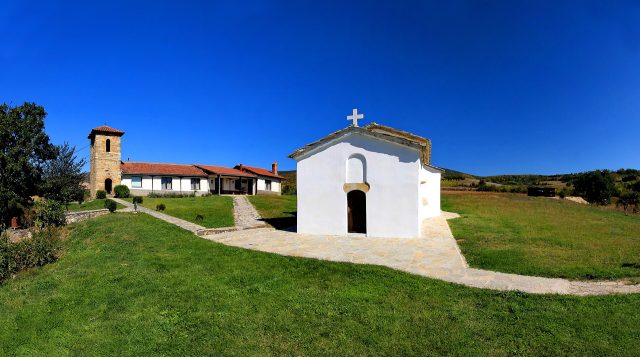
Perched on a quiet hillside near the town of Orahovac in western Kosovo, Zočište Monastery is one of those places that feels untouched by time. It doesn’t appear on most tourist maps, and you won’t find crowds here—just the rustling of leaves, the distant call of birds, and the kind of stillness that makes you slow your steps without thinking. The monastery sits surrounded by low mountains and dense forests, a secluded spot that has drawn pilgrims and wanderers for centuries, not for spectacle, but for something harder to name: a sense of continuity, a quiet resistance to the noise of the world.
The exact origins of Zočište are lost to history, though most scholars agree it dates back to the 14th century, a time when the Serbian Empire was at its height and Orthodox monasteries dotted the landscape. This was an era of ambitious church-building, when rulers like Stefan Dušan sought to leave their mark through stone and fresco. Zočište was one of many, yet it endured where others did not. The monastery’s small, single-nave church follows the architectural traditions of the period—thick walls, a modest dome, narrow windows designed more for defense than for light. Inside, fragments of frescoes remain, their colors faded but their presence still powerful. They depict saints and biblical scenes in the stylized manner of the time, though much has been worn away by neglect and the passage of centuries.
Like so many religious sites in the Balkans, Zočište has seen its share of upheaval. The Ottoman conquest brought destruction to countless churches and monasteries, either through deliberate demolition or gradual repurposing. Zočište survived, but not unscathed. Its original form was altered, its purpose sometimes obscured. In the 19th century, during a period of Serbian national revival, the monastery underwent restoration, only to face new threats in the 20th century. War, displacement, and the shifting borders of empires left their marks here, as they did across the region. Yet the monastery persisted, a quiet witness to the ebb and flow of history.
Today, Zočište remains an active place of worship, though the monastic community is small. The church itself is unassuming—no grand facades or towering spires, just a sturdy stone structure that has weathered storms both literal and metaphorical. Inside, the air is cool and dim, the scent of candle wax mingling with the faint mustiness of old stone. The most revered object here is an icon of the Virgin Mary, said to possess miraculous properties. Whether or not one believes in such things, the icon’s presence is undeniable, drawing visitors who come not just to see, but to touch, to pray, to feel something beyond the ordinary.
Beyond the church, a small cemetery sprawls across the hillside. The gravestones, some dating back hundreds of years, are worn smooth by time, their inscriptions barely legible beneath layers of moss and lichen. A few newer markers stand among them, a reminder that this place is still very much alive. The cemetery is quiet, almost intimate, a space where the past feels close enough to reach out and touch. It’s easy to imagine the generations of monks, villagers, and pilgrims who have walked these paths, each leaving their own mark in ways both seen and unseen.
The landscape around Zočište is as much a part of its story as the monastery itself. The hills roll gently, covered in oak and beech trees that shift color with the seasons. Small streams cut through the valleys, their waters clear and cold. From the higher ground near the monastery, the view opens up to the surrounding countryside—a patchwork of fields, villages, and distant ridges. There’s a sense of timelessness here, as if the land itself has absorbed the weight of history and now carries it lightly.
For those who make the journey, Zočište offers more than just a glimpse into the past. It’s a place where the layers of history feel tangible, where the quiet hum of daily life in a monastery blends with the echoes of centuries gone by. The road to get here isn’t easy—narrow, winding, sometimes little more than a dirt track—but that only adds to the sense of discovery. There are no gift shops, no guided tours, no signs urging you to hurry. Just the monastery, the land, and the stories they hold.
What makes Zočište special isn’t its grandeur or its fame, but its stubborn persistence. It has survived wars, empires, and the slow erosion of time, yet it remains a living place, not a relic. For the people of Orahovac and the surrounding villages, it’s a symbol of something enduring—a connection to the past, a quiet defiance in the face of change. For visitors, it’s a chance to step off the well-trodden path and experience a side of Kosovo that few outsiders see. In a region often defined by its conflicts, Zočište stands as a reminder that history is never just one thing. It’s made up of countless small moments, quiet acts of faith, and the slow, steady work of people who refuse to let the past fade away.