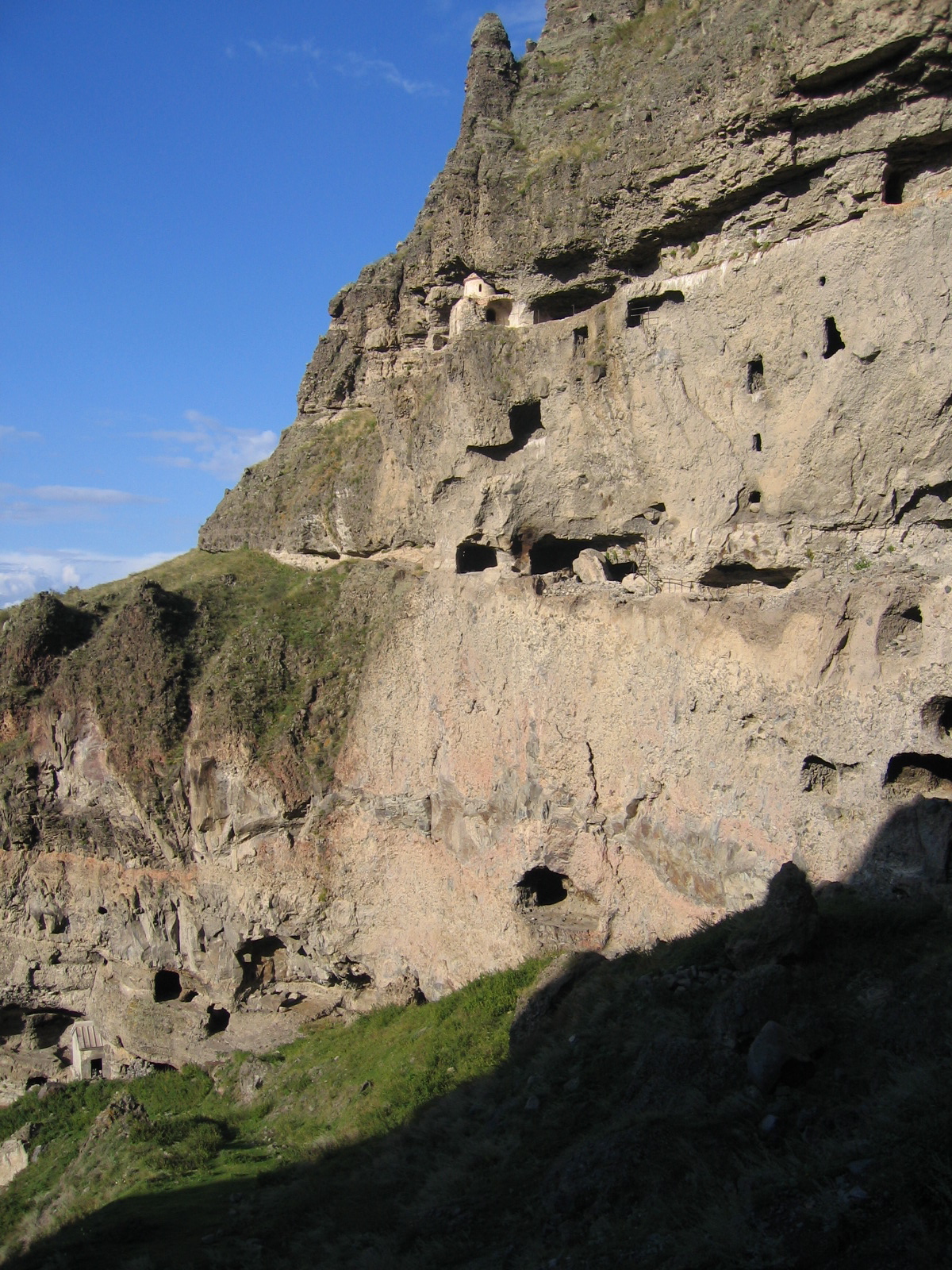
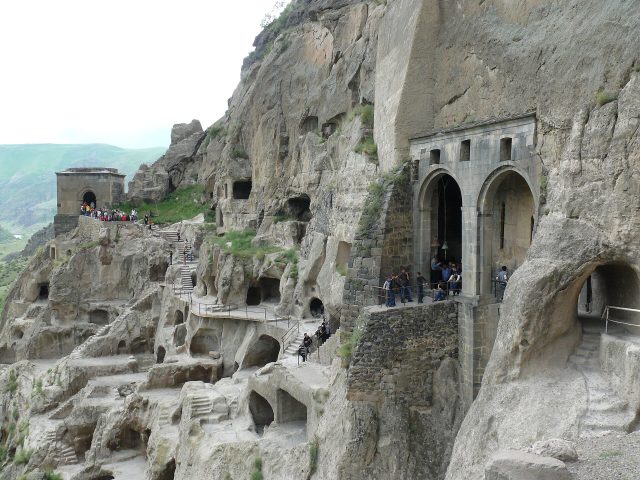
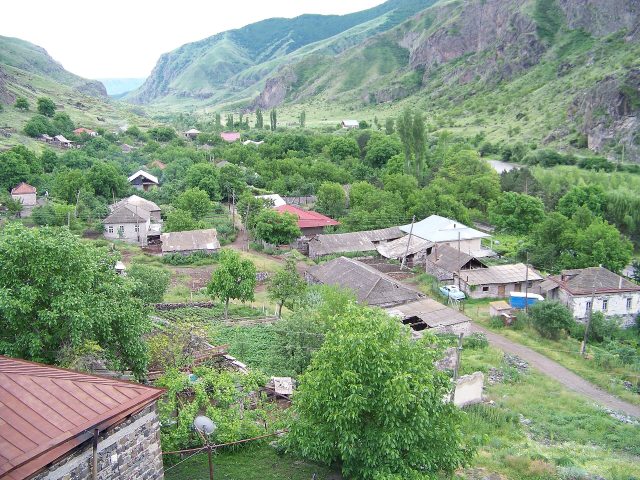
Perched in the dramatic gorge of the Kura River, not far from the small Georgian town of Aspindza, Vani’s Kvabebi Monastery feels like a secret carved into the cliffs. It doesn’t announce itself with grand facades or golden domes. Instead, its stone walls and towers rise almost organically from the rock, as if the mountain itself had grown tired of waiting and decided to build a sanctuary. The road here winds along a narrow ridge, offering glimpses of the valley below, where the river cuts through sheer banks and the distant peaks of the Lesser Caucasus stand guard under a shifting sky. It’s the kind of place where you can almost hear the echoes of medieval travelers—pilgrims, soldiers, and monks—making their way up the steep paths, drawn by the promise of refuge behind those formidable walls.
The story of Vani’s Kvabebi begins in the 8th century, a time when Georgia was still forging its identity as a Christian nation. The region was a crossroads of empires, constantly threatened by Arab invasions, later by Seljuk raids, and eventually by Mongol hordes. The monastery wasn’t just a spiritual retreat; it was a fortress, designed to withstand sieges that could last for months. Its walls and towers were built to endure, and they did. By the 13th century, under the reign of Queen Tamar—one of Georgia’s most celebrated rulers—the monastery flourished. Many of the structures that survive today, including the main church and the labyrinth of underground passages, date back to this golden age.
The architecture here is unmistakably medieval Georgian, yet it carries its own quiet peculiarities. The main church, dedicated to the Dormition of the Mother of God, is constructed from pale stone that glows warmly in the sunlight, as if lit from within. Inside, fragments of frescoes still cling to the walls, though time and neglect have blurred their details. The real strength of the place, though, lies in its fortifications—thick walls punctuated by arrow slits, watchtowers that once scanned the horizon for approaching danger. One of these towers is said to have been commissioned by Queen Tamar herself, though historians still debate the truth of that legend. What’s undeniable is the sense of purpose in every stone, a reminder that this was as much a military outpost as it was a house of prayer.
Beneath the monastery, a network of caves and tunnels stretches into the rock. These weren’t just hiding places; they were lifelines. During attacks, monks could retreat into the depths, where passages led to hidden water sources and storerooms stocked with supplies. Some tunnels even opened near the river, ensuring that those inside could endure the longest sieges. Today, parts of this underground world are accessible, though exploring them requires caution. The steps are worn smooth by centuries of use, and there’s no artificial light to guide the way. But it’s here, in the cool darkness, that the past feels closest. The air is thick with the weight of history, and every uneven surface seems to whisper stories of those who once sought shelter within these walls.
Vani’s Kvabebi is deeply woven into Georgia’s struggle for survival. In the 14th century, it became a stronghold against Mongol forces, and later, as the Ottoman Empire expanded, it stood as a defiant symbol of Georgian resistance. Even after the monastery lost its military importance, it remained a place of pilgrimage, its stones bearing silent witness to the rise and fall of kingdoms. The faded inscriptions on its walls are like footnotes to a larger story—one of faith, war, and the unyielding desire to preserve a culture against all odds.
Nowadays, the monastery is a quiet place, far from the well-trodden tourist paths. There are no souvenir stalls or guided tours here, just the wind rustling through the gorge and the distant murmur of the river below. Restoration work is underway, but it’s done carefully, with an eye toward preserving the site’s raw authenticity. Locals still treat Vani’s Kvabebi with reverence, not just as a historical monument but as a living piece of their heritage. You might encounter shepherds grazing their flocks on the slopes or elderly villagers making their way to the church to light a candle, their footsteps echoing in the same spaces where medieval monks once walked.
Visiting Vani’s Kvabebi isn’t like ticking another landmark off a list. It’s more like stepping into a different time. The air carries the scent of wild herbs and damp stone, and the silence is so complete that you can almost hear the past breathing. It’s easy to imagine the lives that unfolded here—monks chanting in the dim light of oil lamps, soldiers standing watch on the towers, farmers seeking shelter behind the walls when danger approached. The monastery doesn’t just sit in the landscape; it’s part of it, shaped by the same forces that carved the gorge and bent the river to its will.
If you find yourself in this corner of Georgia, take the time to linger. Sit on a rock overlooking the valley, where the Kura twists like a silver ribbon through the cliffs. Walk the path that leads to the monastery, feeling the uneven ground beneath your feet. The place has a way of slowing you down, of making the present moment feel both fragile and eternal. There’s no need for grand narratives or dramatic revelations here. The stones, the wind, the river—they tell the story just fine on their own.