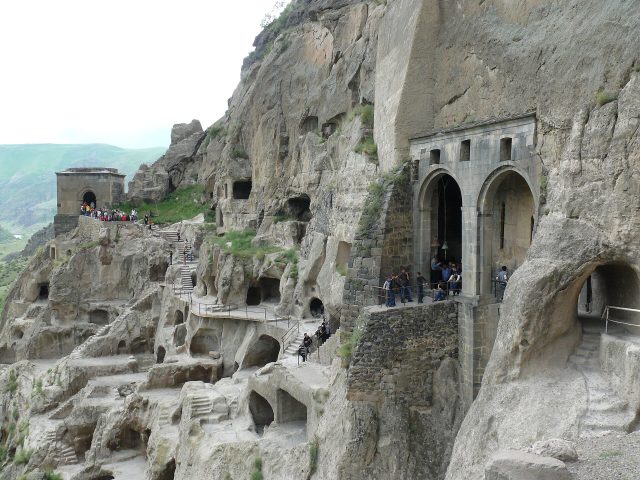
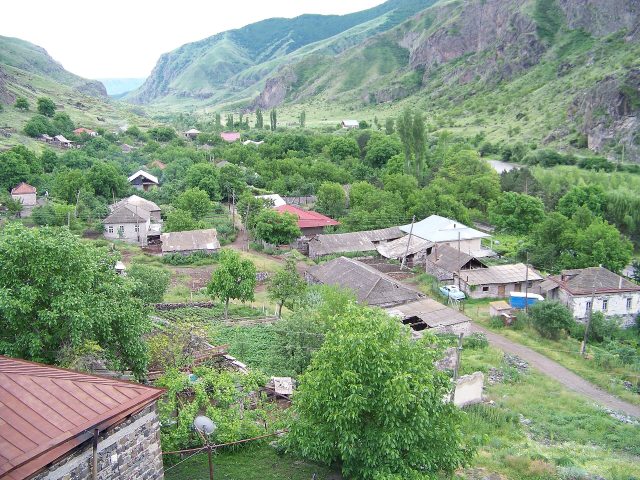
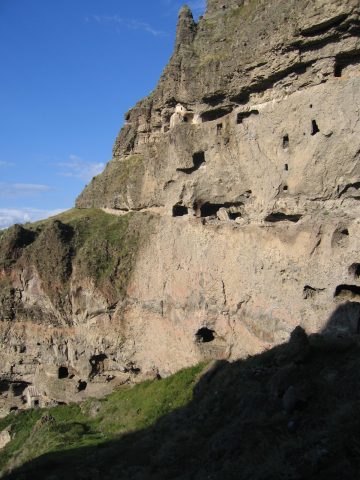
The Church of St. George in Aspindza sits on a hill above the Kura River valley. No tour buses stop here, no stalls sell souvenirs. The trees rustle, locals come to light candles, and the air smells of wild herbs and warm stone. From the hilltop, mountains stretch into the distance, their slopes marked by villages and patches of forest.
Historians place its construction between the 10th and 11th centuries, when Georgia thrived under the Bagrationi dynasty. Christianity had already spread widely, and churches like this one served as both places of worship and community hubs. The building has survived invasions, earthquakes, and restorations, yet its walls still hold traces of the people who once gathered beneath its arches. The architecture is simple: clean lines, a sense of harmony, and no ornamentation beyond what was necessary. Unlike the grander churches in Tbilisi or Mtskheta, this one feels small, built for prayer rather than spectacle.
The interior is dim and cool. Faded frescoes cover the walls—some original, some restored. Saints with solemn expressions, biblical scenes, and patterns around doorways remain visible. The iconostasis, carved from wood and gilded in places, stands against rough stone walls. Near the altar, a few old icons show faces worn smooth by time and touch. The space is not grand, but it carries a sense of reverence.
For locals, the church is part of daily life. Baptisms, weddings, and funerals take place here. Neighbors gather after services to talk and share bread. The most important day is St. George’s Day, when worshippers from across Georgia fill the church. The celebration spills outside: stalls sell churchkhela, fresh bread, and homemade wine. Children run between the trees, and folk songs drift through the air. Even those who aren’t religious come, drawn by tradition.
Aspindza is a quiet town.
The Kura River winds through the region, its banks lined with willows. In the distance, the snow-capped peaks of the Lesser Caucasus rise against the sky. Nearby, the ruins of Khertvisi Fortress stand—one of Georgia’s oldest and best-preserved strongholds. From Aspindza, you can explore on foot or by car, following narrow roads to hidden villages and abandoned churches.
The Church of St. George isn’t special because of its age or design. It simply exists as it has for centuries. There are no modern additions, no attempts to impress tourists. You can sit on the steps outside, listen to the wind, and watch the light change over the mountains without feeling rushed. It’s the kind of place that stays with you, not because of anything dramatic, but because it makes you pause.
If you’re in southern Georgia, visit Aspindza. The journey there winds through valleys, past orchards and grazing sheep. When you arrive, the church is easy to find—it’s visible from almost anywhere. Walk up the hill, push open the wooden door, and step inside. You might stay for a few minutes or an hour. Either way, you’ll leave feeling like you’ve touched something that connects past and present.