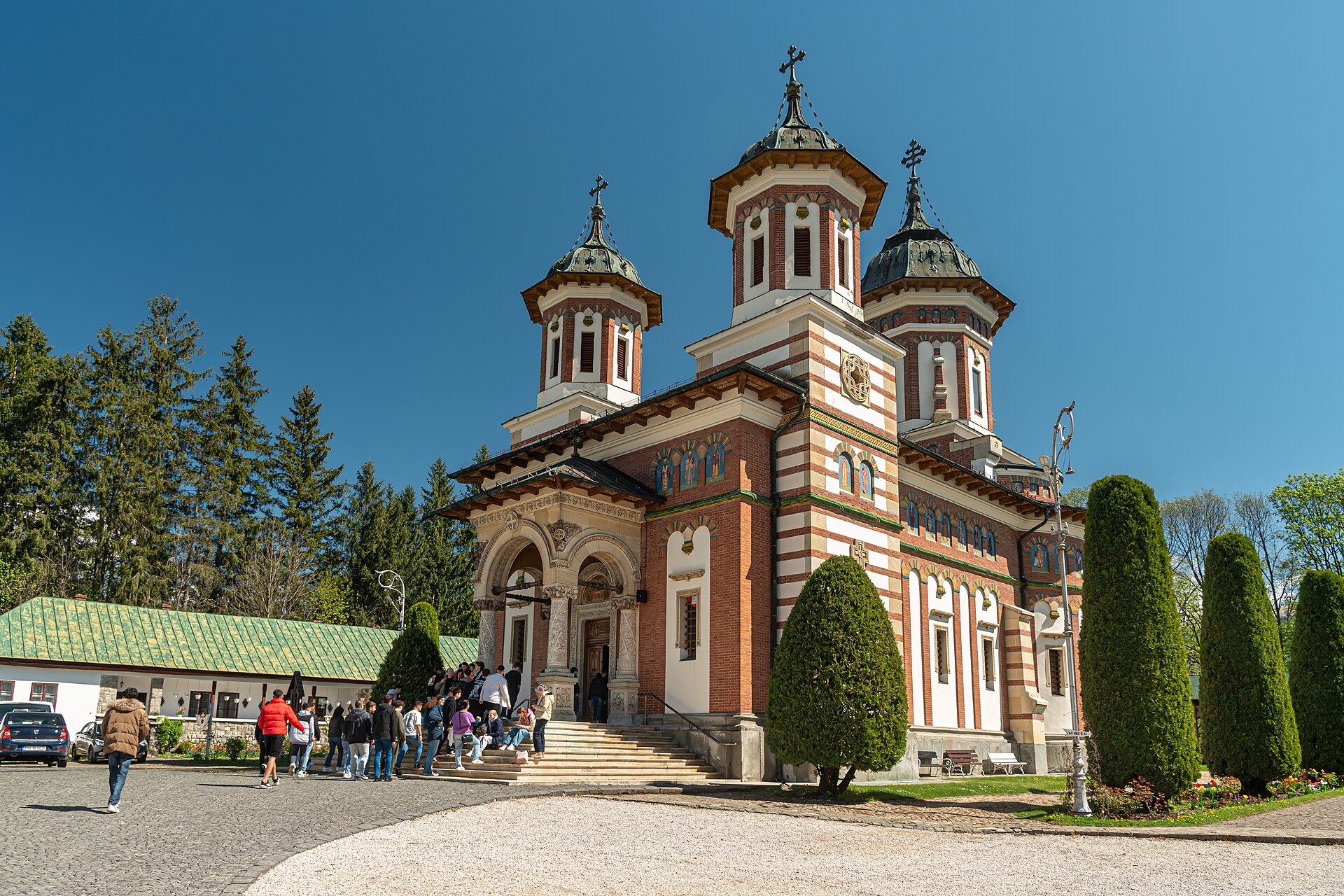
Nestled in the heart of the Carpathian Mountains, Sinaia Monastery feels like a place where time moves differently. The moment you step through its heavy gates, the noise of the outside world fades, replaced by the quiet rustle of leaves and the distant murmur of a mountain stream. The monastery clings to the slope as if it grew from the rock itself, its white walls and red-tiled roofs blending seamlessly with the surrounding forests. There’s no rush here, no crowds—just the kind of stillness that makes you slow down without even realizing it.
Founded in the late 17th century by Prince Mihail Cantacuzino, the monastery was meant to be a spiritual stronghold, a place where faith could take root in these remote valleys. He named it after Mount Sinai, drawing a line between the biblical wilderness and these rugged Romanian peaks. Over the centuries, the monastery has been rebuilt and expanded, but its original purpose has never wavered. It remains a sanctuary for prayer, reflection, and solitude, its architecture a quiet dialogue between Byzantine influences and local traditions. The arched windows, the slender bell tower, and the way the buildings curve with the slope all feel like a natural extension of the landscape rather than something imposed upon it.
The monastery’s church, dedicated to the Dormition of the Mother of God, is the heart of the complex. Inside, the air is thick with the scent of beeswax and incense, and the walls seem to breathe with the stories they tell. Frescoes cover every surface, their colors still vivid despite the centuries, depicting biblical scenes with a warmth that makes them feel immediate. The iconostasis, a masterpiece of gilded woodcarving, draws the eye upward, its intricate details a testament to the skill of the craftsmen who created it. Among the icons, one of the Virgin Mary holds a special place—believed to be miraculous, it has drawn pilgrims from across Romania for generations.
Beyond its spiritual significance, the monastery has played a role in the country’s cultural life. In the 19th century, it became a gathering place for writers, artists, and intellectuals who sought inspiration in its quiet halls. The monastery’s library holds a treasure trove of ancient manuscripts, some dating back to the Middle Ages. These texts offer a glimpse into the region’s intellectual history, preserving not just religious thought but also the everyday concerns of the people who lived here. It’s a reminder that monasteries were once more than places of worship—they were centers of learning, where knowledge was copied, preserved, and passed down.
Today, the monastery is still an active religious community. The monks who live here follow a rhythm that hasn’t changed in centuries—prayer, work, and hospitality. Visitors are welcome to attend services, where the chanting of the choir and the flicker of candlelight create an atmosphere that feels both ancient and alive. For many, it’s a rare chance to step outside the modern world and experience a tradition that has remained largely unchanged. There’s no pressure, no expectation—just the quiet invitation to be present.
The surrounding area is just as compelling as the monastery itself. From here, hiking trails wind upward into the mountains, leading to waterfalls and viewpoints where the valley stretches out below like a living map. In summer, the paths are dotted with walkers; in winter, the slopes fill with skiers, as Sinaia is one of Romania’s most popular resorts. But you don’t need to venture far to appreciate the landscape. The monastery’s garden, with its neatly tended flowerbeds and shaded benches, is a perfect place to sit and watch the light shift across the mountains. Even the simple act of walking along the monastery walls, feeling the cool stone under your hand, can feel like a connection to something enduring.
What makes Sinaia Monastery special isn’t just its beauty or its history—it’s the way it makes you feel. There’s a sense of continuity here, as if the past isn’t something distant but something you can almost touch. The stones underfoot have been worn smooth by centuries of footsteps; the icons have been kissed by generations of the faithful. It’s a place where you can come for many reasons—to pray, to wander, to escape the noise of daily life—but whatever brings you here, it’s hard not to leave with a sense of having touched something timeless. The mountains have a way of making everything else feel small, and the monastery, standing quietly among them, seems to say that some things are meant to last.