Rupite is a quiet village tucked away in southern Bulgaria, a place where the hills roll gently into the distance and the air carries the faint scent of warm earth and mineral springs. It’s known to most as the final home of Vanga, the blind mystic whose name still stirs curiosity and reverence decades after her death. Here, far from the noise of cities, she spent her last years in a house surrounded by the same landscapes that had long inspired her visions. The village itself is unassuming—just a scattering of homes, a few small shops, and the slow rhythm of rural life—but for those drawn to Vanga’s story, it holds a quiet magnetism.
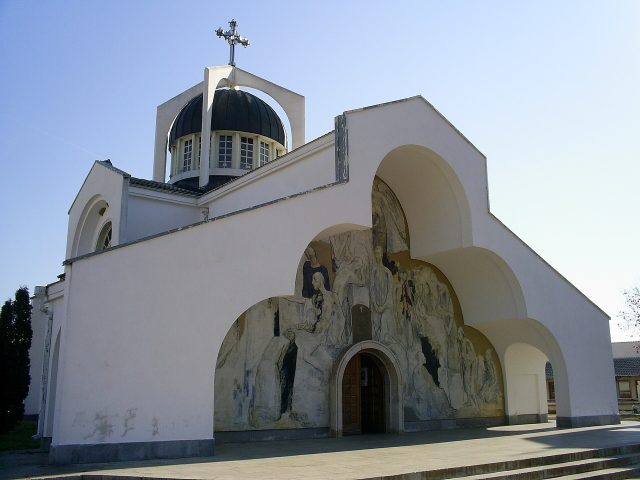
The heart of Rupite is the Church of St. Paraskeva, built at Vanga’s request in the early 1990s, not long before she died. Unlike the ornate Orthodox churches found elsewhere in Bulgaria, this one is simple, its curves and soft lines echoing the contours of the hills around it. Inside, the walls are covered in frescoes depicting biblical scenes, though with details that stray from tradition—some say these were guided by Vanga herself. The church feels intimate, almost personal, as if it were designed less for grand ceremonies and more for quiet reflection. Outside, the air is still, broken only by the occasional rustle of leaves or the distant sound of a car passing on the road.
Vanga’s grave lies just beside the church, marked by a modest white marble headstone under the open sky. There are no grand monuments here, just a low fence and a few flowers left by visitors. The inscription is spare, naming her as Vangelia Gushterova, the woman the world knew as Vanga. People come for different reasons—some to pay their respects, others hoping for the kind of clarity she once offered. Many leave candles, notes, or small tokens, as if the act of writing down a wish might somehow reach her. The place has a weight to it, not heavy, but steady, like the quiet persistence of memory.
Vanga didn’t choose Rupite by accident. She believed the thermal springs here held healing properties, and even now, visitors can soak in the warm mineral waters at a small spa nearby. To her, this was a place where the veil between worlds felt thinner, where time didn’t move in straight lines but in loops and echoes. She lived simply in her later years, seeing people in her home, offering advice, and insisting she was only a conduit, not the source of the knowledge she shared. That humility is part of what lingers in Rupite—the sense that she was never after fame, only connection.
The church and grave have become a pilgrimage site, drawing people from across Bulgaria and beyond. Some are those who once sought her counsel; others are simply curious about the woman who saw things others couldn’t. The village itself remains unchanged by the attention. There are no tourist traps, no loud crowds—just the occasional visitor wandering the paths or sitting on a bench near the church. Locals go about their days, polite but unobtrusive, as if they’ve long since grown used to the quiet stream of people who come and go.
Vanga’s legacy is debated as much as it’s revered. Some see her as a prophet, others as a woman with an extraordinary intuition for human nature. What’s undeniable is the mark she left on those who believed in her. In Rupite, that legacy isn’t preserved in museums or exhibits but in the stories people tell, in the way the light falls through the trees near her grave, in the way the wind carries the sound of the thermal springs. There’s no need for grand explanations here—just the quiet understanding that some places hold more than they show.
Beyond the church, Rupite is a place of simple beauty. The hills rise softly around the village, covered in low forests that turn golden in autumn. The air is clean, the silence broken only by birdsong or the distant lowing of cattle. In summer, the heat can be intense, but the cool waters of the springs offer relief. Winter brings a different kind of peace, when snow dusts the rooftops and the church stands like a silent sentinel over the landscape. It’s the kind of place where time feels slower, where the hours stretch out unhurried.
There’s no agenda in Rupite, no rush to see or do. You can walk the paths around the village, sit by the grave, or simply watch the way the light changes over the hills. The absence of tourist infrastructure isn’t an oversight—it’s part of the place’s charm. This isn’t a destination for those seeking spectacle; it’s for those who want to step into a story that’s still unfolding, where the past and present exist side by side. In Rupite, the extraordinary and the ordinary have always been intertwined, just as they were in Vanga’s life.