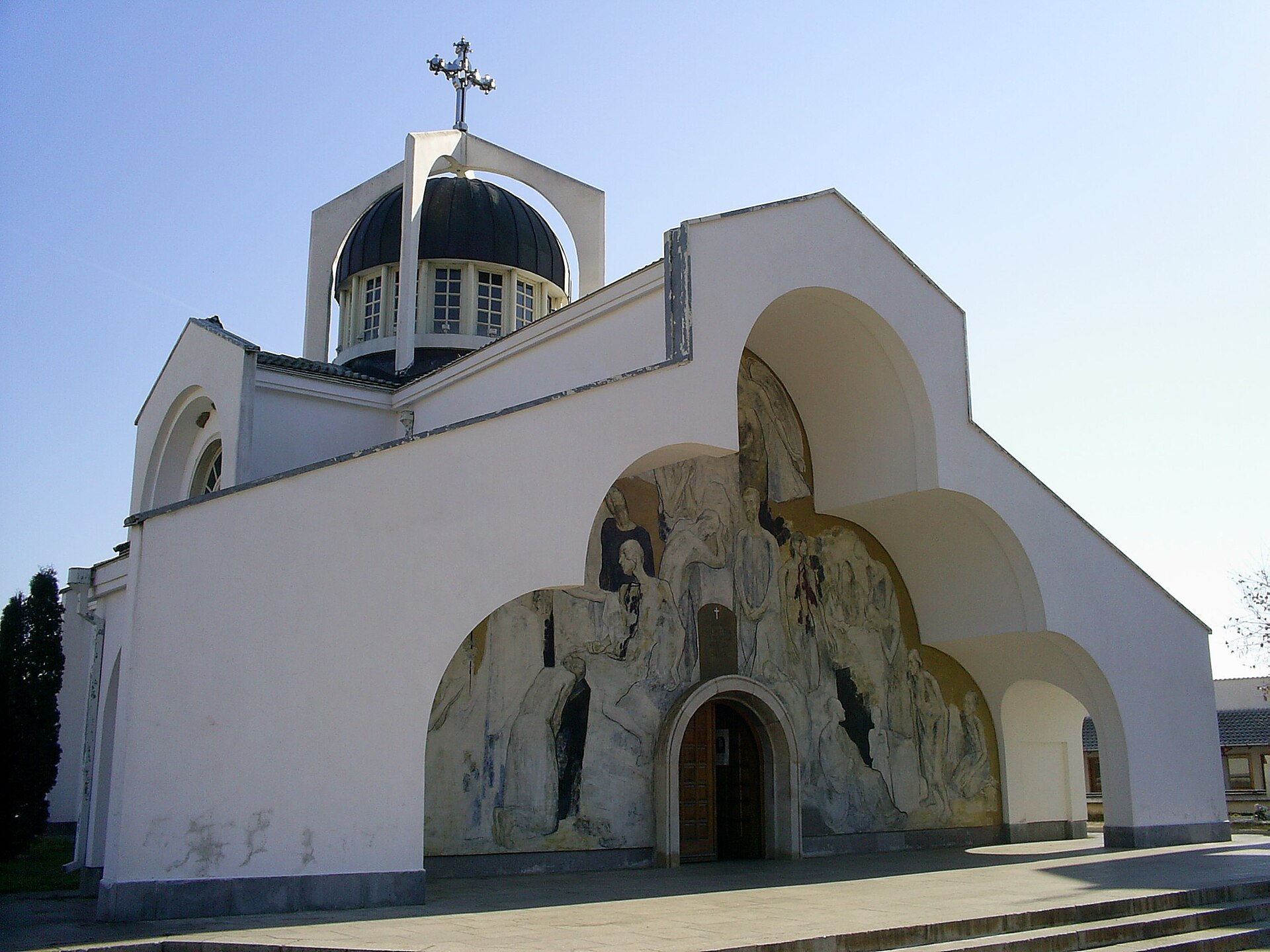
Nestled in the quiet folds of southern Bulgaria, the village of Rupite feels like a place time forgot. It’s small, unassuming, and easy to overlook on a map, yet it holds a strange magnetism, drawing visitors not just for its natural beauty but for something harder to define. The village sits in a valley framed by low mountains, where the air carries the faint scent of sulfur from nearby thermal springs. These waters have been sought after for centuries, long before the modern world took notice. But what truly sets Rupite apart is the Church of Saint Paraskeva, a structure that seems to exist between worlds—part sacred space, part architectural curiosity, and part monument to one of Bulgaria’s most enigmatic figures.
The church was built in the early 1990s, a time when Bulgaria was still finding its footing after decades of communist rule. Its construction was driven by the insistence of Vanga, the blind mystic and seer who spent her final years in Rupite. Vanga was a figure of contradictions: revered by some as a prophetess, dismissed by others as a charlatan, but impossible to ignore. She claimed this land held a unique energy, a convergence of unseen forces that made it sacred. Whether one believes in such things or not, there’s no denying the church she inspired is unlike any other in Bulgaria. Designed by architect Bogdan Tomalevsky, it breaks from tradition with its flowing, organic shapes. The dome resembles a blooming flower, its petals unfurling toward the sky, while the interior is bathed in natural light streaming through large windows. The frescoes inside depict biblical scenes, but with an unexpected twist—among the saints and angels are portraits of Vanga’s contemporaries, a nod to the living world alongside the divine.
The hill where the church stands has been considered sacred for millennia. Long before Christianity took root in these lands, the Thracians built a sanctuary here, drawn to the same thermal springs that still bubble beneath the surface. Later, the Romans constructed baths, harnessing the warm, mineral-rich waters for their healing properties. By the Middle Ages, a small chapel may have stood on this spot, though no records remain to confirm it. Vanga’s choice of location wasn’t arbitrary; she spoke of invisible currents of energy crisscrossing the land, and in her mind, Rupite was a focal point. After her death in 1996, the church became a pilgrimage site, not just for the devout but for those curious about the mysteries she left behind. Some come seeking answers, others simply to stand in a place where the boundaries between the ordinary and the extraordinary feel thinner.
Architecturally, the Church of Saint Paraskeva is a departure from the rigid lines and domes of traditional Bulgarian Orthodox churches. Instead of symmetry and austerity, Tomalevsky’s design embraces curves and asymmetry, as if the building itself is in motion. The entrance is adorned with a mosaic of Saint Paraskeva, her image rendered in vibrant colors that catch the light. Inside, the space feels expansive, almost weightless, with high vaulted ceilings that seem to lift the gaze upward. The frescoes, while rooted in religious iconography, have a modern edge—less rigid, more fluid, as though the stories they tell are still unfolding. The iconostasis, with its intricate carvings and gilded details, anchors the space, a reminder of the church’s spiritual purpose amid its unconventional form.
A short walk from the church is a modest museum dedicated to Vanga’s life. It’s not a grand exhibition, but a collection of personal items: her glasses, a few photographs, handwritten notes, and objects she kept close. The displays don’t attempt to explain her gift or debunk the myths surrounding her; instead, they offer glimpses into the woman behind the legend. Visitors often leave with more questions than answers, which seems fitting. Vanga’s legacy isn’t something that can be neatly packaged or explained—it lingers in the stories people tell, in the quiet conviction of those who believe, and in the way Rupite itself feels suspended between the past and the present.
Beyond the church and museum, Rupite remains a place of quiet rhythms. The village hasn’t been overtaken by tourism; there are no souvenir stalls or crowded cafes, just a handful of locals going about their day. The thermal springs, long used for their healing properties, still draw people seeking relief from aches and ailments. The water is warm, with a faint mineral tang, and the pools are simple, unadorned. Nearby, the Struma River winds through the landscape, its banks lined with trees that rustle in the breeze. The surrounding hills, low and rolling, are covered in forests that change with the seasons—lush green in spring, golden in autumn. It’s a landscape that invites stillness, a place where the outside world feels distant.
For some, the Church of Saint Paraskeva is a place of worship, a sanctuary where they light candles and offer prayers. For others, it’s an architectural oddity, a building that defies expectations. And for many, it’s a destination tied to Vanga’s legacy, a tangible connection to a woman who saw the future in ways no one else could. But Rupite’s appeal isn’t just about the church or the mystic who made it famous. It’s about the land itself—the way the light falls on the hills at dusk, the way the thermal springs steam in the cool morning air, the way the silence here feels different, as if charged with something unseen. It’s a place that doesn’t demand belief, but somehow makes it easier to suspend disbelief, if only for a moment.
There’s no grand narrative to Rupite, no single story that explains why it feels the way it does. Maybe it’s the layers of history buried beneath the soil, the centuries of people who have come here seeking something—healing, answers, peace. Maybe it’s the way the landscape seems to hold its breath, as if waiting. Or maybe it’s simply the quiet conviction of those who visit, the way the place lingers in the mind long after you’ve left. Whatever it is, Rupite doesn’t try to impress. It doesn’t need to. It exists as it always has, a small corner of the world where the ordinary and the extraordinary brush against each other, leaving just enough room for wonder.