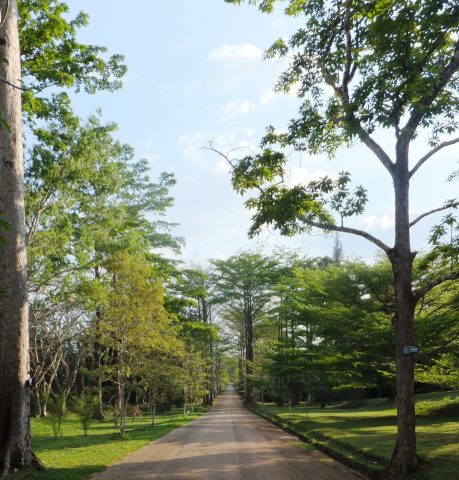
Kisantu Mission is one of those quiet places where history lingers in the air, almost tangible beneath the rustling leaves of its botanical gardens. Founded in the late 19th century by Belgian missionaries, it began as a small outpost of faith in what was then a vast, unfamiliar land. Over time, it grew into a center of religious and social life, shaping the town that now surrounds it. The mission stands as a reminder of an era when European priests arrived with their beliefs, their books, and their vision of progress, leaving behind buildings that still bear the marks of that time.
The architecture here tells its own story, blending European design with local materials and sensibilities. The main cathedral, built in the early 20th century, is a striking structure of red brick, its high vaulted ceilings and narrow windows echoing the Gothic churches of Europe. Yet there’s something distinctly African in its simplicity—the way the light filters through the stained glass, casting soft patterns on the wooden pews, or how the murals inside depict biblical scenes alongside images of the Congo’s rivers and forests. Nearby, the former living quarters of the missionaries now house small museums and administrative offices, their corridors lined with faded photographs and yellowed documents.
The botanical garden, established alongside the mission, is perhaps the most alive part of the complex. It was never just a place of beauty; the missionaries intended it as a living laboratory, a space to study the region’s flora and introduce new species from abroad. Today, the garden is a tangle of green, where towering baobabs stand beside delicate orchids and vines twist around ancient trunks. Walking its shaded paths, you can almost forget the heat outside—until the call of a bird or the hum of cicadas pulls you back into the present. In the evenings, the air grows cooler, and the garden becomes a quiet refuge, far from the noise of the world.
Kisantu Mission is deeply woven into the history of colonial Congo. It wasn’t just a religious center; it was a place where schools, hospitals, and workshops took root, offering education and skills to local communities. Some of the first Congolese priests and teachers trained here, and the mission played a role in shaping the social fabric of the region. Yet its legacy is complicated. For some, it represents cultural exchange and the spread of knowledge; for others, it’s a reminder of a time when foreign powers held sway over the country. The mission doesn’t offer easy answers—it simply stands, a silent witness to the past.
These days, life at the mission moves at its own unhurried pace. The parish is still active, with services held in the cathedral, and the old buildings now host small workshops and classrooms. For the people of Kisantu, the mission is part of everyday life—somewhere to pray, to stroll through the gardens, or to learn a trade. There’s no sense of reverence, just quiet familiarity. Visitors are rare, which only adds to the place’s charm. There are no crowds, no guided tours rushing from one spot to the next, just the slow rhythm of a place that has seen generations come and go.
If you find yourself in Kisantu, it’s worth spending a few hours here. Wander the garden paths, step inside the cathedral, and listen to the stories locals might share about the mission’s past. The town itself is small, with markets selling fresh fruit, brightly colored fabrics, and handmade crafts. There are no luxury hotels or bustling restaurants, just the simple, unfiltered life of a Congolese town. That’s what makes Kisantu special—it’s a place where you can step off the well-trodden path and experience something real, something untouched by mass tourism.
Kisantu Mission isn’t just a relic of history; it’s a living place where the past and present coexist. It doesn’t demand attention or offer grand narratives. Instead, it invites you to sit quietly, to observe, and to reflect on how different worlds—European and African, colonial and local—once intersected here. The questions it raises don’t have simple answers, but that’s part of its quiet power. In a world that moves too fast, Kisantu offers a moment of stillness, a chance to listen to the echoes of time.