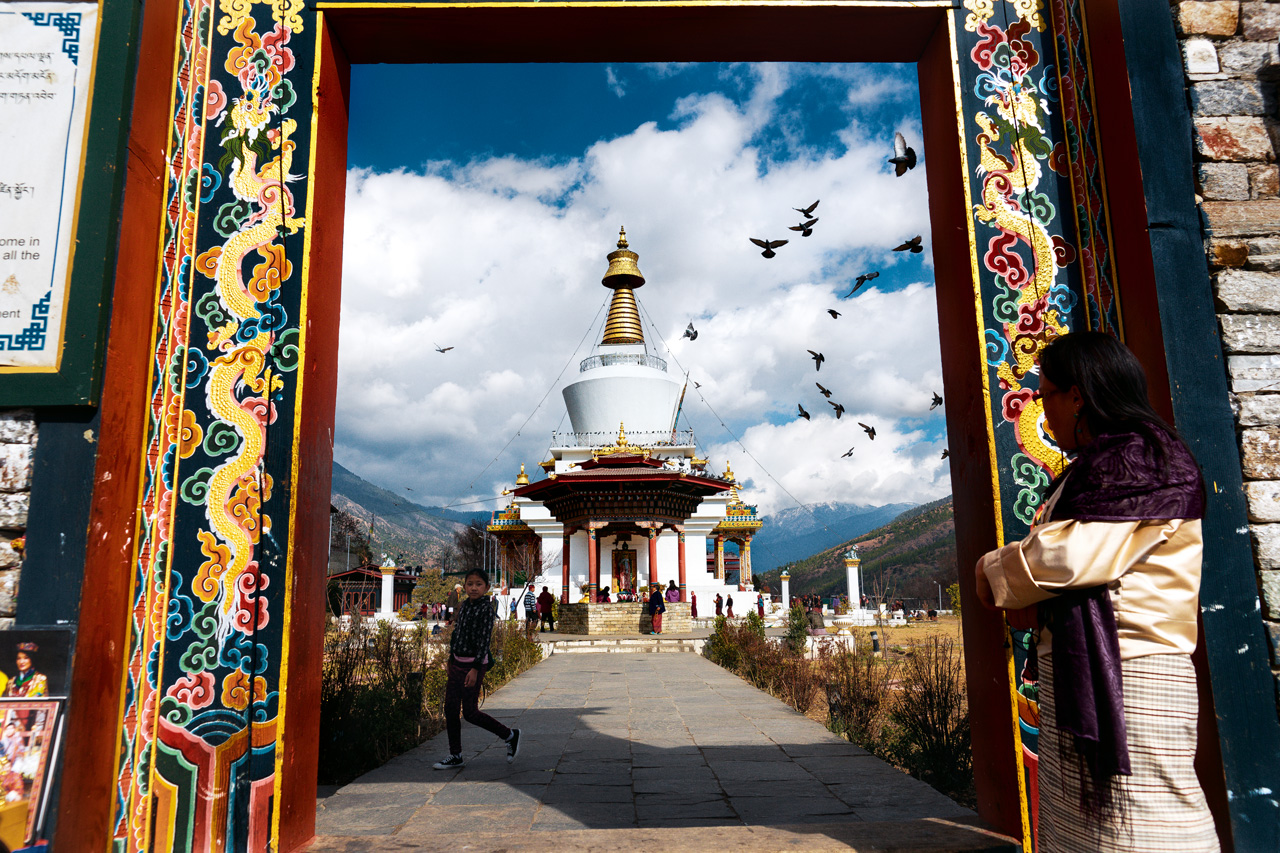
Thimphu’s Memorial Chorten stands as one of the most visible landmarks in Bhutan’s capital, a whitewashed stupa that rises against the backdrop of the surrounding hills. Built in 1974 to honor the third Druk Gyalpo, Jigme Dorji Wangchuck, it was conceived not just as a monument but as a place of daily worship for the city’s residents. Unlike many grand memorials that serve primarily as tourist attractions, this chorten remains deeply embedded in the spiritual life of Thimphu, drawing locals who come to circumambulate its base, spin prayer wheels, and offer butter lamps at all hours of the day.
The structure follows the traditional Bhutanese design of a chorten, with its golden spire, tiered layers, and intricate mandalas painted on the exterior walls. The white facade gleams in the sunlight, especially striking in the early morning when the air is crisp and the city is just waking up. Inside, the atmosphere is quieter, almost hushed, as visitors step into the dimly lit interior where statues of deities and murals depicting Buddhist cosmology line the walls. The scent of incense lingers in the air, mingling with the faint sound of murmured prayers.
What makes this chorten unusual is its role in the urban fabric of Thimphu. While many religious sites in Bhutan are tucked away in remote valleys or perched on mountainsides, this one sits at the heart of the city, surrounded by government buildings, shops, and the occasional stray dog napping in the shade. It’s not uncommon to see elderly Bhutanese making their slow, deliberate circuits around the stupa, their prayer beads clicking softly, while schoolchildren dart past on their way home. The chorten becomes a meeting point, a place where the sacred and the everyday intersect without fuss.
The history of the Memorial Chorten is tied to Bhutan’s modern identity. Jigme Dorji Wangchuck, often called the father of modern Bhutan, initiated a series of reforms that opened the country to the outside world while carefully preserving its cultural heritage. The chorten was one of his final legacies, completed after his death, and it reflects his vision of a Bhutan that balanced progress with tradition. Unlike the fortress-like dzongs that dominate other parts of the country, this structure feels more intimate, almost domestic in scale, as if designed to be part of the city’s daily rhythm rather than an imposing symbol of authority.
Visitors often notice the contrast between the chorten’s serene presence and the bustle of Thimphu’s main streets just a short walk away. The area around it is lively, with vendors selling fresh fruit, prayer flags fluttering in the breeze, and the occasional monk stopping to chat with passersby. There’s no grand entrance or ticket booth—just a simple path leading to the stupa, where the only expectation is that you walk clockwise, as is the custom. The lack of overt tourism infrastructure can be disarming at first, but it also makes the experience feel more authentic, as if you’ve stumbled into a place that exists primarily for the people who live here.
The chorten’s interior is less visited than the exterior, but those who step inside are rewarded with a sense of stillness. The central statue of the Buddha is flanked by smaller figures, their faces serene and slightly worn from years of devotion. The walls are covered in murals that tell stories from Buddhist scripture, their colors faded but still vivid enough to convey the depth of the narratives. On certain days, monks gather to perform rituals, their chanting filling the space with a low, resonant hum. Even if you don’t understand the significance of the prayers, the atmosphere is undeniably moving.
One of the most striking aspects of the Memorial Chorten is how it changes with the seasons. In the winter, the white stupa stands out starkly against the bare hills, while in the summer, it’s often shrouded in mist, giving it an almost ethereal quality. During festivals, the area around it becomes a hub of activity, with masked dances and traditional music spilling into the streets. But even on ordinary days, there’s a quiet magic to the place—whether it’s the way the light catches the golden spire at dusk or the sight of an elderly woman lighting a butter lamp with practiced ease.
For travelers, the chorten offers a glimpse into the spiritual heart of Bhutan, but it’s also a reminder that religion here isn’t confined to temples or monasteries. It’s woven into the fabric of daily life, visible in the way people pause to spin a prayer wheel or murmur a mantra as they pass by. There’s no pressure to participate, no expectation to understand the rituals—just an invitation to observe, to walk the same path as the locals, and to let the rhythm of the place settle into your bones. In a city that’s slowly modernizing, the Memorial Chorten remains a steadfast anchor, a place where the past and present coexist without conflict.