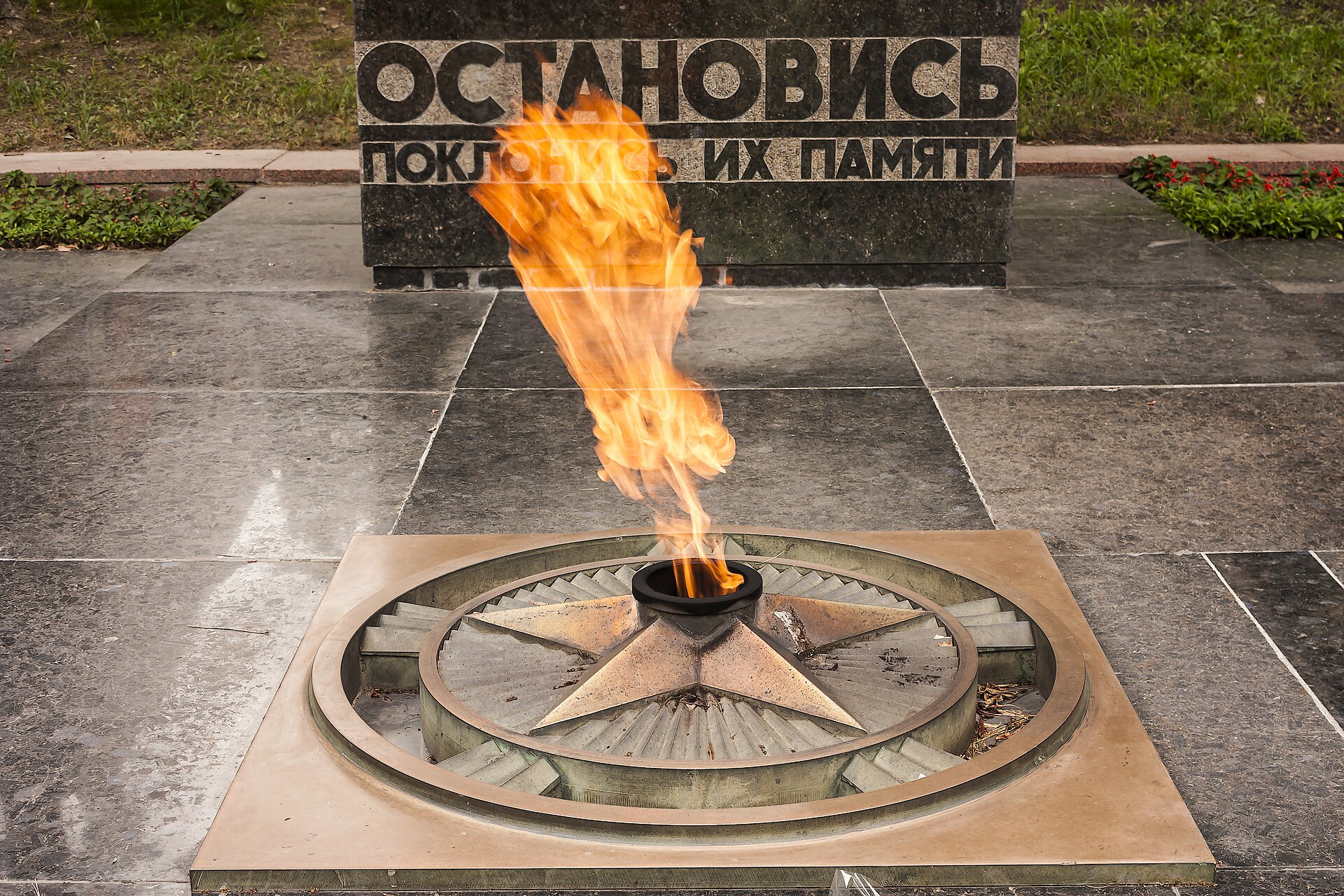
In the quiet heart of Armyansk, a small town in northern Crimea, stands a memorial that carries the weight of history without the grandeur often associated with such places. The Eternal Flame monument is a humble yet powerful reminder of those who never returned from the battlefields of World War II. Unlike the towering war memorials in major cities, this one blends seamlessly into the town’s unassuming landscape—a modest square framed by low-rise apartment buildings and a few trees. There’s no pomp here, no sweeping declarations, just a steady flame and the names of the fallen etched into stone. Yet it’s this very simplicity that makes the place feel deeply personal, as if the memory of war isn’t something distant or abstract, but something that lingers in the air, in the silence between footsteps.
Armyansk itself is a town that rarely appears on tourist maps, but its role in the war was far from insignificant. During the brutal fighting of the 1940s, this corner of Crimea saw some of the conflict’s fiercest clashes. After the peninsula was liberated, the town became one of the many places where life slowly returned to normal, though the scars of war remained. The memorial wasn’t built immediately—it came later, when the country began to grapple with the scale of its losses and the need to honor those who had sacrificed everything. No one here seems to remember the exact date it was unveiled, and perhaps that doesn’t matter. What does matter is that the flame still burns, and the names on the granite stele are still read, year after year.
The memorial’s design is straightforward, almost austere. A tall granite obelisk bears the names of the soldiers who died defending Crimea, while the Eternal Flame flickers beside it, its light casting long shadows as dusk falls. The flame is kept alight around the clock, a silent sentinel that never sleeps. Flowerbeds surround the monument, tended by locals who treat the place with quiet reverence. Along the edges of the square, smaller plaques list more names—each one a life cut short, a family left behind. There are no dramatic sculptures or elaborate murals here, just the raw, unadorned truth of war.
For visitors, the memorial offers something rare: a moment of reflection without the noise of guided tours or the pressure of curated exhibits. There’s no one here to tell you what to feel or how to remember. Instead, the place speaks for itself—a stillness that settles over you as you stand before the flame, the weight of the names pressing in. It’s a reminder that war wasn’t just a series of battles fought in distant fields; it was something that reached into every home, every village, no matter how small. Even in a town like Armyansk, the echoes of that time are still palpable.
In recent years, the memorial has taken on a new role as a gathering place for younger generations. Schoolchildren come here for lessons in courage, listening to veterans share their stories—stories that aren’t found in textbooks. On Victory Day and other commemorative dates, the square fills with people laying flowers, their voices hushed, their movements deliberate. For many of these children, this is their first real encounter with the idea of sacrifice, the first time they hear about the war not as a chapter in history, but as something that shaped the lives of their grandparents and great-grandparents. It’s a quiet education, one that doesn’t rely on speeches or ceremonies, but on the simple act of standing together in remembrance.
The architecture of the memorial is unpretentious, almost understated. There are no soaring arches or intricate carvings, just clean lines and honest materials. The granite stele, the flame, the plaques—all of it serves a single purpose: to remember. It doesn’t try to impress or overwhelm; it simply exists, a permanent fixture in the town’s daily life. That lack of pretense might be why it feels so at home here, why it doesn’t stand out as something foreign or imposed. It’s as much a part of Armyansk as the apartment blocks and the trees, a silent witness to the passing of time.
For the town’s residents, the memorial is more than just a landmark. It’s a bridge between past and present, a place where generations meet. You’ll often see elderly men and women standing before the flame, their hands clasped, their eyes distant. Sometimes they bring their grandchildren, pointing to the names on the plaques, telling stories of relatives who fought or fell. These conversations are the real heart of the memorial—small, private moments where history isn’t just remembered, but passed down. It’s in these quiet exchanges that the past stays alive, not as a series of dates and events, but as something deeply human.
Armyansk isn’t a place that draws crowds, and the Eternal Flame isn’t the kind of monument that makes it onto postcards. But that’s part of what makes it special. There are no grand museums here, no sprawling memorial complexes with interactive displays. Instead, there’s something far more intimate: a direct, unfiltered connection to history. The memorial doesn’t just commemorate the war; it keeps the memory of those who fought in it alive in a way that feels immediate and real. It’s a place that doesn’t let you forget the cost of peace, or the responsibility of remembering. And in a world where the past can sometimes feel distant, that’s no small thing.