The Perekop Isthmus has always been a threshold—a narrow strip of land where Crimea meets the mainland, where the Black Sea brushes against the shallows of the Sea of Azov. And at the heart of this crossing lies the Perekop Rampart, an ancient earthwork that has stood for millennia as both a barrier and a silent witness to the ebb and flow of empires. Unlike the crowded ruins of more famous sites, the rampart remains unassuming, a long, grassy ridge stretching across the steppe, its presence felt more than seen. There are no souvenir stands here, no guided tours—just the wind, the scent of dry grass, and the quiet weight of history pressing against the soles of your shoes.
The origins of the rampart are lost in the haze of antiquity, but its story begins with the earliest struggles for control over this strategic choke point. The Greeks, who established colonies along the Black Sea coast, likely recognized its importance, as did the Scythians, who roamed these lands long before the first stones of Rome were laid. By the Middle Ages, the Genoese, those masterful merchants and builders, reinforced the earthworks, turning them into a formidable line of defense. But it was in the 17th century that the rampart gained its most infamous role, becoming the backbone of the Perekop Fortress, a bulwark of the Crimean Khanate against Cossack raids and Russian incursions. Each layer of earth, each ditch and embankment, tells a story of conflict, trade, and the relentless push of civilizations across this narrow land bridge.
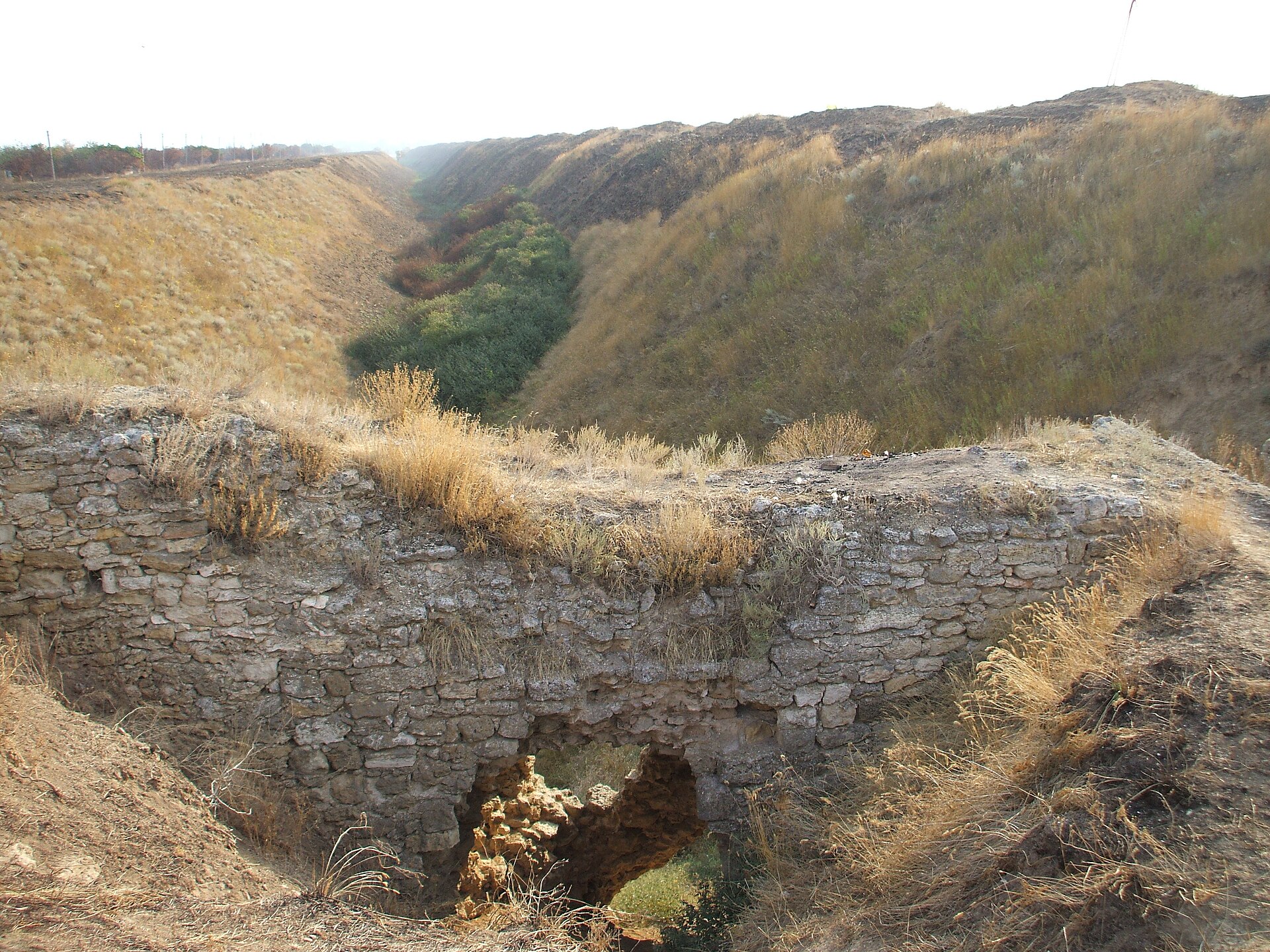
Stretching nearly eight kilometers from west to east, the rampart rises in places to ten meters, its gentle slopes belying its once-formidable purpose. From its crest, the view is vast and unbroken—on one side, the dark blue expanse of the Black Sea; on the other, the shimmering shallows of the Sea of Azov. On clear days, the distant outline of the Crimean Mountains hovers on the horizon, a reminder of the peninsula’s rugged beauty. The steppe around it is flat and open, a deliberate choice in its construction, designed to give defenders an unobstructed line of sight over the approaches to Crimea. Even now, standing on its summit, it’s easy to imagine how exposed and vulnerable an attacking force must have felt, marching across that empty plain toward the waiting walls.
Today, the rampart appears little more than a low hill, its surface softened by time and overgrown with wild grasses and shrubs. But look closer, and the remnants of its past emerge: the faint outlines of trenches, the crumbling edges of old fortifications, the occasional scatter of stones that once formed walls. Archaeologists have unearthed coins, weapons, and everyday objects here, each a fragment of the lives spent defending or assaulting this place. Modern roads cut through the rampart in places, as if trying to erase its significance, but the earth remembers. Climb its slopes, and the illusion of a simple hill vanishes—this was a frontier, a line drawn in the sand between worlds.
The rampart’s fate has always been tied to that of the Perekop Fortress, which once stood at its base like a guardian. The fortress is gone now, reduced to ruins during the Russo-Turkish wars of the 18th century, but its name lingers in the memory of this land. For centuries, Perekop was the gatekeeper of Crimea, the last obstacle before the peninsula’s fertile plains and coastal riches. Whoever held it controlled access to the entire region, and its capture or loss often decided the outcome of wars. Battles were fought here, treaties signed, and armies broken. The fortress may be gone, but the rampart endures, a quiet monument to the struggles that shaped this corner of the world.
To the people who live nearby, the Perekop Rampart is more than a relic—it’s a familiar presence, woven into the rhythm of their lives. Shepherds graze their flocks along its slopes, herbalists gather wild plants in its shadow, and families sometimes picnic on its grassy flanks. The steppe around it is alive with the scent of wormwood and feather grass, and in spring, the ground erupts in a riot of red poppies and wild tulips. Summer brings the dry, warm breath of the sea, while winter covers the rampart in snow, rendering it nearly invisible against the white expanse. Yet no matter the season, it remains, steadfast and unchanging, a silent sentinel over the land.
There’s something deeply compelling about a place like this, where history isn’t confined to plaques or glass cases but is instead written into the earth itself. The rampart offers no explanations, no neatly packaged narratives—just the raw, unfiltered past, waiting to be discovered. You can walk its length for hours, imagining the tramp of soldiers’ boots, the roar of cannon fire, the shouts of men locked in battle. Or you can simply sit on its crest, watching the steppe stretch endlessly before you, listening to the wind carry whispers of centuries gone by. It’s not a place for those seeking entertainment or convenience, but for those who want to feel the pulse of history beneath their feet.
In recent years, archaeologists and historians have turned their attention to the rampart, conducting excavations and studying its ancient defenses. Some sections have been restored, their contours sharpened to give visitors a sense of the original structure. Yet despite these efforts, the site remains largely unknown to the wider world, overshadowed by Crimea’s more famous attractions. Perhaps that’s for the best. The rampart’s power lies in its quiet persistence, its refusal to be tamed or commercialized. It doesn’t need crowds or fanfare—it has endured for thousands of years, and it will endure for thousands more, a living testament to the forces that have shaped this land. All it asks is that you pause, look, and listen.