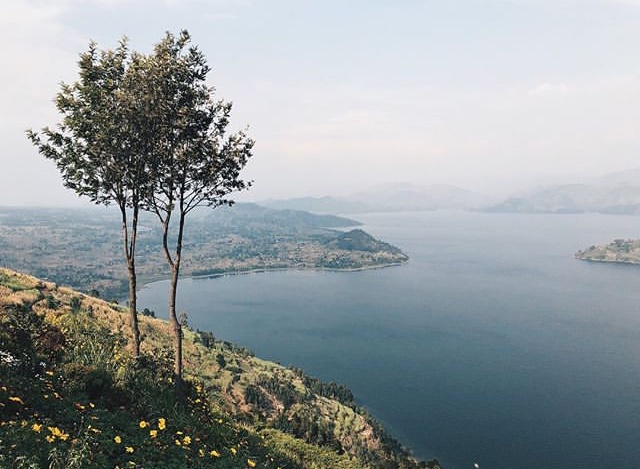
Perched on a hill overlooking Lake Nyanza, the Genocide Memorial in Nyanza is a place where history lingers in the air, heavy yet impossible to ignore. The view from here stretches across the rolling Rwandan landscape, a quiet expanse that contrasts sharply with the violence that once unfolded below. In 1994, over the course of a hundred days, nearly a million people were killed in Rwanda, and this memorial stands as both a testament to their lives and a quiet plea to ensure such horror is never repeated.
The memorial’s design is unassuming, built from local stone and concrete in a way that feels more like an invitation than a monument. There are no grand gestures here, no towering statues or dramatic inscriptions. Instead, the buildings blend into the hillside, their simplicity encouraging reflection rather than awe. Inside, the exhibits unfold with a quiet dignity—photographs, documents, and personal belongings that tell the stories of those who were lost. The most haunting displays are often the smallest: a child’s shoe, a school notebook, a drawing left unfinished. These objects don’t need embellishment; their silence speaks volumes.
Nyanza was at the heart of the genocide. In April 1994, armed groups began targeting Tutsi and moderate Hutu across the region, turning churches and schools—places that should have offered sanctuary—into sites of massacre. The memorial now stands on the grounds of what was once a church, where hundreds sought refuge only to meet their deaths. Around it lie mass graves, holding the remains of thousands. Every April, during the national period of mourning, survivors and their families gather here to remember, their presence a reminder that the past is never as distant as it seems.
Rwanda has spent the decades since the genocide rebuilding, not just its infrastructure but its identity. The country has emerged as one of Africa’s most stable nations, a transformation that feels almost miraculous given the scale of the destruction. The memorial is part of that healing process, serving as both a keeper of memory and a warning. Educational programs for students and visitors are held here, not to dwell on the past for its own sake, but to ensure that the lessons of history are passed down. The hope is that understanding how division and hatred took root might prevent them from ever doing so again.
For many Rwandans, the memorial is deeply personal. Some come to search for names on the memorial walls, to light a candle, or to sit in silence. Others share their stories with visitors, their voices steady even as their words carry the weight of loss. These conversations are never easy, but they are necessary. They strip away the abstraction of history, making it real in a way that textbooks never could. For foreigners, the memorial offers a chance to grasp the human scale of the tragedy—to see not just numbers, but faces, lives, and the quiet resilience of those who survived.
The grounds around the memorial are peaceful, almost serene. Trees provide shade, flowers bloom in careful rows, and benches invite visitors to sit and reflect. Beyond the hill, the Rwandan countryside stretches out in all directions, its beauty undisturbed by the horrors that once played out here. That contrast is what makes the memorial so striking. The land itself seems to move on, indifferent to human suffering, while the memorial stands as a quiet counterpoint—a place where the past is not allowed to fade.
There is no attempt here to sensationalize or shock. The memorial’s power lies in its restraint. It doesn’t demand attention; it earns it. There are no dramatic sculptures or sweeping declarations, just the quiet accumulation of facts, objects, and stories. For Rwandans, it is a place of mourning and remembrance, a space where they can honor those they lost. For outsiders, it is a lesson in how quickly humanity can unravel—and how painstakingly it must be rebuilt.
The memorial in Nyanza is more than a museum. It is a living connection to the past, one that refuses to let history be forgotten. It doesn’t offer easy answers or neat resolutions, because there are none. Instead, it asks visitors to sit with the discomfort of what happened, to listen, and to carry that memory forward. In a country that has worked so hard to move beyond its trauma, the memorial serves as both a scar and a salve—a reminder of what was lost, and a promise that it will not be lost again.