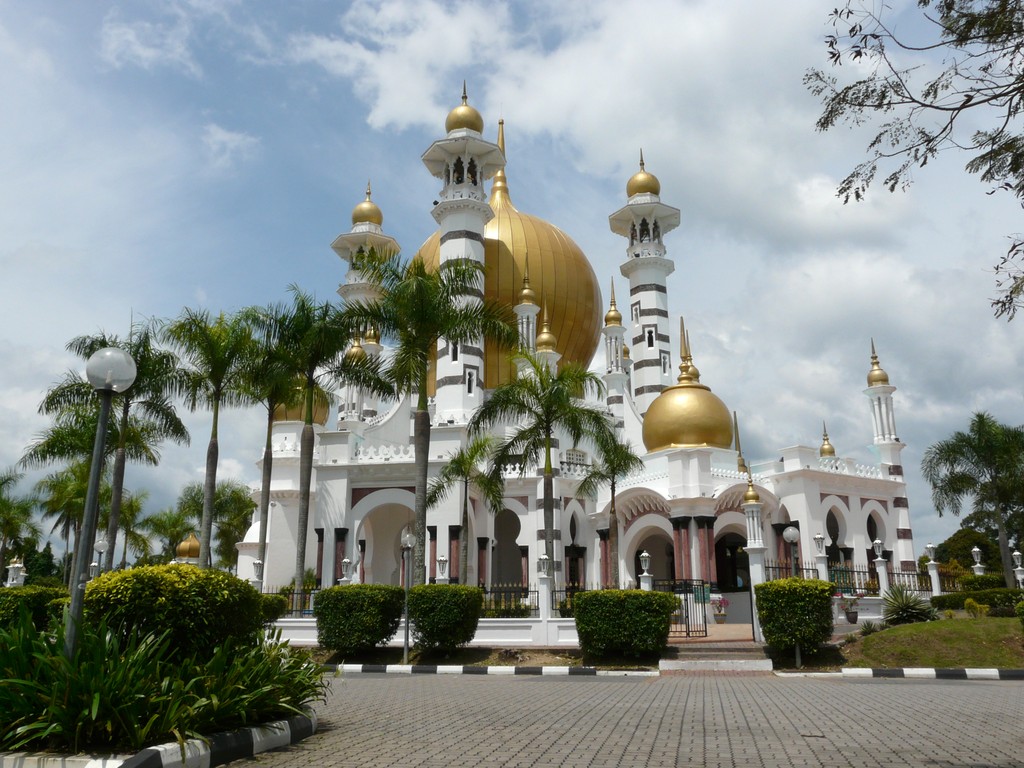
Perched on the edge of Ipoh, the Ubudiah Mosque stands as a quiet monument to Malaysia’s early 20th-century transformations. Its gleaming white domes and minarets rise above the lush hills of Perak, their pristine surfaces almost surreal against the tropical backdrop. Built in 1917 under the orders of Sultan Idris I, the mosque was one of the first major Islamic structures in the region, a time when Malaya was still under British protection. More than just a place of worship, its construction was a deliberate statement—an assertion of cultural identity in an era of colonial influence.
The mosque’s architecture blends Moorish and neo-Moorish styles, reflecting the tastes of the Muslim world at the turn of the century. The central dome, flanked by four smaller ones, echoes the grandeur of Indian and Middle Eastern mosques, yet there’s something distinctly local in its execution. White marble dominates the structure, its brightness contrasting with the dark wooden doors and latticework, creating a play of light and shadow that shifts with the sun. Inside, the space is uncluttered but thoughtful—geometric patterns adorn the walls, the mihrab’s carved panels draw the eye, and the prayer hall feels expansive, its simplicity inviting quiet reflection.
A wide staircase, lined with palms and flowering shrubs, leads up to the mosque, which sits on a gentle rise. The surrounding gardens are meticulously kept, offering shaded spots where locals sometimes come to escape the heat. Unlike the bustling streets of Ipoh, the atmosphere here is one of stillness, broken only by birdsong and the distant hum of the city. It’s a place that moves at its own pace, unhurried and measured, as if time itself slows down within its walls. Even non-Muslim visitors often find themselves lingering, whether to contemplate faith, history, or simply the beauty of the surroundings.
The mosque’s construction wasn’t without challenges. Sultan Idris took a personal interest in the project, envisioning it as a symbol of Perak’s prosperity. But shortly after its completion, he passed away, and the mosque became not only a testament to his reign but also his final resting place. His mausoleum stands nearby, and many come to pay their respects. For Ipoh’s residents, Ubudiah is more than a religious site—it’s a piece of their shared past, a reminder of how the country evolved while holding onto its traditions.
At times, the mosque becomes a hub of community life. During festivals like Eid al-Fitr and Eid al-Adha, hundreds gather here, the grounds transforming with stalls serving food, the air filled with prayers and the scent of spices. On ordinary days, the mosque welcomes visitors, though it remains an active place of worship. Respecting its customs—dressing modestly, removing shoes—is part of the experience. Women are advised to cover their shoulders and knees, while men should avoid shorts and sleeveless shirts.
Ipoh is often celebrated for its colonial architecture and tin-mining heritage, but Ubudiah Mosque offers a different perspective. It’s a city where cultures, religions, and traditions intertwine, where even amid modern life, there’s room for quiet contemplation. For those drawn to Ipoh’s street food or historic districts, the mosque might come as a surprise—a place without crowds or fanfare, where the only distractions are the white walls, the green lawns, and the sense that time moves just a little differently here.
If you find yourself in Ipoh, it’s worth setting aside an hour or two to visit. The best time is late afternoon, when the setting sun bathes the domes in gold and stretches the shadows long and soft. You can sit on a bench in the garden, watching locals pray or stroll along the paths, or climb the steps to examine the details—the intricate carvings on the doors, the mosaic floors, the way light filters through the high windows. In those moments, it’s easy to see why this place matters to Ipoh’s residents. It doesn’t demand attention; it simply exists, a reminder that true harmony often lies in simplicity.