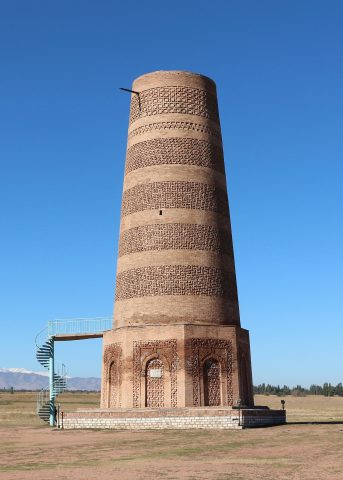
Tokmak’s central mosque is the kind of place that doesn’t announce itself with fanfare but lingers in memory long after you’ve left. Tucked away at the quiet intersection of two unhurried streets, it sits at the heart of a provincial Kyrgyz town where life moves at its own gentle pace. There are no tour groups here, no souvenir vendors or grand entrances—just the steady rhythm of daily worship and the occasional passerby pausing in the shade of its walls to catch their breath.
The mosque’s architecture is unassuming, almost austere, yet that simplicity is precisely what makes it feel authentic. Built in the traditional Central Asian style, it has a rectangular base, a flat roof, and a single minaret reaching toward the sky. The facade is clad in pale brick that glows warmly in the sunlight, while inside, the spacious prayer hall is lined with carpets and softly lit by modest chandeliers. There are no gilded domes or intricate mosaics like those found in more famous mosques across the region, but that lack of ornamentation gives the space a quiet dignity.
Like the town itself, the mosque carries layers of history. Tokmak was once a key stop on the Silk Road, a crossroads where merchants, travelers, and cultures intersected. Over the centuries, the city has been shaped by Turkic, Mongol, Persian, and later Kokand and Russian influences. The mosque, like many buildings in Tokmak, has seen its share of changes—repurposed, neglected, and eventually restored—but it has always remained a place of worship and community for the local Muslim population. During the Soviet era, when religious practice was suppressed, the building was used for secular purposes, but after Kyrgyzstan gained independence, it was returned to its original purpose.
Today, the mosque serves as both a religious and cultural hub. On Fridays, men gather for Jumu’ah prayers, while on other days, women come to pray or simply sit in quiet reflection. The mosque also hosts Quranic study sessions for children and adults, and during Islamic holidays like Eid al-Adha or Eid al-Fitr, the courtyard fills with worshippers. For locals, the mosque is not a relic to be revered from a distance but a living part of their daily lives—unpretentious, familiar, and deeply rooted in the community.
The area around the mosque is worth exploring as well. Nearby, a small bazaar offers fresh fruit, flatbread, and homemade cheese, its stalls fragrant with herbs and spices in the summer and the smoky scent of grilled samsa in the winter. A short walk leads to the Chu River, where clear water flows between banks lined with reeds and willows—a peaceful spot for a stroll or a picnic. Tokmak isn’t a city of grand tourist attractions, and that’s part of its charm. Here, you won’t find staged performances of local life; instead, you’ll see the quiet, unfiltered rhythm of a town that has always been more about substance than spectacle.
This mosque isn’t the kind of place you visit for a photo opportunity or to tick off a bucket-list item. It doesn’t dazzle with grandeur or opulence, but that’s precisely why it feels genuine. Time moves differently here—unhurried, unscripted. People come not for the show but for the stillness. If you find yourself in Tokmak, it’s worth stopping by, even just for a few minutes. Sit in the courtyard, listen to the murmur of prayers, and watch as the setting sun casts a golden glow over the minaret, turning the mosque’s walls into something almost luminous. It’s a small moment, but one that captures the quiet soul of the place.