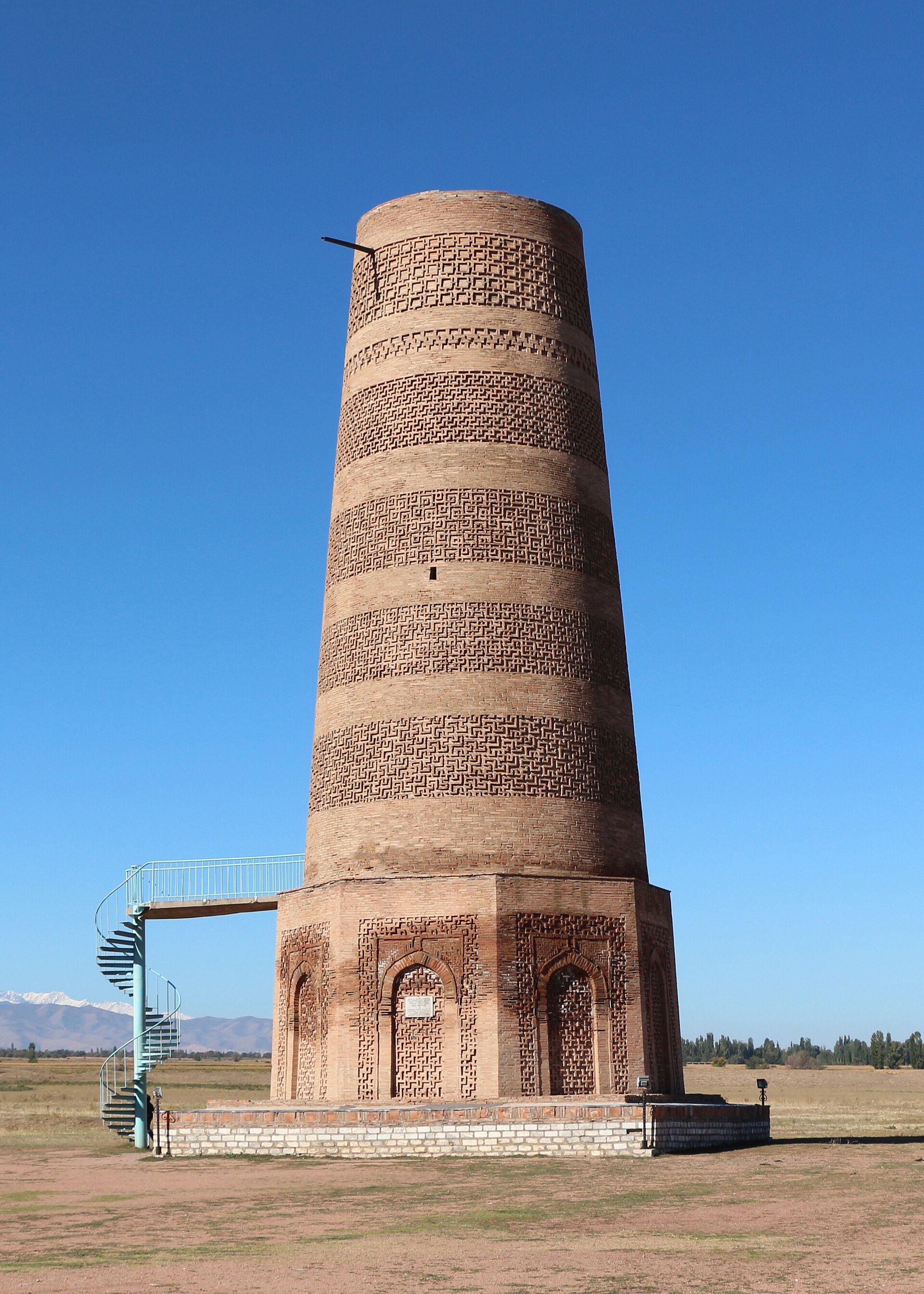
The Burana Tower rises from the edge of Tokmak like a quiet sentinel of centuries past. Its weathered brick walls, shaped by time and wind, stand tall against the vast steppe, a reminder of the days when this land was a crossroads of the Silk Road. Once part of the ancient city of Balasagun, which served as the capital of the Karakhanid state, the tower is one of the few surviving structures from that era. It isn’t just an architectural monument—it’s a bridge between the present and a distant past, a place where history feels tangible.
Built sometime between the 10th and 11th centuries, the tower was more than a watchtower; it was a symbol of power. Originally reaching forty-five meters in height, earthquakes and the passage of time have reduced it to twenty-one meters. Inside, a narrow spiral staircase winds upward to the top level, where the view stretches across endless fields, rolling hills, and mountains fading into the horizon. From this height, the tower seems fragile, yet that fragility gives it a sense of life, as if it still breathes with the stories of those who once stood here.
Scattered around the tower are stone statues known as *balbals*, ancient grave markers left by Turkic tribes over a thousand years ago. Some depict warriors with weapons, others show women adorned with jewelry, each carved with a striking simplicity. Nearby, the remnants of fortress walls and building foundations hint at the scale of Balasagun, a city that once thrived here. The stones lie quietly, as if guarding secrets of the people who walked these lands long before.
Legends cling to the Burana Tower like the wind that sweeps across the steppe. One tells of a ruler who built the tower to protect his daughter from a prophecy foretelling her death on her sixteenth birthday. Despite his efforts, fate could not be cheated—a snake hidden in a basket of fruit bit her on the appointed day. Another story speaks of treasures buried beneath the tower, though no one has ever found them. These tales add a layer of mystery to the place, turning it from a mere monument into something more personal, a witness to human hopes and tragedies.
Today, the tower is a place where history feels close enough to touch. There are no crowds, no noise, just the silence of the steppe and the wind whispering through the stones. Visitors come not for flashy attractions but for the chance to connect with something enduring. Time moves differently here, as if the land itself remembers the people who lived and died within sight of these walls.
The architecture of the tower is simple yet striking. The brickwork, laid without mortar, has endured for centuries, a testament to the skill of its builders. Narrow arrow slits on different levels served both as lookouts and defensive positions. Inside, the space feels tight and dim, but that only adds to the sense of stepping into the past, where every stone has a purpose.
The steppe around the tower changes with the seasons. In spring, wild tulips bloom across the plains. By summer, the grass turns golden under the relentless sun, and in autumn, the landscape glows with warm hues. Winter transforms the scene entirely, the tower standing stark against fields of snow. Locals regard it with quiet pride, a piece of their heritage that few have never visited.
A trip to the Burana Tower isn’t just a stop on a tourist route—it’s a chance to see Kyrgyzstan in a different light. There are no grand palaces or bustling markets here, just the steppe, the mountains, and the wind carrying stories of the past. The tower stands as a reminder that history isn’t always written in books. Sometimes, it’s etched into stone, surviving the centuries to tell its own silent tale.