Novi Pazar is a city where layers of history unfold at every turn, and few places embody its past as vividly as the Isa-beg Mosque. Perched on a hill overlooking the old town, this 16th-century structure stands as a quiet testament to the Ottoman era, when the city was a bustling crossroads between Bosnia and Constantinople. Back then, Novi Pazar thrived as a commercial hub, and the mosque was more than a place of worship—it was a symbol of imperial authority, a statement of wealth, and a center of influence in a region where faiths and cultures intersected.
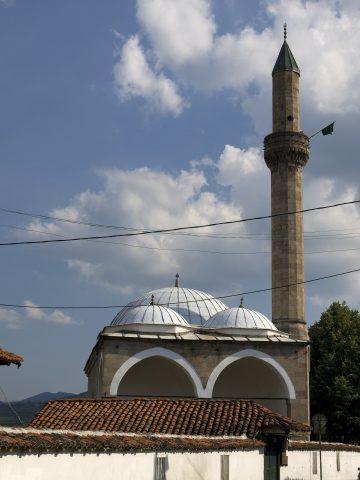
The mosque’s architecture reflects the early Ottoman style, though with subtle local touches. Built from stone and brick, its slender minaret rises gracefully above the city, a delicate line against the sky. Inside, the space is uncluttered yet carefully composed: tall windows filter soft light onto woven carpets and walls adorned with calligraphic verses. The central dome, supported by arches, follows a design seen in mosques across the empire, while the surrounding courtyard once housed a madrasa, a library, and a hammam—now reduced to fragments, hinting at the complex’s former grandeur.
Isa-beg, the Ottoman official after whom the mosque is named, played a key role in shaping Novi Pazar’s development. Historical records describe him as a patron of the city, helping to transform it into a strategic outpost of the empire. At the time, Novi Pazar was a melting pot of religions—Muslims, Orthodox Christians, and Catholics lived side by side, and the mosque stood near churches and monasteries that still exist today. Its construction was not just an act of devotion but a deliberate effort to anchor Islamic presence in a region where Christianity had long dominated.
Like many historic buildings, the Isa-beg Mosque has weathered its share of hardships. Earthquakes and wars left their marks, none more devastating than the bombings of World War II, which ravaged the city. The mosque survived, though barely, and required extensive restoration. Later, during the conflicts of the 1990s, it became a focal point once again—not as an architectural landmark, but as a symbol of faith and identity. Today, it remains an active place of worship while also being recognized as part of Serbia’s cultural heritage, protected by the state.
What makes the mosque special is not just its history, but the atmosphere it holds. Unlike crowded tourist sites, it feels untouched by time. Inside, the silence is broken only by the occasional footsteps of visitors or the murmur of prayer. The minaret, once used to call the faithful to prayer, now offers a quiet vantage point over Novi Pazar’s old town, where narrow streets wind between tiled roofs and green hills stretch into the distance. At dusk, the mosque is bathed in gentle light, its silhouette sharp against the fading sky.
For locals, the Isa-beg Mosque is more than a monument—it’s a living part of their community. Beyond religious services, it hosts cultural events, gatherings, and lectures. Efforts have been made in recent years to draw more visitors, but it remains overshadowed by Serbia’s more famous landmarks. Perhaps that’s its charm: the mosque doesn’t demand attention. It simply exists, a quiet witness to centuries of change.
A visit here isn’t about ticking off a sightseeing list. Whether you’re drawn by history, architecture, or the chance to experience Novi Pazar’s unique character, the mosque offers a moment of stillness. Time seems to slow within its walls, allowing space to reflect. If you’re lucky, you might hear the wind rustling through the trees of the old cemetery nearby, where generations of the city’s residents rest. It’s a place where the past feels close enough to touch.