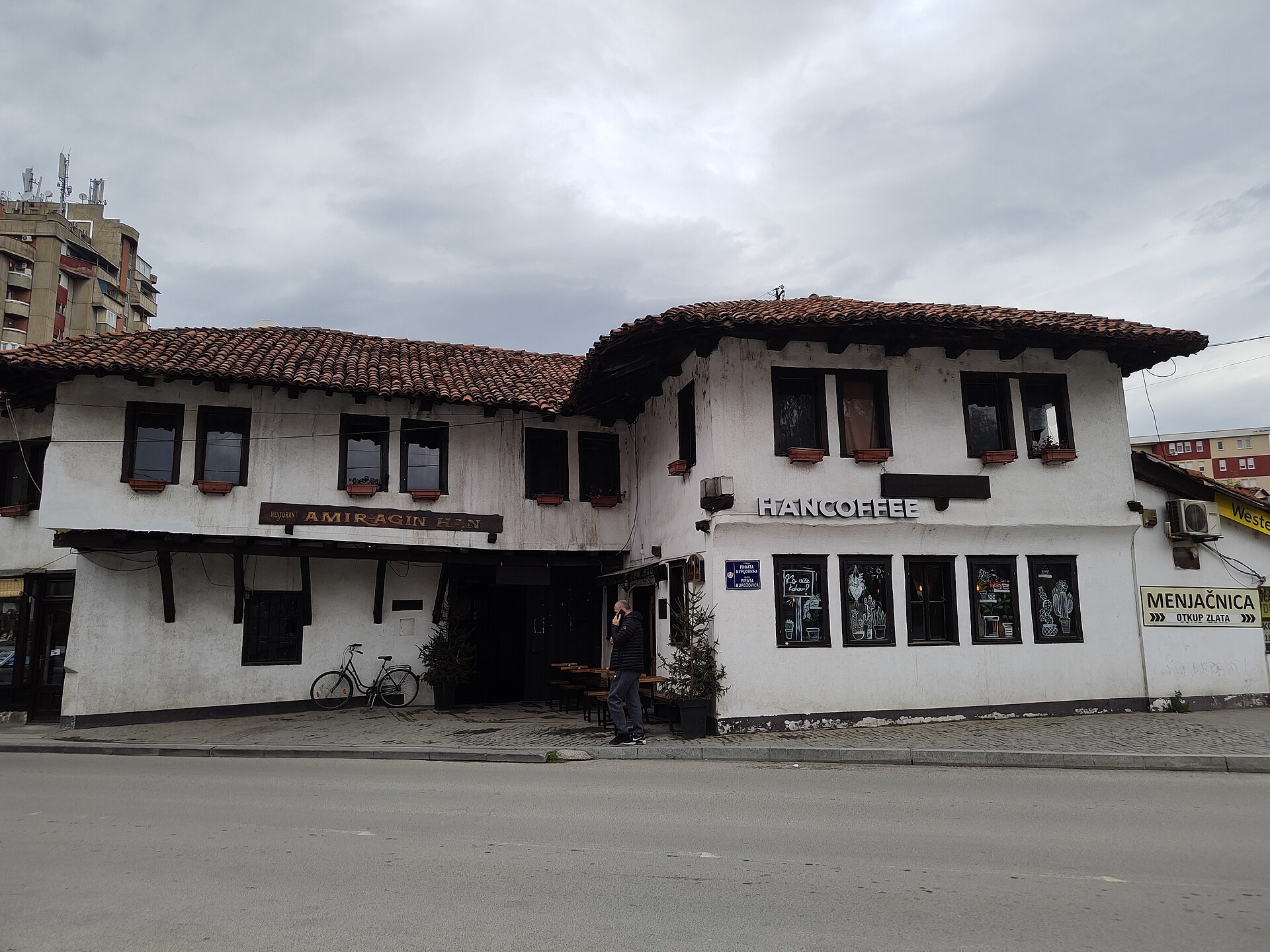
Amir-agin Han in Novi Pazar is one of those rare places that feels suspended in time, as if the centuries have left it untouched. Built in the early 1600s, this caravanserai once served as a vital stop for merchants, travelers, and pilgrims moving along the ancient trade routes that connected the East and West. Novi Pazar was then a bustling hub under Ottoman rule, where caravans laden with silk, spices, and other goods would pause before continuing their journeys. The han stands today as a quiet witness to that era, its walls holding the echoes of a time when the city was a crossroads of cultures and commerce.
The architecture of Amir-agin Han is classic Ottoman caravanserai design—thick stone walls enclosing a central courtyard, flanked by two levels of arched galleries. The ground floor was once used for storing goods and sheltering pack animals, while the upper level provided lodging for weary travelers. Small windows and sturdy wooden doors were built not just for practicality but for security, a necessity in an age when bandits and political unrest made long journeys perilous. Though the building has weathered the centuries, its structure remains largely intact, a testament to the craftsmanship of its builders. Some restoration work has been done, but the han still bears the marks of time, giving it an air of authenticity that modern reconstructions often lack.
Stepping into the courtyard, it’s easy to imagine the scene centuries ago. The space would have been alive with activity—merchants haggling over prices, animals braying, and the murmur of conversations in half a dozen languages. A well in the center of the courtyard was once the heart of the han, where travelers would gather to quench their thirst and exchange news from distant lands. Today, the courtyard is quiet, the only sounds being the occasional footsteps of a visitor or the rustle of leaves in the breeze. The stillness makes it easier to picture the han as it once was, a place of rest and respite in a world that moved at the pace of a camel’s stride.
Novi Pazar has always been a city where different cultures and religions intersected, and Amir-agin Han is a perfect example of that legacy. It wasn’t just Muslim travelers who sought shelter here; Christians, Jews, and others passing through would have found a temporary home within its walls. The han was a place where people from all walks of life could share a meal, a story, or a moment of rest, regardless of their background. In an era when travel was difficult and dangerous, such places were essential, fostering connections that transcended borders and beliefs. Even now, the han serves as a reminder of how trade and movement have always brought people together, long before the concept of globalization entered the modern lexicon.
Caravanserais like Amir-agin Han were once a common sight along the trade routes of the Ottoman Empire, but their role faded as roads improved and travel became faster. Many have since been repurposed—some into museums, others into boutique hotels or cultural centers. Amir-agin Han, however, remains in a state of quiet limbo. It hasn’t been turned into a polished tourist attraction, and that’s part of its charm. There are no souvenir stalls, no crowds, no guided tours with rehearsed scripts. Just the building itself, standing as it has for centuries, waiting for those who seek it out.
For anyone interested in the history of the Balkans, Novi Pazar is a city that rewards exploration. It’s home to several well-preserved Ottoman-era monuments, and Amir-agin Han is one of the most evocative. It may not have the fame of Istanbul’s mosques or Sarajevo’s bridges, but that only adds to its appeal. This is a place for those who prefer their history unfiltered, who want to experience the past not through the lens of a guidebook but as it truly was—imperfect, layered, and deeply human.
Visiting the han isn’t just about admiring old stonework. It’s about stepping into a different rhythm of life, one that moved at the pace of a caravan rather than a smartphone. Walking along the galleries, you can almost hear the sounds that once filled the space—the clatter of hooves, the murmur of prayers, the aroma of coffee and spices mingling in the air. Novi Pazar has changed dramatically since the han was built, but within its walls, the past feels tangible. It’s a rare opportunity to connect with a way of life that has all but disappeared.
Today, Novi Pazar is a lively, modern city, but its historical roots are never far from the surface. Amir-agin Han is a reminder that beneath the veneer of contemporary life, there are layers of history waiting to be uncovered. It’s a place for those who seek more than just pretty sights—who want to understand how people lived, traded, and traveled centuries ago, and how those connections shaped the world we know today. History isn’t just about dates and battles; it’s about the quiet moments, the everyday exchanges, and the places that preserve them. And that’s exactly what Amir-agin Han offers—a chance to step back in time and listen.