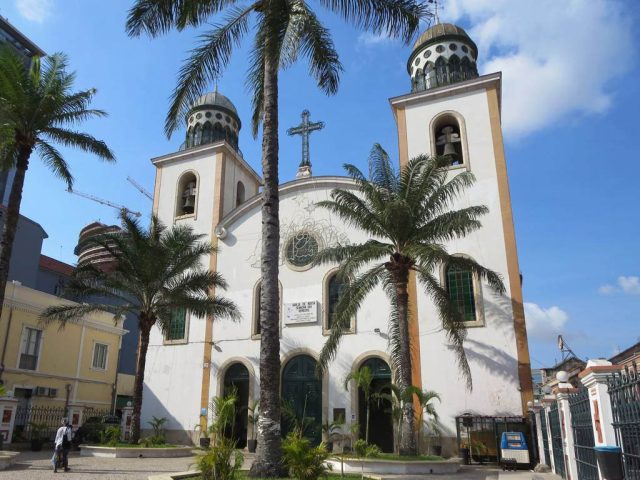
The Mausoleum of Agostinho Neto is one of those places in Luanda that commands attention, even if you’re not particularly drawn to politics or history. Perched on a hill overlooking the city and the Atlantic Ocean, its imposing structure is impossible to miss. The building rises in a vast concrete spiral, a shape that feels both ancient and futuristic—like a modern ziggurat reaching toward the sky. It houses the remains of Angola’s first president, Agostinho Neto, a poet and revolutionary whose name is synonymous with the country’s struggle for independence.
Construction began in the late 1980s, not long after Neto’s death in 1979, but the mausoleum wasn’t completed until 2012. The design was the work of Cuban architects, a detail that reflects the deep ties between Angola and Cuba during the revolutionary period. The style blends late modernism with brutalist elements—raw concrete forms, minimal ornamentation, and an unmistakable sense of grandeur. Inside the spiral, museum halls document Neto’s life and the broader history of Angola’s fight for independence.
Agostinho Neto himself was a complex figure. To some, he remains a national hero, the symbol of liberation from colonial rule; to others, his presidency was marked by internal strife and economic challenges. Yet his role in shaping modern Angola is undeniable. Born into a modest family, he studied medicine in Portugal, where he became involved in the anti-colonial movement. Upon returning to Angola, he led the MPLA—the People’s Movement for the Liberation of Angola—which secured the country’s independence in 1975 after years of war.
The mausoleum is more than just a memorial; it’s part of a larger complex that includes a museum, a library, and landscaped grounds. Inside, visitors can see personal items belonging to Neto, along with documents, photographs, and exhibits covering key moments in Angola’s mid-20th-century history. The focus is on the independence struggle and the early years of self-rule, though the narrative carries the expected patriotic tone of such sites. Even so, the displays offer a glimpse into the forces that shaped the nation.
The architecture of the mausoleum evokes mixed reactions. Some see it as powerful and majestic; others find it stark and imposing. The bare concrete walls create a sense of austerity, yet the spiral design gives the structure a dynamic quality, as if it’s growing from the earth. The interior is surprisingly airy, with light filtering through the massive form. The view from the top is particularly striking—Luanda unfolds below in a way that feels different from street level, revealing its layered history of colonial-era neighborhoods, modern developments, and the sprawling hills that define the city.
Visiting the mausoleum isn’t just about paying respects to a historical figure; it’s also a chance to see Luanda from a new perspective. The city is often perceived as chaotic, a place where colonial legacies, African traditions, and contemporary urban life collide. But here, on the hill, the atmosphere is quieter, more reflective. The surrounding green spaces offer a respite from the bustle, and locals come not only for official ceremonies but also to walk, relax, or take photos against the backdrop of the monument.
For many Angolans, the mausoleum remains a symbol of national pride, a reminder of the difficult path to freedom. Official events are held here, wreaths are laid, and speeches are given. Yet the site is open to everyone, and the mood is more solemn than strictly formal. Even if you’re unfamiliar with Neto’s biography, the place itself invites contemplation—of how history is preserved in architecture, and how a nation’s past continues to shape its present.
Luanda is a city of contrasts, and the Mausoleum of Agostinho Neto is one of the landmarks that helps make sense of them. It stands at the intersection of memory and modernity, of collective history and personal reflection. There’s no forced grandeur here, just a quiet sense of significance. If you find yourself in Luanda, it’s worth making the climb—not just for the view, but for the chance to feel the pulse of a city and a country still in the process of defining itself.