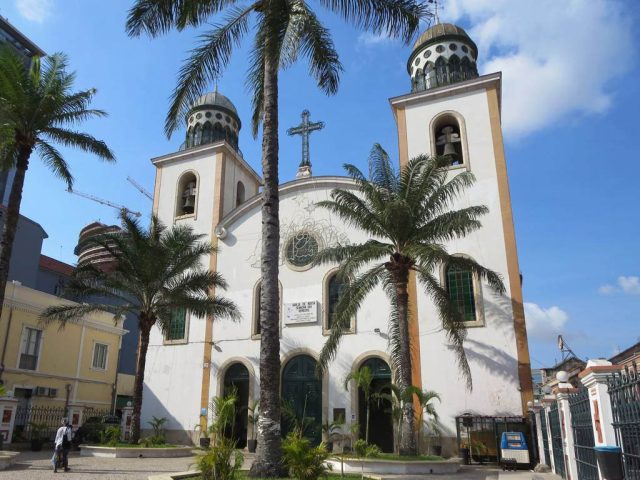
Perched on a hill in the heart of Luanda, the Igreja e Convento de Nossa Senhora do Carmo stands as a quiet witness to centuries of change. Built in the 17th century by Portuguese settlers, this church and monastery complex was more than just a place of worship—it was a symbol of colonial authority, a center of community life, and a refuge in a land far from home. Today, its whitewashed walls rise above the modern cityscape, a stark contrast to the glass and steel of contemporary Luanda, yet deeply connected to the city’s layered past.
The architecture reflects the colonial Baroque style that defined Portuguese settlements of the era. The façade is unassuming, almost austere, but closer inspection reveals delicate stone carvings, slender columns, and arched doorways that lend the building an unexpected grace. Inside, time seems to slow. Wooden pews, weathered by generations of worshippers, line the nave, while faded frescoes and gilded altarpieces hint at the grandeur of its early days. The main altar, with its intricate gold leafwork, remains the focal point, a relic of an age when the church was the spiritual and social heart of the colony.
The adjoining monastery once housed Carmelite monks who arrived with the first Portuguese settlers. In its prime, the complex served multiple roles—welcoming pilgrims, educating locals in the Catholic faith, and even offering shelter during raids. Though its original purpose has faded, the monastery’s thick walls and narrow windows still whisper of the disciplined lives once lived within. Some of the old cells remain, their heavy doors and sparse interiors a reminder of the austerity that defined monastic life.
For Luanda, Nossa Senhora do Carmo is more than a historical landmark; it’s a thread connecting the city’s past to its present. Founded as a small Portuguese outpost, Luanda grew into a bustling capital, yet the church has remained a constant. In colonial times, it was where officials gathered, families celebrated baptisms, and communities mourned their dead. After Angola gained independence in 1975, many colonial symbols were reexamined, but the church endured—not as a relic of oppression, but as a piece of shared heritage. Today, it bridges generations, a place where the old and new coexist.
Visiting the church offers a rare sense of stepping into history. Unlike museums, where artifacts are displayed behind glass, here the past is tangible—the creak of floorboards underfoot, the coolness of stone walls, the hush of wind through narrow windows. The small square surrounding the church is a peaceful retreat, where locals sit in the shade of trees and visitors pause to photograph the weathered gravestones in the adjacent cemetery. The atmosphere is one of quiet reflection, a stark contrast to the energy of the city beyond.
Yet Nossa Senhora do Carmo is far from a relic. It remains an active place of worship, with Sunday services drawing congregations of all ages. The blend of ancient frescoes and modern prayers creates a living continuity, a sense that history here isn’t frozen but evolving. Even during Angola’s turbulent periods, the church never closed its doors, and that resilience is palpable. It’s a place where the past isn’t just remembered—it’s still being written.
For those exploring Angola’s history, the church is essential. It offers a human-scale perspective on the colonial era, one that transcends politics and ideology. There are no grand narratives here, just the quiet weight of memory preserved in wood and stone. The church doesn’t preach; it invites. It doesn’t demand attention; it earns it through the stories etched into its walls.
In recent years, restoration efforts have begun to breathe new life into the aging structure. The work is slow, hindered by limited resources and the challenges of preserving centuries-old materials, but progress is visible. The gradual return of its former beauty isn’t just for tourists—it’s a gift to Angolans, a way to reconnect with the layers of history that shape their identity. Places like Nossa Senhora do Carmo remind people that the past isn’t just a series of events; it’s a foundation.
Luanda is a city of contrasts—where skyscrapers rise beside colonial mansions, and bustling markets give way to quiet streets. The Igreja e Convento de Nossa Senhora do Carmo is one of those rare spaces where time seems to stand still. It’s a place to pause, to look back, and to consider how much has changed—and how much remains the same. More than just an architectural landmark, it’s a living testament to the people who built it, prayed within it, and kept its story alive. In a city that never stops moving, the church offers a moment of stillness, a chance to listen to the echoes of the past.