Perched on a solitary plateau in the Judean Desert, Masada rises like a silent sentinel above the shimmering expanse of the Dead Sea. The sheer cliffs drop away on all sides, leaving the fortress isolated in a landscape of sun-baked rock and endless sky. This is a place where history isn’t just remembered—it lingers in the air, in the weight of the stones beneath your feet, in the way the wind carries echoes of a past that refuses to fade. Masada isn’t merely ruins; it’s a monument to human defiance, a story carved into the desert itself.
The fortress was born from the ambition of Herod the Great, a ruler whose name still carries the weight of both grandeur and brutality. In the late first century BCE, he chose this impregnable perch not just for its strategic advantage—controlling the valley below—but for its sheer inaccessibility. The cliffs made attack nearly impossible, while the elevation offered a vantage point over the surrounding wilderness. Herod transformed the plateau into a palace-fortress, a self-contained world of luxury amid the harsh desert. Here, he built lavish halls with mosaic floors, thermal baths, and even a sophisticated water system that captured every rare drop of rain. It was a place where he could retreat from the world, surrounded by opulence that stood in stark contrast to the barren landscape beyond the walls.
Yet Masada’s most enduring legacy wasn’t shaped by Herod’s excesses. It came decades after his death, during the First Jewish-Roman War. In 66 CE, a group of Jewish rebels known as the Sicarii seized the fortress from Roman control, turning it into a final stronghold as the rebellion crumbled across Judea. For three years, Masada held out against the might of Rome, its defenders defiant even as the empire tightened its grip. Then, in 73 or 74 CE, the Romans breached the walls after constructing an enormous earthen ramp and siege tower. What they found inside was not a living enemy, but the aftermath of a choice: according to the historian Josephus, the rebels had taken their own lives rather than surrender. The story of their last stand became legend, a tale of resistance so absolute that it transcended history and entered the realm of myth.
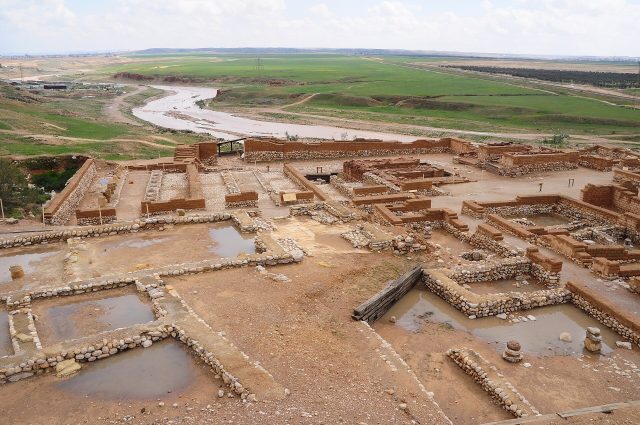
For centuries, the account was dismissed as dramatic exaggeration—until archaeologists began uncovering the truth in the mid-20th century. Excavations revealed the remains of Roman encampments at the base of the plateau, the traces of siegeworks, and within the fortress itself, the ruins of Herod’s palaces, a synagogue, and fragments of Hebrew scrolls. Most haunting were the artifacts tied to the final days: pottery shards inscribed with names, possibly used to draw lots, and strands of women’s hair preserved by the dry desert air. The evidence didn’t just confirm the story; it made it visceral, turning abstract history into something tangible.
Today, Masada is one of Israel’s most visited sites, though it remains a place apart from the usual tourist crowds. The most common route to the summit is the Snake Path, a winding trail that climbs the eastern slope. The ascent takes about an hour, and the desert offers no mercy—sun beats down relentlessly, while gusts of wind threaten to knock you off balance. But the struggle makes the view from the top all the more rewarding. Below, the Dead Sea stretches out like a sheet of liquid silver, its surface so still it seems to reflect the sky. The horizon blurs into the haze, and for a moment, it’s easy to imagine why Herod chose this place. Here, at the edge of the world, time feels suspended, as if the past and present exist side by side.
Even in ruin, Masada’s architecture is striking. The remnants of Herod’s two palace complexes still hint at their former grandeur—the northern palace with its terraced gardens and mosaic floors, the western palace with its once-luxurious baths. Most impressive, perhaps, is the water system: aqueducts and cisterns that turned a desert fortress into a self-sustaining stronghold. At the base of the plateau, the Roman camps are remarkably well-preserved, their earthworks and barracks still visible. Walking among them, it’s impossible not to feel the weight of history pressing in, as if the events of two thousand years ago are still unfolding in some quiet, unseen way.
Masada is more than a historical site; it’s a symbol. For many Israelis, the fortress embodies resilience, a reminder of what it means to fight for freedom against impossible odds. It’s a place where military units hold swearing-in ceremonies, where visitors come not just to see ancient stones but to connect with something deeper. As the sun sets over the Dead Sea, casting long shadows across the plateau, the silence grows heavier. The wind carries no voices, yet it feels as though the past is still here, watching, waiting.
A visit to Masada is less about sightseeing and more about immersion. There are no crowds jostling for space, no vendors hawking souvenirs—just the desert, the wind, and the quiet weight of history. You can wander the ruins for hours, trying to picture the lives that once filled these spaces: the clatter of sandals on stone, the murmur of voices in the palace halls, the desperate decisions made in the final days. Or you can simply sit at the edge of the plateau, looking out over the vastness of the desert, and feel the pull of a place that refuses to let go. Some landscapes have a way of making you confront what it means to be human—and Masada is one of them.