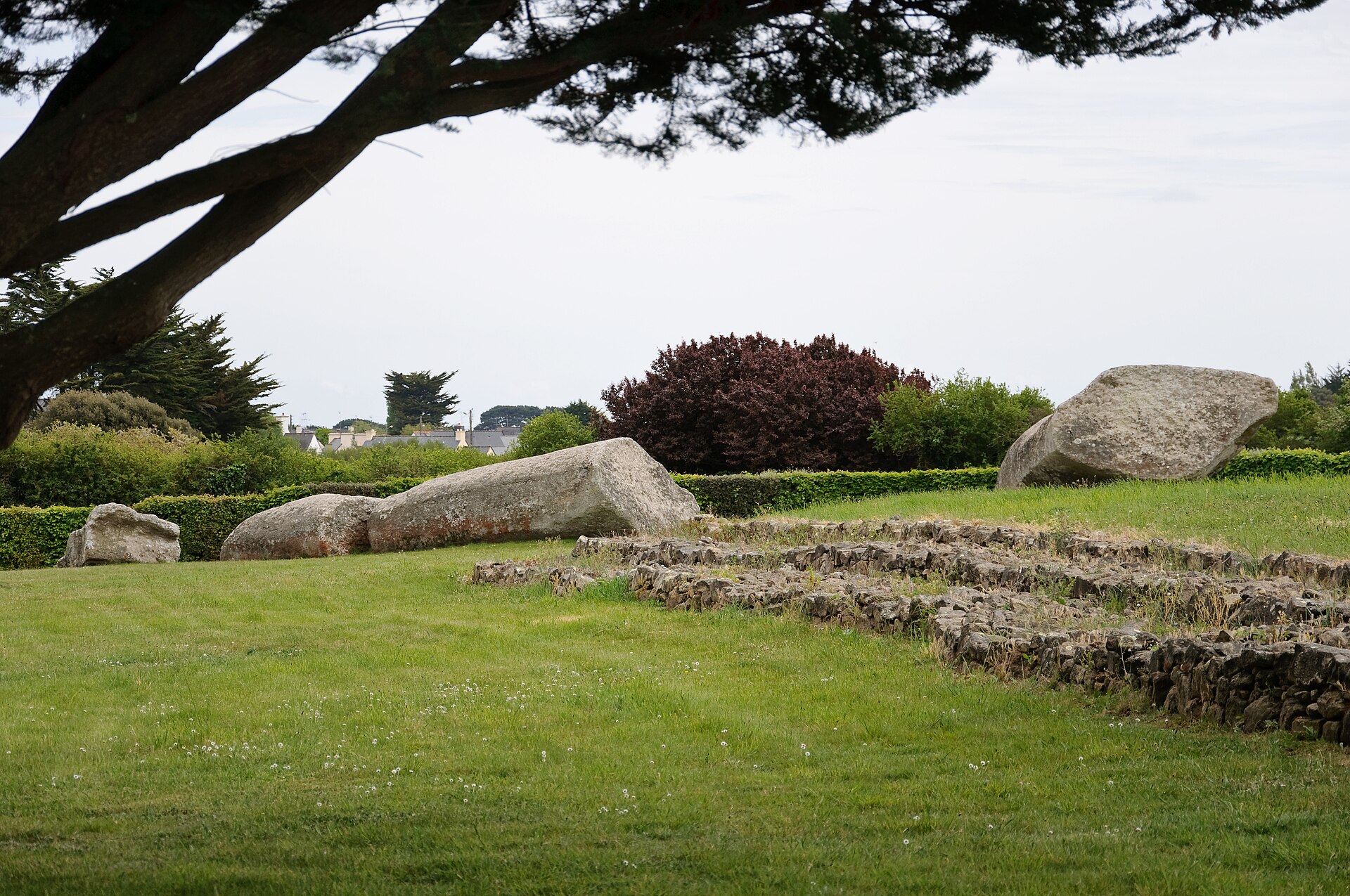
The Er-Grah menhir is one of those quiet stones that make you pause and think about time. It stands on the edge of Carnac, almost hidden among the fields and low hills, yet its story stretches back thousands of years. Unlike the famous alignments of Carnac, where thousands of stones march in precise rows, Er-Grah is a solitary figure, just over a meter tall, its rough granite surface weathered by centuries. It feels like a lone sentinel, left behind from a time when Neolithic people first drove it into the earth.
No one knows for certain why menhirs like this one were erected. Archaeologists debate whether they served as ritual sites, astronomical markers, or waypoints along ancient trade routes. Er-Grah, like most of its kind, bears no inscriptions or symbols to offer clues. That ambiguity is part of its appeal—it doesn’t explain itself, leaving room for imagination. Perhaps it once stood among other stones, or maybe it was always alone, marking a place of significance for people long gone.
Er-Grah isn’t as imposing as the giant stones of Carnac’s main alignments or the grand dolmens scattered across Brittany. It’s modest, even unassuming, with uneven edges and the faint scars of erosion. But that simplicity is what makes it special. There are no crowds here, no signs or barriers, just the quiet expanse of Breton fields. The air feels still, as if time itself slows down, and it’s easy to picture people from millennia ago passing by, perhaps touching the stone for luck or leaving offerings nearby.
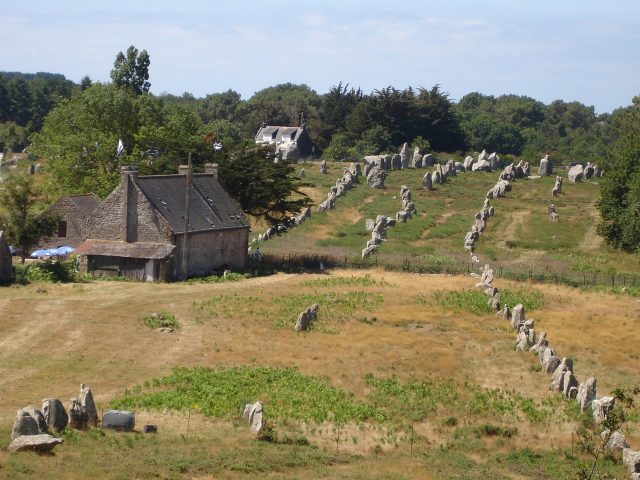
The Carnac megalithic complex is one of Europe’s most enigmatic sites, with thousands of stones arranged in intricate patterns between 5000 and 3000 BCE. Their purpose remains unclear, though theories abound. Er-Grah lies slightly apart from the main rows, yet its connection to them is undeniable. It might have been part of a secondary ritual or served as a landmark for travelers. Whatever its role, its presence is a reminder that even well-known archaeological sites hold corners where mysteries linger.
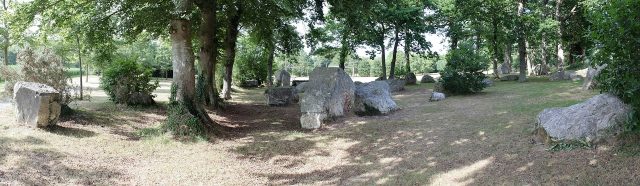
Visiting Er-Grah isn’t so much about sightseeing as it is about stepping into history. There’s no rush, no need to follow a guide or pose for photos. You can simply walk up to the stone, run your fingers over its rough surface, and try to sense the weight of the past. Brittany has a way of feeling timeless, and places like this amplify that feeling. The landscape around Carnac is dotted with other menhirs, each one a silent witness to an era we barely understand.
For centuries, the Carnac stones were overlooked, even dismissed as ordinary by locals who sometimes repurposed them for building material. It wasn’t until the 19th century that scholars began studying them seriously, and since then, Carnac has become a key site for understanding Neolithic Europe. Er-Grah, like the others, endured long periods of neglect before reclaiming its place in history—though it remains less celebrated than its more famous counterparts.
Reaching Er-Grah is part of the experience. You can walk or cycle from Carnac along country roads, the journey itself a slow unraveling of the landscape. Along the way, other scattered menhirs appear among the fields and forests, each one inviting a pause. On clear days, the views stretch across rolling green hills and granite outcrops, with the distant Atlantic shimmering on the horizon.
Er-Grah isn’t just a stone; it’s a reminder of how little we truly know about the past. It has stood here for over five thousand years, surviving the rise and fall of civilizations, the shift of religions, the march of time. Maybe it was once part of something larger, or maybe it has always been a solitary marker. Either way, its quiet presence makes you wonder about the stories hidden in even the most unassuming places. Sometimes, the most meaningful discoveries lie just off the beaten path.