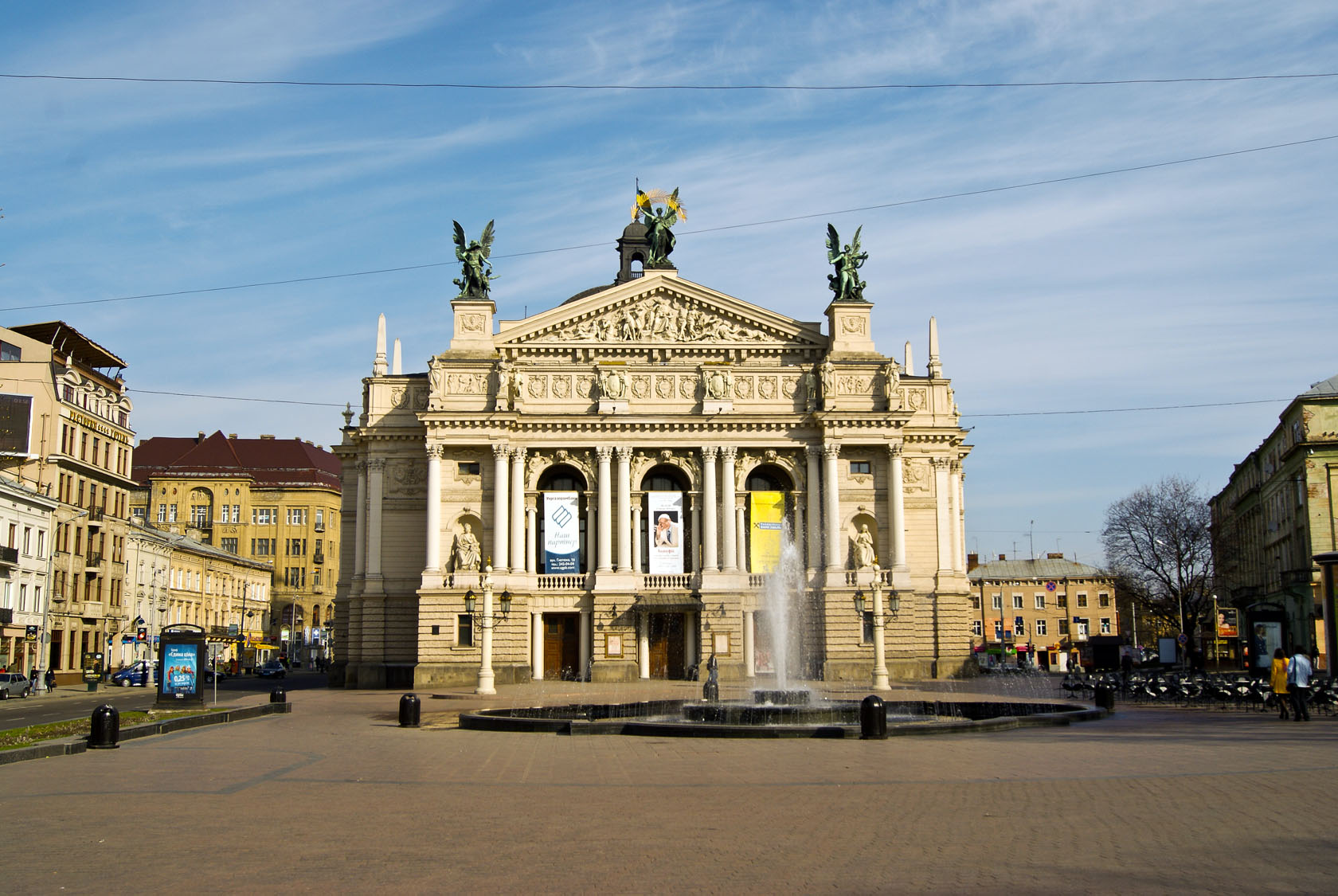
The Lviv Opera House dominates Svobody Avenue, its sculpted facade visible from blocks away. Designed by Zygmunt Gorgolewski, the building won the 1895 competition for a theater that would match Lviv’s ambitions. Construction lasted five years, with workers laying 1,200 oak piles into the swampy ground to support the structure. The exterior mixes Neo-Renaissance symmetry with Baroque flourishes—columns, pilasters, and a central pediment crowned by a bronze Apollo in a chariot. Below him, allegorical figures of Drama, Comedy, and Music flank the entrance, their faces carved from local sandstone.
Inside, the main auditorium seats 1,046 people. Gold leaf covers the proscenium arch, balconies, and ceiling medallions, while crimson velvet upholstery contrasts with white marble staircases. The chandelier, weighing 1.5 tons, casts a warm glow over the parterre. Painters Stanisław Rejchan and Stanisław Dębicki spent two years on the ceiling frescoes, depicting scenes from Greek mythology alongside Ukrainian folk tales—Persephone’s descent into Hades shares space with a Cossack wedding dance.
Acoustics were a gamble. Gorgolewski’s solution—a double-shell construction with air gaps—isolated the auditorium from street noise and vibrations. The result: a clarity that lets a whispered line carry to the last row. Engineers still debate how he achieved it without modern modeling software.
When the theater opened on October 4, 1900, the program included excerpts from Moniuszko’s Halka and Verdi’s La Traviata. The audience—Polish aristocrats, Ukrainian intellectuals, Jewish merchants, and Austro-Hungarian officials—reflected the city’s layered identity. Over the next two decades, the stage hosted Ukrainian-language premieres of Natalka Poltavka and Yiddish operettas like Shulamis. During World War I, the building served as a military hospital; in 1919, it reopened with a performance of The Bartered Bride to celebrate the short-lived West Ukrainian People’s Republic.
Soviet rule brought changes. In 1939, the theater was renamed the Lviv State Opera and Ballet Theater, and Russian classics dominated the repertoire. Yet the building resisted erasure. The original frescoes remained untouched, and Ukrainian folk motifs in the decor—embroidered patterns on the curtain, carved sunflowers on the boxes—survived censorship. In 1991, after independence, the theater reverted to its original name and began restoring pre-Soviet works. Today, the season includes Taras Bulba by Mykola Lysenko alongside Swan Lake and La Bohème.
Locals use the Opera House differently than tourists. A student might buy a 100-hryvnia ticket for a balcony seat to see Romeo and Juliet, while a couple on a first date meets under the chandelier before walking to a nearby café. On summer evenings, the steps outside become an impromptu stage for street musicians. Inside, the smell of rosin and old wood lingers in the wings, where dancers stretch before rehearsals.
Backstage, the green room walls are lined with black-and-white photos: Maria Callas in 1952, Rudolf Nureyev in 1964, Ukrainian soprano Solomiya Krushelnytska in 1902. The original stage machinery—counterweights and pulleys—still operates the curtain. In the basement, a narrow tunnel leads to the former bomb shelter, now used for storage. Upstairs, the royal box, reserved for Habsburg officials in 1900, now hosts visiting diplomats.
Do you hear that?
The faint strains of a violin scale drift from the orchestra pit. It’s 5 p.m., and rehearsals for The Nutcracker are underway. Outside, the streetlights flicker on, illuminating the Opera House’s facade. The building doesn’t just stand here—it breathes.