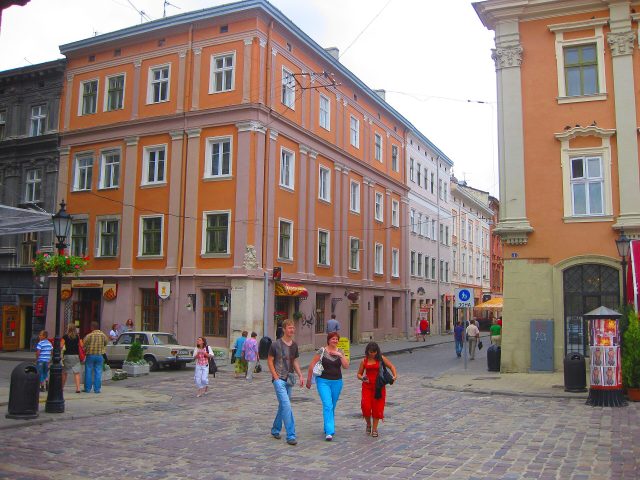
Lviv’s Latin Cathedral stands at the very center of the city, a quiet witness to centuries of change. Its walls hold the weight of history in every stone, each layer revealing a different era—Gothic arches giving way to Baroque flourishes, Renaissance details blending with later restorations. The building didn’t rise all at once but grew over time, shaped by the hands of different generations. Today, it remains one of the most recognizable landmarks in Lviv, not just for its height or grandeur, but for the way it anchors the old city, both physically and in the imagination of those who visit.
Construction began in the late 14th century under King Casimir III the Great, when Lviv was a thriving hub of trade and culture within the Kingdom of Poland. The cathedral was meant to be the city’s principal Catholic church, a symbol of its growing importance. The first parts to take shape were the choir and presbytery, built in the Gothic style with pointed arches and ribbed vaults. Over the following decades, the nave and tower were added, their forms gradually softening as tastes shifted. The warm hue of the local stone used in its construction gives the cathedral a distinctive glow, especially in the late afternoon when sunlight catches its walls.
Inside, the cathedral feels like a museum of sacred art, where every corner tells a story. The main altar, a masterpiece of Baroque excess, draws the eye with its gilded carvings and dramatic use of light. Saints and angels seem to float above the worshippers, their expressions frozen in devotion. The side chapels are just as rich in detail—some adorned with 16th-century frescoes, others housing the tombs of Lviv’s merchant families. One of the most striking is the Chapel of the Holy Body, where faded murals depict biblical scenes with a quiet intensity. Nearby, the Campian Chapel holds the ornate tomb of a prominent patrician family, a reminder of the city’s once-powerful elite.
The cathedral has seen its share of history unfold within its walls. Polish kings were crowned here, city councils convened, and during sieges, its thick stone walls offered shelter to those seeking refuge. When Lviv came under Austrian rule in the 19th century, the building fell into neglect, its grandeur dimmed by time and shifting political tides. Restoration efforts in the early 20th century brought it back to life, though some details were lost forever. Today, it remains an active place of worship, where Mass is celebrated alongside organ concerts and occasional exhibitions. The sound of footsteps on the worn stone floor mingles with the murmur of prayers, creating a rhythm that feels timeless.
From the outside, the cathedral’s facade is a study in contrasts. The Gothic rose window above the main entrance once held vibrant stained glass, though now only fragments remain. The tower, long the tallest structure in Lviv, offers a sweeping view of the old city—red-tiled roofs, church domes, and the distant hills that cradle the city. On clear days, the horizon seems to stretch endlessly, a reminder of how Lviv has always been a crossroads, a place where different cultures and histories intersect.
Stepping inside is like entering another world. The noise of the city fades, replaced by the hush of the nave and the occasional echo of a closing door. Visitors often linger, tracing the outlines of frescoes or reading the inscriptions on old tombstones. Some come to pray, others to admire the craftsmanship, but all leave with a sense that this place is more than just a building—it’s a living connection to the past. The cathedral has survived wars, fires, and political upheavals, yet it endures, its stones holding the memories of those who built, worshipped, and sought solace within its walls.
Beyond its doors, life in Lviv moves at a different pace. Market Square buzzes with cafes, street musicians, and the laughter of tourists, but inside the cathedral, time slows. The air is cooler, the light softer, filtered through centuries-old glass. It’s a place where the present and the past coexist, where the weight of history feels tangible. Even a short visit can leave a lasting impression, a sense of having touched something enduring.
The Latin Cathedral has inspired artists, writers, and musicians for generations. It appears in paintings, postcards, and poems, a symbol of Lviv’s resilience and beauty. More than just a monument, it’s a part of the city’s identity, a reminder that history isn’t just a series of dates but a story woven into the very fabric of the place. For those who take the time to look, it offers a glimpse into the soul of Lviv—a city where the past is never far away.