Perched on the edge of a sheer cliff overlooking the Black Sea, the Swallow’s Nest is one of those rare places that feels both familiar and fantastical. Even if you’ve never set foot in Crimea, you’ve likely seen its silhouette—the slender towers, the pointed roofs, the delicate balconies clinging to the rock like something out of a storybook. It’s the kind of structure that seems too whimsical to be real, yet there it stands, a tiny castle defying gravity and time. But behind its fairy-tale appearance lies a story far more grounded in human ambition, chance, and even a brush with disaster.
The castle as we know it today wasn’t the first building to occupy this dramatic perch. In the early 20th century, when Crimea was the playground of Russia’s elite, the cliff belonged to a German oil baron named Baron von Steingel, who built a wooden cottage here in the Gothic style. The land changed hands a few times—first to a merchant, then to a doctor—before the current stone structure took shape. Designed by architect Leonid Sherwood, it was modeled after the medieval castles of the Rhine, though on a far more modest scale. The building barely survived its early years; in 1927, a powerful earthquake cracked the cliff beneath it, forcing engineers to reinforce the foundation with reinforced concrete. Remarkably, the repairs didn’t diminish its charm. If anything, the knowledge that this delicate-looking castle has weathered such forces only adds to its mystique.
From an architectural standpoint, the Swallow’s Nest is more stage set than fortress. The entire structure measures just over a hundred square meters, with only a handful of small rooms inside. Yet this very compactness is part of its appeal. The narrow spiral staircases, stained-glass windows, and intricately carved woodwork all contribute to an atmosphere of medieval romance, though the interior has served many purposes over the decades. During the Soviet era, it housed a reading room, and later, a restaurant. Today, it operates as a museum, though most visitors come not for the exhibits but for the view from the terrace—a panorama of sea, sky, and the rugged Crimean coastline that makes the climb worthwhile.
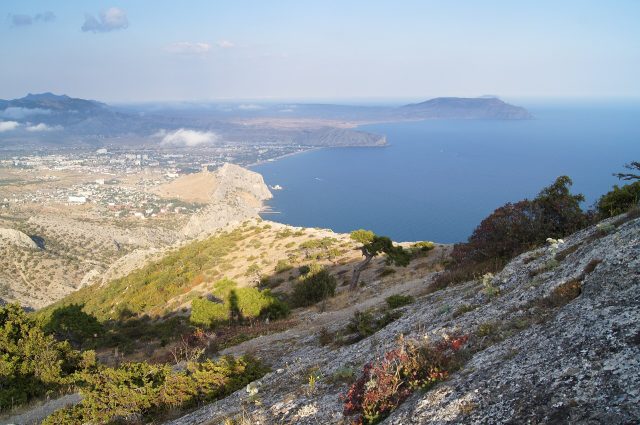
The cliff itself, known as Aurora, is nearly as famous as the castle. Rising about forty meters above the water, it offers one of the most breathtaking vistas in the region. On clear days, the distant peak of Mount Ai-Petri is visible, its jagged outline cutting into the horizon. Local lore claims the cliff was named after the Greek goddess of dawn, though historians suggest the name more likely comes from the Genoese, who once controlled this stretch of coast. Whatever its origins, the site has drawn people for centuries. Archaeologists have uncovered traces of Roman settlements nearby, a reminder that this place has always been a crossroads of cultures and civilizations.
Nowadays, the Swallow’s Nest is one of Crimea’s most photographed landmarks, a magnet for tourists, photographers, and couples celebrating weddings. In summer, the area buzzes with activity, especially at sunset, when the golden light transforms the cliffs into something almost otherworldly. Winter brings a different mood—fewer crowds, mist curling around the castle, the whole scene taking on the eerie beauty of a Gothic novel. Even in peak season, though, it’s possible to find a moment of quiet. A short walk up the hillside or down to the water’s edge often reveals a secluded spot where the view is just as stunning, but the noise of the crowd fades away.
Getting here is straightforward. From Yalta, a bus runs directly to the site, or you can take a leisurely walk along the coast—about an hour from the city center. The route itself is part of the experience, winding past beaches, parks, and grand old villas, many of which date back to the pre-revolutionary era. If you’re driving, be prepared for limited parking, especially in summer. Many visitors opt to leave their cars in Yalta and walk the rest of the way, which not only avoids the hassle but also allows for a more immersive journey through the landscape.
For all its popularity, the Swallow’s Nest never feels overrun. Perhaps it’s because the real draw isn’t the castle itself, but the natural beauty that surrounds it. The sea, the cliffs, the mountains—these elements create a sense of solitude, even when the terrace is crowded. The castle’s small size also helps; visitors don’t linger long inside, so the crowds disperse quickly. And if you’re willing to climb a little higher, to one of the less obvious viewpoints, you can often find a quiet corner where the same stunning vista unfolds without the distraction of other people.
More than just a tourist attraction, the Swallow’s Nest has become a cultural icon, its image reproduced on postcards, souvenirs, and even currency. Yet its true magic lies not in its fame, but in the way it interacts with the landscape. Unlike many grand structures that dominate their surroundings, this tiny castle doesn’t overpower the scenery—it enhances it. It’s as if the cliff and the building were meant for each other, each making the other more striking. That harmony is why the Swallow’s Nest continues to captivate, not as a museum piece, but as a living testament to the way human creativity and natural beauty can come together in perfect balance.