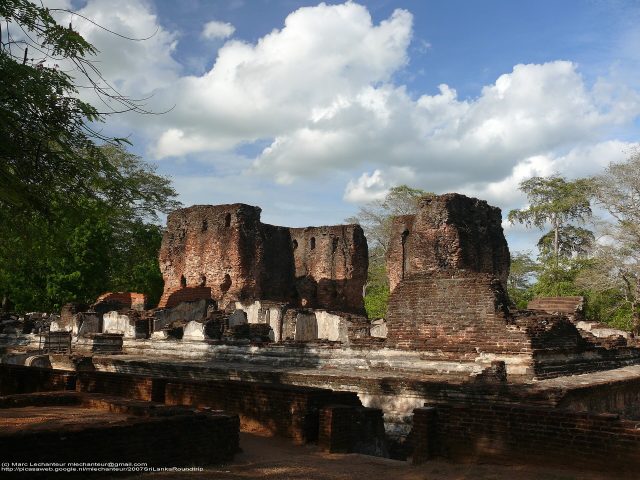
Perched on a gentle rise in the ancient city of Polonnaruwa, Lankatilaka feels like a place where time has paused to catch its breath. It isn’t the largest of the ruins here, nor the most ornate, but there’s something about it that lingers in the mind long after you’ve walked away. The temple’s brick and stone walls, weathered by centuries of monsoons and sun, seem to hold the weight of history in their very texture. Inside, the air is still, broken only by the occasional rustle of leaves or the distant call of a bird. The dim light filtering through narrow windows casts long shadows, making it easy to imagine the voices of monks who once filled these halls with chanting and prayer.
Lankatilaka was built in the 12th century under the reign of King Parakramabahu the Great, a ruler whose name is synonymous with the golden age of Polonnaruwa. His vision went beyond military conquest; he sought to create a legacy of spiritual and cultural grandeur. The temple was part of Alahana Pirivena, a vast monastic complex that served as both a religious center and a symbol of the kingdom’s power. In its prime, Lankatilaka would have been a hive of activity—not just for worship, but for scholarly debate, royal ceremonies, and even the quiet machinations of court politics. The walls that remain today once bore witness to all of it.
The architecture of Lankatilaka reflects the refined simplicity of Sinhalese design from this period. Unlike the towering dagobas or intricately carved moonstones found elsewhere in Polonnaruwa, this temple is understated, almost austere. Its long, rectangular structure rises in tiers, with thick walls that taper slightly as they ascend, giving the building an unexpected lightness. The entrance is marked by worn stone carvings, their details softened by time, while inside, fragments of frescoes and Buddha statues hint at the temple’s former glory. The real magic, though, lies in the way the space feels—open, airy, and somehow intimate despite its size.
What makes Lankatilaka unique is its role as part of a larger, now-vanished complex. In its heyday, the temple was surrounded by meditation halls, libraries, living quarters for monks, and even small pavilions for rest. Today, only the foundations of these structures remain, but they offer a glimpse into how thoughtfully the site was planned. The temple’s position on a low hill wasn’t accidental; it provided both a vantage point and protection from the floods that occasionally swept through the area. The builders clearly understood the land as much as they did the needs of those who would use the space.
Like many of Polonnaruwa’s ruins, Lankatilaka has endured its share of hardships. After the city’s decline as a capital, the temple was gradually reclaimed by the jungle, its statues defaced and its walls crumbling. European explorers later rediscovered it, but much of its history remains shrouded in mystery. Now a protected site, it draws visitors who come not just to see, but to feel the weight of the past. Pilgrims still leave offerings of flowers, a quiet reminder that for some, this place is more than just a relic.
Walking through Lankatilaka is a strangely personal experience. The climb up the stone steps feels like a journey backward in time, each one worn smooth by centuries of footsteps. The air is thick with the scent of damp earth and wild grass, and the play of light and shadow on the walls makes it easy to lose track of the present. Inside, the silence is almost tangible, as if the temple itself is holding its breath. There’s no grand spectacle here, no overwhelming sense of scale—just the quiet dignity of a place that has seen empires rise and fall.
One of the unexpected pleasures of visiting Lankatilaka is its relative obscurity. Unlike the more famous ruins in Polonnaruwa, it doesn’t attract crowds, which means you can explore at your own pace. The surrounding landscape—fields stretching toward distant trees, the outlines of other ancient structures on the horizon—only adds to the sense of stepping into another era. If you’re lucky, you might see locals arriving with offerings, their presence a subtle reminder that this temple, though abandoned, is still very much alive in the rituals and memories of those who remember its significance.
There’s a humility to Lankatilaka that sets it apart. It doesn’t demand awe or admiration; it simply exists, a silent witness to the passage of time. The cracks in its walls, the faded carvings, the way the light slants through the windows—all of it tells a story, not just of kings and monks, but of the countless ordinary people who once walked these halls. It’s a place that invites reflection, not just about history, but about the quiet resilience of the things we build and the legacies we leave behind.