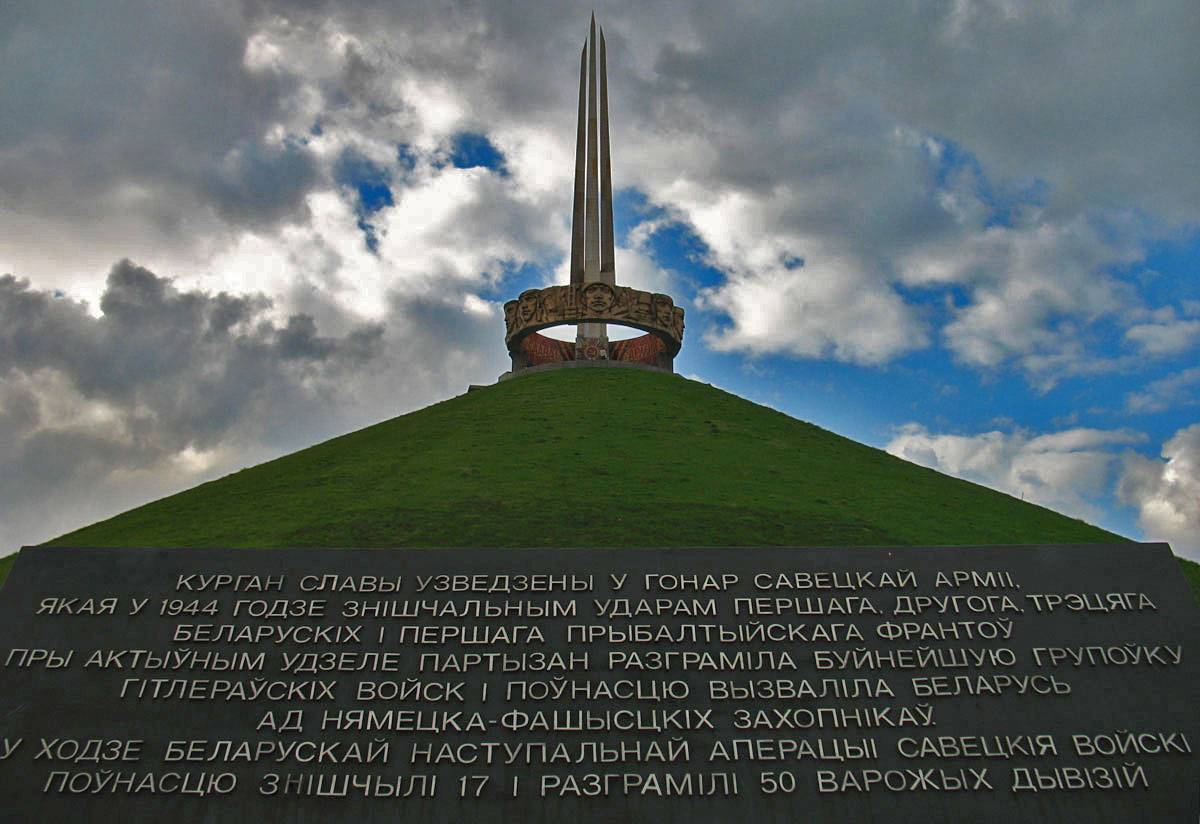
The Hill of Glory stands quietly on the outskirts of Minsk, near the village of Kolodishchi, where the land still carries the weight of history. This is the place where, in the summer of 1944, Soviet forces broke through enemy lines during Operation Bagration, turning the tide of the war in Belarus. Today, the battlefield is silent, but the silence here is different—it feels heavy with memory, as if the wind rustling through the pines still carries the echoes of artillery fire and the footsteps of those who fought.
The memorial itself is more than just an earthen mound. Rising nearly seventy meters high, it was designed as a powerful symbol of both victory and loss. Four bayonets, sharp and unyielding, pierce the sky, each representing one of the four fronts that advanced during the operation. They stand frozen in time, a reminder that while the war ended decades ago, its lessons must never fade. Inside the hill, a dimly lit memorial hall holds the names of those who never returned, their stories etched into the walls in silent tribute.
Climbing the broad steps to the top feels like a journey through history. With each ascent, the surrounding landscape unfolds—endless forests, quiet fields, and winding roads that now seem peaceful, almost ordinary. But this was the ground where lives were decided in an instant, where every inch of soil was contested. At the summit, bronze figures of soldiers stand in mid-stride, their faces set with determination. They are not depicted in anger, but in quiet resolve, their postures speaking of sacrifice. Fresh flowers often lie at their feet, left by those who still remember.
The idea for the Hill of Glory took shape in the 1960s, when the wounds of war were still fresh. There were debates over how best to honor the fallen—should it be a traditional monument, a museum, or something more? In the end, architects Oleg Stakhovich and Andrei Bembel envisioned a space that blended art with nature, a place where the landscape itself would tell the story. Construction took years, and in 1973, the memorial was officially opened. Since then, it has become one of Belarus’s most important sites, drawing not just tourists but veterans, schoolchildren, and families who come to pay their respects.
Surrounding the hill is a quiet forest park, where visitors can walk along shaded paths or sit on benches, lost in thought. There are no crowds here, no noise—just the rustling of leaves and the occasional distant sound of a car on the highway. On clear days, the view from the top stretches to the horizon, the same horizon that once marked the front lines. This is not a place for entertainment, but for reflection, and perhaps that’s why it resonates so deeply with those who visit.
The Hill of Glory is more than a monument; it is part of the national identity, a reminder that freedom comes at a cost. There are no grand speeches here, no patriotic slogans—just silence and the weight of memory. Every year on May 9th, thousands gather to lay flowers and honor the dead, but the memorial is never truly empty. Some come from far away, others live nearby and visit regularly, as if seeking solace in its quiet presence.
The architecture is simple but striking. The four bayonets, reaching toward the sky, symbolize not just the military fronts but the collective experience of a nation at war. Inside the hill, the memorial hall is dimly lit, with narrow shafts of light illuminating the names on the walls. There are thousands of them, each one a life cut short. Visitors often pause before these lists, searching for familiar names or simply trying to grasp the scale of the loss.
Over the years, the Hill of Glory has remained unchanged, but people’s relationship with it has evolved. For some, it is a place of mourning; for others, a symbol of resilience. First-time visitors are often struck by how peaceful it feels, despite its tragic history. Others return again and again, as if the site offers a kind of comfort. Whatever the reason, few leave without feeling its impact. It forces you to confront difficult questions: What does war truly mean? Why is memory so fragile? And why must we keep it alive?
There are no signs here telling people how to behave, no guards enforcing rules—just the wind, the trees, and the quiet presence of those who come to remember. The Hill of Glory is not a museum, not a park, not just a monument. It is a place where the past and present meet, where silence speaks louder than words. And perhaps that’s why it matters so much—to those who live nearby, and to those who travel from afar to stand on this ground.