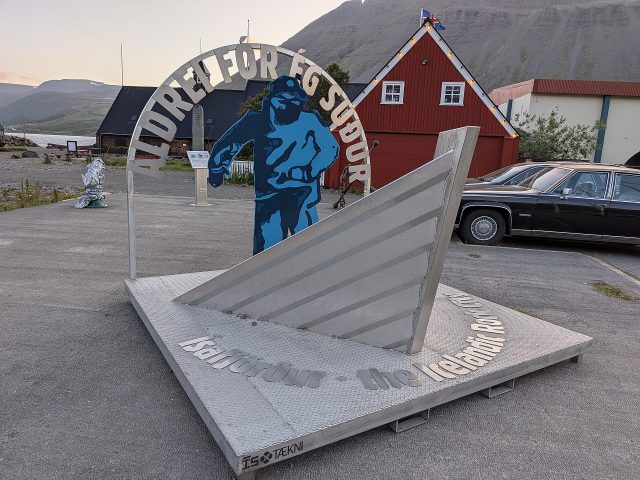
Ísafjörður sits where the raw beauty of Iceland’s northern landscapes meets the quiet rhythm of a small coastal town. Life here moves at its own pace, shaped by the fjord’s presence and the slow turning of the seasons. In the heart of the town, the Edda Cultural Center stands as a place where locals and visitors alike gather—not just to see, but to feel the pulse of this remote corner of the world.
The building itself is a piece of history, constructed in the early 1900s as a school for the children of fishermen and farmers. Its architecture is unassuming yet sturdy, with thick stone walls and large windows designed to catch the faint northern light. For decades, it served as a place of learning before falling into disuse, only to be revived in the early 2000s as a cultural hub. The restoration preserved its original character while adapting it for modern use, blending the old with the new in a way that feels natural rather than forced.
Today, Edda is a space where Icelandic culture unfolds in its many forms. The center hosts exhibitions by local artists, their work often reflecting the stark beauty of the fjords, the ever-changing sea, and the quiet resilience of life in the north. Some displays feature photographs of old fishing villages, while others showcase traditional crafts like wool weaving or woodcarving—skills passed down through generations. Beyond art, the center offers lectures on regional history, workshops where visitors can try their hand at Icelandic crafts, and even language classes for those curious about the local tongue.
Music holds a special place here. Iceland has a deep musical tradition, and Ísafjörður is no exception. The center regularly hosts performances by local musicians, ranging from folk tunes played on the langspil—a traditional Icelandic string instrument—to contemporary compositions. Occasionally, small festivals bring together musicians and listeners in an intimate setting, where the sound of guitars and violins fills the air, and the evening unfolds over cups of coffee and homemade pastries.
But Edda is more than just a venue for events. It’s a gathering place for the community, where people come to connect, learn, and simply be. Book clubs meet in its cozy corners, writers share their work at literary evenings, and newcomers to the town find a welcoming space to settle in. The center’s small library offers a quiet retreat, its shelves lined with books in Icelandic and other languages, a testament to the town’s openness to the wider world.
The building itself tells a story. Its wooden panels, high ceilings, and large windows overlooking the fjord are remnants of its past life as a school. In summer, sunlight spills across the floors, and the sounds of seabirds drift in from outside. Winter transforms the space into a warm refuge from the cold, where the scent of coffee and the murmur of conversation create a sense of comfort. It’s a place where the past and present coexist, where the walls seem to hold the memories of generations.
For travelers, Edda offers a glimpse into Iceland beyond the usual tourist path. There are no crowds here, no rush to see everything at once. Instead, there’s the chance to sit down with a local, to hear their stories, and to understand what it means to live in a place where the land and sea dictate the rhythm of life. Occasionally, the center hosts small markets where artisans sell handmade goods—knitted hats, pottery, or jewelry crafted from local stones—each piece carrying a bit of the north’s spirit.
Ísafjörður isn’t Reykjavík. It doesn’t hum with the energy of a capital city, and that’s precisely its charm. Time moves differently here, and Edda is one of those places where that difference is most apparent. It doesn’t try to impress or overwhelm; it simply exists, a quiet corner where culture is alive in the everyday—where people, stories, and traditions come together in a way that feels both ordinary and extraordinary.