The lighthouse at Kribi stands where the Atlantic meets the Cameroonian coast, a quiet sentinel on a rocky headland shaped by the ocean’s relentless force. Even on calm days, waves crash against the stones below, sending up sprays of saltwater that linger in the air. It’s not just a navigational aid but a place where history, nature, and the rhythms of local life intersect—unassuming yet enduring.
Built in the late 19th century, the lighthouse was part of colonial efforts to secure trade routes along West Africa’s coast. Ships traveling between Europe and the continent relied on such beacons to avoid hidden reefs and shifting sands. Kribi, positioned along the Gulf of Guinea’s edge, was a key stop for vessels carrying goods and passengers inland. Over time, the lighthouse witnessed the shift from colonial commerce to modern shipping, its purpose evolving but never fading.
The structure itself is simple and practical—a tall white tower capped with a red lantern room, a design familiar to coastal lighthouses worldwide. Built to withstand storms and the corrosive salt winds that sweep in year-round, it has held its ground for over a century. Inside, the old mechanisms that once powered the Fresnel lenses remain, though the light now runs on automation. Nearby, the empty keeper’s quarters still carry traces of the families who once lived there, their presence lingering in the quiet corners of the buildings.
For locals, the lighthouse is just another part of the landscape, as ordinary as the palm trees or the sandy beaches. Fishermen setting out in their small boats know its light by heart but rarely think about its past. Occasionally, visitors or photographers arrive to capture the tower against a sunset or stormy waves, and for a brief moment, it becomes the focus of attention. Yet even then, it remains on the edges of Kribi’s daily life, a fixture rather than a spectacle.
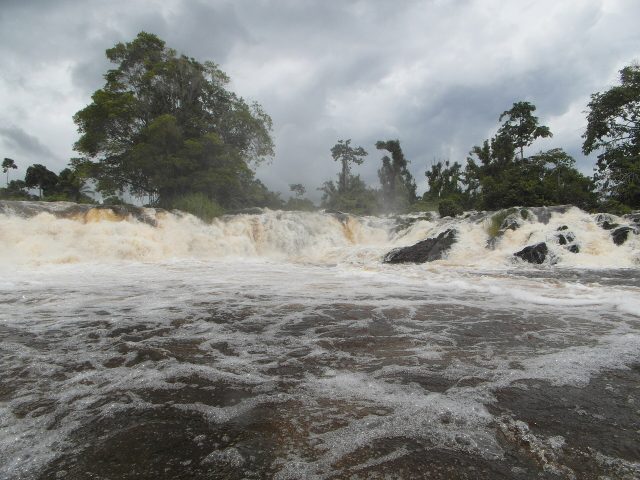
The area around the lighthouse is wild and striking. On one side, the ocean stretches endlessly, its waves roaring as they break against the rocks. On the other, dense tropical vegetation shelters birds and small animals. At low tide, the exposed rocks reveal shells, seaweed, and tiny crabs, but when storms roll in, the waves surge so high that spray reaches the base of the tower. Locals know to stay clear of the shore in such weather, when the ocean’s power is impossible to ignore.
Kribi moves at its own unhurried pace. Unlike the bustling port of Douala, it sees few tourists, and the lighthouse, though visible from afar, isn’t the town’s main attraction. Its significance is more symbolic than practical—a reminder of humanity’s attempts to tame the sea, even as nature ultimately dictates the terms. On clear days, the view from the top offers a sweeping panorama of the coast, where fishing boats return with their catch and children play on the sand. It’s a scene that has changed little over the decades.
The lighthouse requires occasional upkeep. Salt and wind take their toll, eroding metal and concrete, and local authorities must periodically repair it. Yet it endures, much as it has for over a hundred years, still serving its quiet but essential role. For sailors passing by, its light signals the nearness of land, a reassuring marker after long stretches at sea. For Kribi’s residents, it’s just another part of their world—unremarkable until the moment it’s needed again.
Sometimes, school groups visit the lighthouse. Children peer at the old machinery, listen to stories about the keepers who once tended the light, and ask questions that don’t always have answers. For them, it’s a glimpse into the past, a chance to imagine what life was like here before electricity or modern navigation. In those moments, the lighthouse stops being just a building and becomes a living piece of history.
At night, when the light flickers to life, the lighthouse takes on a different character. Its beam cuts through the darkness, illuminating waves and the silhouettes of distant boats. In those hours, time seems to slow, and it’s easy to feel a connection to those who stood here before, watching the same light sweep across the water. It’s a place where past and present coexist, where the ocean’s constancy reminds us that some things remain unchanged, no matter what else shifts around them.